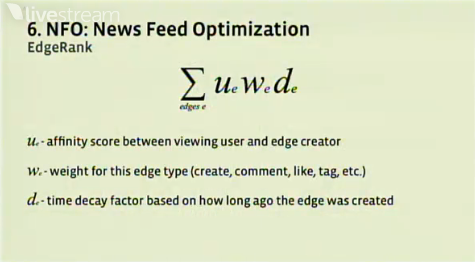
Michael Berstein, a researcher at MIT, posts a snapshot of the algorithm used to calculate what is shown to you in the Facebook Top News feed.
The algo is called EdgeRank and he describes it as such:
I’ll cut through the math using words. Whenever somebody interacts with a news feed item, they create an edge to that item. So if I comment on a friend’s new puppy photos, I’ve created an edge to your photos. When trying whether to show the photos in your news feed, Facebook looks at how closely you interact with everyone who has an edge to the item. So, with the puppy photos, it considers your affinity to the friend who created the photos, and then me because I commented on them.
This all comes down to — initialization matters. If my high school friends are the first to comment on a news feed item, the EdgeRank of that item for other high school friends is high. So, other high school friends will see the item. If grad school friends are the first to comment, then other grad school friends are likewise going to see it.
I had no idea that the elapsed time between a posting and when you interact with the object had something to do with future relevance calculations but now that I think of it, it makes sense. The same has happened to my twitter usage – since I’ve shifted timezones, I mostly see tweets and posts from friends in the European timezone so, in a self-fulfilling way, any service looking to see which content I engage with the most will most likely determine that it’s things coming from my European friends.
More details about Faebook’s EdgeRank algorithm and a link to the full video which was presented at f8 over on TechCrunch.
It’s hard to wrap up a major conference, especially when you didn’t attend, but viewing things from a distance sometimes helps because only the loudest messages make it all the way over.
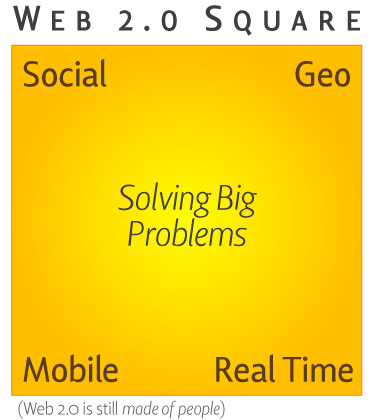
Before the conference even started, Fred Wilson threw out a one-liner that got people thinking. He called it the Golden Triangle.
The three current big megatrends in the web/tech sector are mobile, social, and real-time.
To Fred, the vectors between each of these points on his triangle represented the biggest opportunities over the next few years and where he, as a technology VC, was going to focus his attention.
Ross Mayfield, his line from the first Web 2.0 conference is still relevant, added Geo to Fred’s Triangle and posted his virtual napkin up on flickr.
The importance of Geo cannot be ignored as the most obvious (and easiest) way to add context to information which is being harvested and sent our way in increasingly alarming rates. We talk about a world in which there are 1 billion mobile devices. Imagine what happens when each of these gets a camera, gps, and bluetooth sensor and an IP connection to pull in real-time updates. Adds a new dimension to Right Here, Right Now.
So while HTML Page Indexers of yore were failing at finding us the best Chinese in Helsinki or plumber in London, Social Discovery became the new nectar. Facebook leads to FriendFeed leads to Twitter and now our capacity to consume and process has overloaded. Groups, Hashtags, Lists, Folders, call them what you will but this manual organization of streams is beginning to feel like e-mail folder management all over again. The Googles and Microsofts have added the Twitter firehose to their indexes but somehow I don’t see that as solving the problem unless they can filter on your social connections as well (rumor has it Google Profiles are about to play a much more important role Google Social Search is now live).
Which brings us to Social Filters.
Marshall Kirkpatrick has been following this topic for a long time. He bangs the Social Filter drum again in a post about Facebook’s News Feed redesign,
Someday social networking is going to be like the telephone. Today you can’t send messages from Facebook to people on MySpace or LinkedIn but that isn’t going to last forever. Just as you can call someone who uses T-Mobile from your Sprint phone, someday sharing and messaging between online social networks will be a given.
How will social networks retain users then? Why stick with Facebook when some smaller service offers a decentralized social networking service outside of Facebook’s control but still tied into your friends on Facebook and elsewhere?
These services will someday have to compete on user experience, when they no longer have your social connections locked-in. The service that does the best job filtering up the most important information you have coming your way will likely be the service you stick with. That’s going to be a key area of competition between social networks.
Yes, it’s no longer about who “owns” the social graph – it’s who provides the best services on top of a shared graph. Someone mentioned that Tim Berners Lee said at the conference that AOL was to WWW as Facebook is to distributed social networks. Just as we thought it silly that AOL wanted to put it’s famous wall around the internet, we may also look back in amazement thinking that anyone could have the audacity to think they could own the world’s social address book.
There is a race on right now to own the social graph. But we must ask whether this service is so fundamental that it needs to be open to all.
It’s easy to forget that only 15 years ago, email was as fragmented as social networking is today, with hundreds of incompatible email systems joined by fragile and congested gateways. One of those systems – internet RFC 822 email – became the gold standard for interchange.
We expect to see similar standardization in key internet utilities and subsystems. Vendors who are competing with a winner-takes-all mindset would be advised to join together to enable systems built from the best-of-breed data subsystems of cooperating companies.
Bringing it all together you can almost hear the synapses of the global brain achieve self-awareness. Not only are we moving to a web of sensors feeding real-time data into the grid, we are annotating it by injecting bits of human commentary and behaviors across an increasingly distributed social graph.
A phone in one corner of the world sends off a snapshot which is immediately re-tweeted via the world’s largest telephone tree. More reasoned minds pick up the samples, turn it over and examine it and later conclude that no, the calculated mass of the balloon could in fact not hold a small boy aloft – rumor refuted! Lesson learned and the network becomes a little smarter, more skeptical, less knee-jerk adolescent. Sentient if you will.
The pieces are in place, the machines are warmed up. It was fun while it lasted but it’s time to put Failblog aside and see if we can move on to tackle bigger problems. O’Reilly and Battelle wrap up with their call to arms,
2009 marks a pivot point in the history of the Web. It’s time to leverage the true power of the platform we’ve built. The Web is no longer an industry unto itself – the Web is now the world.
We can be so cruel sometimes but that doesn’t make this any less funny. Reflections of Reflections is a series of critiques of MySpace/Facebook profile pictures. More in this genre in 20 Male Poses of Facebook.
There’s been good debate around how the source of traffic to sites is changing, shifting from the search engines to social sites such as Facebook and Twitter. I confirmed that I too am seeing a greater percentage of traffic come in via links shared on social sites and shared a colleague’s theory about what this would mean for Google’s advertising revenues. Fred Wilson also posted about this topic here and here.
What about attention? How does the average visitor from a social site compare to someone from a search engine? Niall Kennedy tweeted the following stats from his referral logs:
Twitter: 7 seconds
Digg: 20 seconds
StumbleUpon: 40 seconds
Facebook: 52 seconds
Delicious: 82 seconds
Here are my stats for the past year:
StumbleUpon: 40 seconds
Digg: 42 seconds
FriendFeed: 53 seconds
Facebook: 60 seconds
Twitter: 86 seconds*
Delicious: 110 seconds
Techmeme: 114
MyBlogLog: 176 seconds
Compared to the attention span of those coming from the major search engines we get:
Live.com (MSFT): 21 seconds
Yahoo: 35 seconds
Google : 40 seconds
Ask: 46 seconds
It would be interesting to see figures from other sites, especially online shopping sites which are the ones most interested in getting (and therefore likely to pay for) traffic. While it’s clear that visitors from social sites are more engaged with my blog because they tend to hang around a bit longer, that may not be the case with a shopping site where there is less intent to purchase than if they come from a search engine but Mark Essel thinks otherwise.
Increasingly, the flow of web links is being made between individuals via social media sites. Your good fishing buddy who knows the Bay area, shares a link to his favorite supply store. As focused communities become populated across geographic barriers, local quality referrals become more likely. But what if you want to know what store fishermen prefer in San Francisco? You could simply use twitter search for fishing san francisco. In real time you could send a message to several individuals who are interested in fishing in that region.
Shared links are compelling but they need to be matched with impulse buying or discoverable when you’re looking for it. I’m thinking of O’Reilly’s flash discount shared via twitter (44% off to celebrate the 44th president) which was effective in bumping registration at the recent Web 2.0 Expo. The other way to generate business via shared links is to make them searchable so you can find what you need when you want it – but then we’re right back at sending traffic via search again. Yes, you can search twitter but you can find this stuff on Google too.
The jury’s still out as I think this will be a slow shift of behavior that will take a long time to impact existing business models. The real prize is back to social search which would combine the best of the recommendation trusts of social networks with the ability to find what you need when you’re looking for it.
Facebook recommendations married to Google ‘s structure and ranking? That’s the subject of another post.
—o—
* I dug into the Twitter figures because they’re so out of whack with what Niall is seeing and it looks like there are a few visitors that hung out for a long time that are pushing that average higher than it should be.
With over 175M users, Facebook has famously opened up for distribution of marketing messages from businesses, brands, and celebrities. My wife Tivo’d an appearence by Mark Zuckerberg on Oprah introducing it to its mainstream audience and most surely to any brand marketer interested in reaching Oprah’s audience. If Jason Calcanis puts the value of a slot on twitter’s suggested users at $250,000, then a slot on any Facebook featured user page has got to be multiples of that.
If you hit Facebook in a logged out state, look for the, “To create a page for a celebrity, band or business, click here.” link and this is what you’ll see. No more fan pages – social influence is now officially reserved and will most likely be for sale.
Liz Gannes posted that Perez Hilton is now seeing more traffic coming in via Facebook than Google.
My colleague Udo Szabo at Nokia HQ in Finland has a theory that I call the Unified Theory of Interweb Economics. The theory goes something like this:
Advertising is a function of your traffic volume, the more traffic that comes to your site, the higher rates you can charge.
Social sites such as Facebook and Twitter have a lot of link sharing going on as friends post links to share them with each other.
When Facebook and Twitter send more traffic than Google search referrals, advertising dollars will follow the source of that traffic.
Google’s dominance in online advertising will be threatened.
One would think we’re seeing the first hints of that with perezhilton.com and it will take a long time before we see this trend across the board. But in hindsight this is obvious and looking at my stats for the past month I find that 44% of my visitors are coming from search engines and 45% from referring sites with a vast majority coming from StumbleUpon, a social site for sharing links.
The more you think about it, the shift in balance of power has already taken place. SEO is still a big industry but now there are companies that will help you with SMO (“social media optimization”). On twitter we’re starting to see scam artists try and insert themselves into the conversation just as they used to do with Splogs.
And so the wheel turns round once again and there appears to be a new king of the hill – AOL Keyword > Yahoo Category Link > Google Keyword Ranking > Social Site referral.
The jury’s still out as to which social site will send you more links but it’s looking more and more like Facebook. We used to have the Digg effect but no one talks about that anymore. Twitter certainly has the ability to send you a bunch of traffic in short order but the audience is still mostly the early-adopter set and any traffic will most likely be short-lived as the re-tweets scroll into the past.
Facebook, with 175 million users, certainly has the right broad-based distribution to broadcast a link and send back traffic. They have added new features such as FriendFeed’s “like” feature to make quick sharing easy. The Facebook Connect and Comments widgets also will help insert new links into Facebook for redistribution.
But while it’s great to get an influx of new visitors via a social site, it’s no good if it’s not a lasting reference. Has the pendulum swung to far the other way? There are some searches that work great on the real-time web, the latest viral video comes to mind, but others such as the listing for your local plumber just don’t work on something like twitter. Not that it’s worth anything but I still get a regular influx of traffic because I’m the #2 listing for insulting british slang even though the post is over three years old.
I think it’s fair to say that the social sites such as Facebook and Twitter will erode Google’s monopoly on online advertising. Google’s never been really good at building social sites and have shared in the growth of social networking in the past by providing the advertising engine for the most popular social sites. What happens with these sites start to go direct to the advertisers? Will Facebook advertising revenues come from traditional cost-per-click/auction model or is some other type of model required to succeed in a social networking site?
Getting up to speed here at Nokia after joining three days ago – lots of institutional knowledge tucked away across the intranet which features a bewildering array of internal blogs, wikis, and video archives. One thing I immediately notice is that the average age of people who work here in the Mountain View office is older than that at Yahoo. There’s a historical perspective to what they build which informs what they do so it’s sensitive to regional and generational needs and practices.
A colleague recently passed around a link to a Wired article that lamented that modern day social networks have killed the ability to “lose touch” with a friend and let them fade into the background. Instead we have to take action and ban, block, or un-friend them which seems a bit rash (especially when services such as Qwitter tell you when someone has un-subscribed). It’s like shouting out to someone, “You’re not my friend!”
From my perspective, Nokia is very interested in the social impacts of the tools that they build. For instance, on the drive down I was listening to Matt Locke talk about how people have collectively “hacked” social gestures for the introduction of mobile phones into society. The phone booth that we would use to exit a public space to make a phone call evolved into a “hood” structure. With cell phones we used to cup our mouth or duck our head to indicate we were on the phone but now have evolved (?) into talking freely in the clear while sporting a blinking Bluetooth headset. It is still early days with regards to social networks. We haven’t evolved a similar set of shared gestures beyond perhaps the @reply which is really only understood by a tweetist.
When I was a kid we had to network socially by punching a random bunch of digits into a keypad, (or twirling a dial with your finger – a dial!) picking up a big clumsy plastic thing attached to a squiggly wire, and speaking into it. If you were lucky your buddy was on the other end. Worse, it was done one person at a time! You kids never had it so good!
Updating my Facebook profile to reflect my new employer, I notice that I know no one here at Nokia. I have a list of people my manager recommend that I sync up with to soak up the lay of the land – should I use the phone, email or maybe Facebook?
Facebook said last week that they aim to be the next Mobile Address Book. Just like the address book on my Blackberry connects with Yahoo’s corporate LDAP servers to look up the latest phone number or email of any Yahoo employee, Facebook and other social networks are building mobile clients to become the consumer version of the Blackberry Enterprise Server.
Connecting on Facebook is easy – invitations come in, you approve them, and then you each get access to more information about that person. The first time I installed the mobile Facebook app on my portable broadband device (Blackberry, not iPhone) was when I needed to look up a phone number on the way to a meeting with Mary Hodder. We had set the whole thing up on Facebook and it never occured to me as I walked out the door that I didn’t have her phone number. I downloaded the client and installed it while walking over to meet her so I could confirm that address which wasn’t in my phone’s address book.
The concept of a connected address book really takes hold in the mobile space when it’s a pain to navigate the web to look someone up. Yahoo has their oneConnect client for the iPhone. LinkedIn and Plaxo also have mobile interfaces.
So who is going to build the most compelling mobile address book? What are the most important elements?
When someone updates their profile, push updates out to each address book.
Lookup service to find contacts not in your address book
Import and Export of contacts.
Avatar or Photo support as a visual memory.
Fields for profiles on other social networking sites (MyBlogLog, Twitter, Brightkite, Last.FM, etc).
Lifestreaming to browse your contact’s latest updates. Nice to know before you call them, gives you context.
Yahoo, Facebook, LinkedIn, Plaxo, or something else? Which service will pull together all the features you need and gain the critical mass needed to become the default address book in the cloud and on your phone?
When a contact calls, your phone displays a photo, social networking “status” info, as well as past meetings and any notes you’ve entered on that contact.
Choose your own written form of communication: e-mail, social network message, IM, Twitter, SkypeChat — whatever. So, for example, you can choose e-mail, and I can choose Facebook messaging. You send an e-mail to me, and I get a Facebook message. I reply with a Facebook message, and you get an e-mail.
Connect with calendar data so meetings with contacts are logged with the contact data. That way you’ll be reminded in the future about your history with each contact.
Kill any contact information. You should have the ability to decide you don’t want to share your Skype contact anymore, so you should be able to blast it from everybody’s address books.
Contains information related to marketing campaigns of the user. These are shared with Google AdWords / Google Ads when the Google Ads and Google Analytics accounts are linked together.
90 days
__utma
ID used to identify users and sessions
2 years after last activity
__utmt
Used to monitor number of Google Analytics server requests
10 minutes
__utmb
Used to distinguish new sessions and visits. This cookie is set when the GA.js javascript library is loaded and there is no existing __utmb cookie. The cookie is updated every time data is sent to the Google Analytics server.
30 minutes after last activity
__utmc
Used only with old Urchin versions of Google Analytics and not with GA.js. Was used to distinguish between new sessions and visits at the end of a session.
End of session (browser)
__utmz
Contains information about the traffic source or campaign that directed user to the website. The cookie is set when the GA.js javascript is loaded and updated when data is sent to the Google Anaytics server
6 months after last activity
__utmv
Contains custom information set by the web developer via the _setCustomVar method in Google Analytics. This cookie is updated every time new data is sent to the Google Analytics server.
2 years after last activity
__utmx
Used to determine whether a user is included in an A / B or Multivariate test.
18 months
_ga
ID used to identify users
2 years
_gali
Used by Google Analytics to determine which links on a page are being clicked
30 seconds
_ga_
ID used to identify users
2 years
_gid
ID used to identify users for 24 hours after last activity
24 hours
_gat
Used to monitor number of Google Analytics server requests when using Google Tag Manager
1 minute
You can find more information in our About Me and .



![Reblog this post [with Zemanta]](http://img.zemanta.com/reblog_c.png?x-id=6e08aa3a-5a81-4bc7-821f-2f4748a8815d)