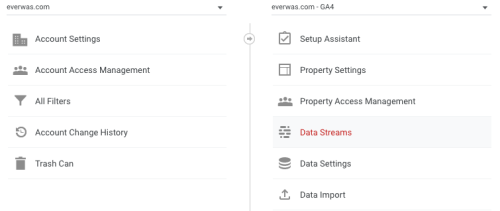
I don’t know why Google makes it so difficult to find the tracking script in the new G4 analytics. I guess it’s to keep consultants busy but if you’re scratching your head and trying to figure out where to find this analytics script in GA’s new setup, you’ve come to the right place.
Click on the Admin gear in the lower left hand corner of the screen.
Select the Account, in the second column, click on Data Streams
then select Web and click the right arrow.
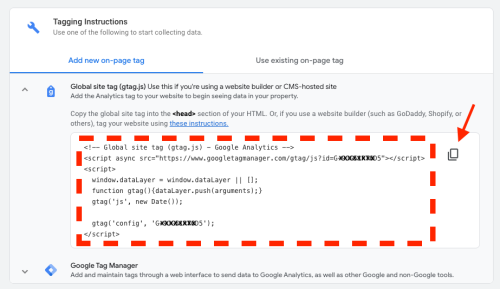
scroll down to Tagging Instructions and click Global site tag to open up the drop down with your G4 tracking script. You can then copy the script you need to use on things like the SmartNews SmartFormat plugin or anywhere else you need to track pageviews.
At this year’s Google I/O developer conference, CEO Sundar Pichai spoke of how augmented reality (AR) glasses embedded with Google’s real-time translation services could break down the language barrier in face-to-face communication. While not explicitly announcing any hardware, he did show a video with a pair of glasses with a heads-up display that would show the results of Google’s real-time translation technology as “subtitles for the world.”
Google Translate + AR Glasses = Subtitles for the World
Taking another run at the ill-fated Google Glass vision is a game-changer and speaks to the maturity and deep pockets of Google as a corporation. Taking lessons learned from Google Glass 1.0 the company has improved the technology to a point where it’s less interruptive (and doesn’t make you look like a cyborg) and ready for more widespread adoption.
We are tiptoeing into the post-computer world where “technology fades into the background” and allows us to push away the unnatural hardware interfaces and interruptive notifications from the human-to-human interaction and realize the true vision of AR – to augment the world around you.
Combine this “subtitles for the world” mentality to another Google Lens enhancement, Scene Exploration and now you have useful metadata from Google’s Knowledge Graph overlayed on the world around you. Check out the video below which jumps to the demo of how Google envisions you can use Scene Exploration to learn about the contents of items on the shelf at the grocery store.
Google Scene Exporation demo at 7:00
Exciting times! Caveat is, as with all real-world technology, things will be rough in the beginning. I work in a Japanese company and sometime we turn on the real-time translation AI in Google Hangouts to see if we can get a decent translation of the meeting. Let me just say the results are not quite there yet. As Pichai said, there’s a lot of work to do.
The competition has not stood still either. We also have Facebook’s Smart Glasses focused, as you would expect, on the capture and sharing features with a light that goes on to warn you if someone is filming. Snapchat’s Spectacles (pictured below) overlay 3D filters over what you look at thru their glasses bring the Snapchat Lens experience to the world around you, leave the psychedelics at home. The future is here, we just need to improve the software.
It’s now well-documented that outside forces took advantage of social media platforms to spread rumors in order to swing the 2016 presidential election. Journalists digging into the story are looking more closely at the tools used to purchase advertising that helped amplify these rumors, and are horrified by what they are discovering.
In the days of print, each advertisement was reviewed by multiple people from both the organization that bought the ad and the publication that ran it. Extreme care was taken to make sure the advertising complemented the editorial and the message was the right fit for the audience, not only to maximize effectiveness but also to avoid instances such as the one below.
Despite careful review, print ad placements sometimes backfire
Online advertising is a delicate balance between scale and quality. The dream is to serve a perfectly targeted ad to as many people as possible. But because of the scale, it is impossible to manually review each and every ad creative for quality and fit. In the online world, people “optimize” and let the algorithms do the work.
While at Yahoo, I met with an advertiser who wanted to learn about our behavioral targeting options. I was working with a team that was thinking about exposing detailed facets of the massive Yahoo audience that would help advertisers reach very specific segments. When I walked into the room, the client had a spreadsheet he was using to allocate his million-dollar budget. After asking a few questions about his goals, I proposed a few very targeted criteria to build his target audience. Unfortunately, he grew frustrated because the total audience was too small and we were going to have to run hundreds of queries to build up the reach he needed. He didn’t have the time to continue the exercise nor appetite to keep track of all the data to show ROI to his client. The meeting wrapped up with four very broad buckets into which he poured roughly $250k each and called it a day.
He couldn’t be bothered with the details.
This is the state of online advertising today. The tools available to reach massive scale are even more sophisticated but to do it right, with quality, requires manual oversight. Ad units can be configured to dynamically swap out ad copy and assets depending on the target audience, which can also be built algorithmically. Ad spend adjusts automatically and APIs monitor trending keywords to take early advantage of trending topics and get broad reach on the cheap.
“Programmatic Advertising” is a blanket term for techniques used to automatically generate thousands of “personalized” ads at massive scale. Because it’s automated, generating ad copy variants and target segments is inexpensive. The downside is that quality suffers if you take out the human element, leaving the robots to mind the store.
This slideshow requires JavaScript.
There are many examples that show us that resulting matches still need regular review. As long as ad matching algorithms such as Google’s and Facebook’s remain black boxes, a regular human review is necessary to prevent the unexpected.
Which brings me back to what we’re learning today. Last week Facebook shared that ad placements made to “amplify divisive messages” were used to influence the 2016 elections. We are slowly uncovering the extent of information warfare that uses social media platforms to weaponize fake news. Using programmatic advertising to draw attention to and amplify these campaigns is a natural extension.
More careful review of editorial content posted to social networks is important to verify facts and prevent the spread of “fake news.” On the flip side, advertising platforms need review as well because ad targeting is also rife with repugnant audience segments automatically suggested by the algorithms. As they should, Facebook and Google have both said that more rigorous review is on the way but there will always be the tension of profit motives to discourage too rigorous a lens.
In the late-90’s, the movie Wag the Dog spins a tale of how a Washington “spin doctor” (Robert De Niro) hires top Hollywood producer (Dustin Hoffman) to engineer public opinion. The film made light of the gullible public but there was a broader, cynical message about how media (and the press) can be used to manipulate public opinion.
Today we are seeing this same scenario played out, but instead of manipulating public opinion through TV and Hollywood, public opinion is bought and sold using social networks and online advertising.
Isn't ironic that the word "campaign" is used to describe a presidential election, advertising buy, and military invasion?
There is a Challenge Match taking place in Seoul between Google’s DeepMind AlphaGo computer program vs. 9 dan professional Lee Sedol (9 dan is the highest rank). Most of the engineers at SmartNews have a background in machine learning and are following the matches closely on a dedicated internal Slack channel.
The YouTube coverage is very good with professional English commentary from Michael Redmond, the first Western Go player to reach 9 dan. Go is a fascinating game and Michael’s commentary is quite good and easy to understand even for beginners like me.
The first two matches went to Google and it looks like history is being made. I’ve embedded videos for the upcoming matches as well.
Google Trends announced last week that they’ve upgraded their service to be real time. Using their tools, I created a dashboard so you can quickly see who’s trending in Google Search for the past 7 days. If I did this right, this page should continually update.
I’ll manually add/remove names as the list of candidates change.
Democratic Party
Republican Party*
*There are too many in the field to fit on Google’s graph (Google Trends only takes up to five terms to compare). I took the top five announced candidates in the polls.
Kevin Kelly calls archival digital storage “movage” because when you keep something in an archive, you need to move it around regularly to keep it current, fresh, and on the latest media.
Why manage your hard drive storage under a desk when you can send it over to the professionals for $10/month? For the same price, Dropbox only gives you 100 MB. Game on!
10 years ago, when I was looking for a place to live, I had three maps to help me zero in on where to look. I was concerned with schools so I had a map from greatschools.org along with a school district map showing which houses served which schools. I then had a real estate map from realtor.com that showed the price of houses in the area. Back then the wish was to overlay the two maps on top of each other and, indeed, some of the original mashups which kicked off the Web 2.0 movement were driven by these types of demands.
Since then, the Google Maps teams has been busy pulling in all sorts of layers together and have gathered them all together into their Google Maps Gallery which launched today. There’s a load of things to get lost in (including the overlay of San Francisco in 1938 shown above).
Two tear-jerker videos illustrate the power of technology to connect over distance. Watch and marvel the world we live in. Happy Thanksgiving everyone.
Google Search services connect two old friends across political boundaries. This video was put together by the Google India team.
Skype connects two girls on opposite ends of the earth who share a disability, part of Skype’s Stay Together campaign.
Cookie Consent
We use cookies to improve your experience on our site. By using our site, you consent to cookies.
Contains information related to marketing campaigns of the user. These are shared with Google AdWords / Google Ads when the Google Ads and Google Analytics accounts are linked together.
90 days
__utma
ID used to identify users and sessions
2 years after last activity
__utmt
Used to monitor number of Google Analytics server requests
10 minutes
__utmb
Used to distinguish new sessions and visits. This cookie is set when the GA.js javascript library is loaded and there is no existing __utmb cookie. The cookie is updated every time data is sent to the Google Analytics server.
30 minutes after last activity
__utmc
Used only with old Urchin versions of Google Analytics and not with GA.js. Was used to distinguish between new sessions and visits at the end of a session.
End of session (browser)
__utmz
Contains information about the traffic source or campaign that directed user to the website. The cookie is set when the GA.js javascript is loaded and updated when data is sent to the Google Anaytics server
6 months after last activity
__utmv
Contains custom information set by the web developer via the _setCustomVar method in Google Analytics. This cookie is updated every time new data is sent to the Google Analytics server.
2 years after last activity
__utmx
Used to determine whether a user is included in an A / B or Multivariate test.
18 months
_ga
ID used to identify users
2 years
_gali
Used by Google Analytics to determine which links on a page are being clicked
30 seconds
_ga_
ID used to identify users
2 years
_gid
ID used to identify users for 24 hours after last activity
24 hours
_gat
Used to monitor number of Google Analytics server requests when using Google Tag Manager
1 minute
You can find more information in our About Me and .