For less than $100 you too can whip together a pocket cam rig to film test users of your mobile app and spot trouble areas. From the Artefact blog:
Staring over your participant’s shoulder isn’t creating the most natural situation when testing user experiences. You get less than ideal viewing angles, participants can’t get into a flow and it’s hard to get good video of it all. So how do you get around that? I’ll introduce to you a few key pieces of hardware and software that can make your life a little easier. Maybe even the coolest researcher in your department, in less than an hour.
Flickr’s Camera Finder tells us that the traditional point-and-shoot cameras are on the way out while, as a whole, camera phones are on the way in. As the saying goes, the best camera is the one you have in your pocket. What if one were to go with this trend and merge what’s best about a digital SLR with the best things on a mobile phone?
Seattle-based Artefact rethink the camera phone form factor into one that combines the high quality features of a DSLR (interchanging lens, focus, aperture control) with the flexibility of a modern, touchscreen phone (connected, programmable, flexible UI). Just a design concept at this point but something this is a production version of hacks that we’re already seeing in the wild.
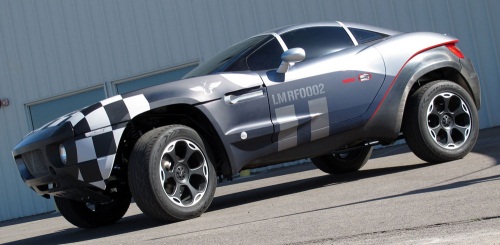
I just listened to a TWiST interview with John “Jay” Rogers, President and CEO of Local Motors, a Southern California company that has set up a platform for a vibrant community of car enthusiasts to share and vote on each other’s car designs. There first car, the Rally Fighter, is coming off the line and already has waiting list of back-orders. Several highlights from the interview:
– Local Motors taps into a passionate audience, “Everyone thinks they are right when it comes to cars.” It’s easy to spin up a passionate thread about a new design. The value-add of the Local Motors company is that they vet the designs and pick and chose which ones to incorporate “Not a crowd-designed car, it’s a car who’s design came from the crowd.” After a year, they have over 70,000 Creative Commons licensed designs.
– Jay paraphrases Chris Anderson, editor of Wired, described the automobile industry as a glass full of rocks. The large auto companies are the rocks and Local Motors is a niche car company that acts as sand between the rocks. There is room for a company, that is building specialty cars on spec, to be profitable with small production runs.
– Jay is good friends with the founders of Threadless (a crowd-sourced t-shirt company) and his company is built on the same model. Many of the designers in the Local Motors community come from the automotive industry which only productizes a handful of designs each year. Imagine Local Motors as a company that sifts through the best of the rest to come up with winning designs that may not meet the large scale appeal of a Ford or Toyota but still be something “game-changing.” They also provide budding transportation design students a platform to showcase their portfolio.
– Local Motors’ mission statement, We will create game-changing cars with an unprecedented level of customer service. What this means in practice is that the process of delivery and manufacturing is transparent and hands on. You not only put together your custom order, you are also asked to come to the factory and actually build your car. All designs, down to the CAD drawings and build instructions are online for review and customization.
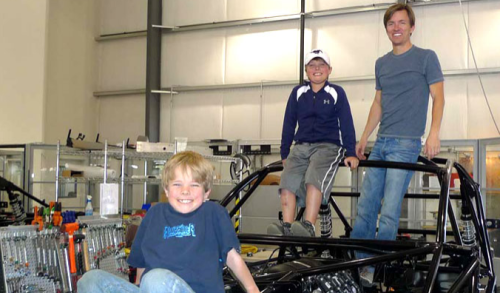
– The US Department of Transportation allows you to drive cars that you build yourself (and register as a “Specialty Constructed Vehicle”) which is why, included in the $60k cost of delivery of their first car, the is two long weekends at the “micro-factory” learning how to build your car and putting it together with the Local Motors team. You not only get a car, you learn, from the inside out, how your car is put together.
Local Motors Build Experience
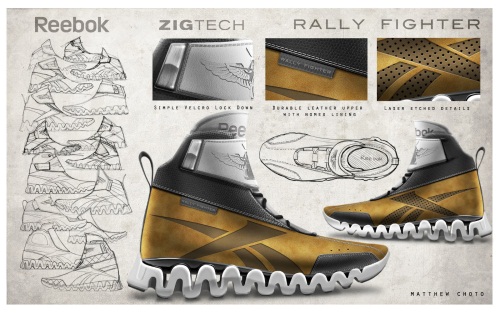
– The Local Motors model is working so well, that they have branched out. Reebok commissioned the community to design a shoe (winning design below). During the interview, Jay mentioned that they are thinking of opening up the community to other things that need to be designed and built.
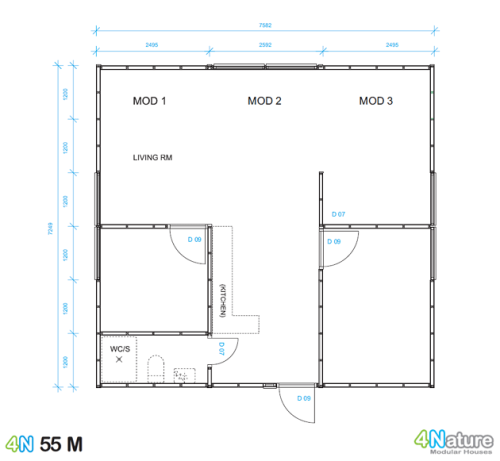
4Nature is a Finnish company that makes modular homes that are easy to construct, giving people in disaster zones long term shelter, getting them out of tents or other short term shelters. A 55-square meter house can be built by three people in 48 hours using simple tools without electricity. I met Mikael Arpiainen, the CEO of 4Nature, several months back and he explained to me the concept and the good work they were doing for the people of Haiti and refugee camps in Africa. Shortly after the earthquake in Japan, I reached him via email and he sent on some more information about his company which I summarize below.
55 sq. meter home made of 3 modules
The idea is to start with a basic “module” of 18-square meters which can be combined with other modules to make any structure you need. Pieces can be added on or removed easily and because the modules are built ahead of time in quantities, they are cheap and easy to ship and handle. It’s like Lego. Once a shelter is no longer needed, they can be disassembled and re-used again and again, cutting down on waste and saving on the initial investment.
The structures are designed to be built quickly, without the need of a foundation. They can be built on corkscrew like pillars so the height of the home can be adjusted as necessary. The philosophy behind these homes is that they can be built by anyone so that people begin to rebuild their lives and help each other while helping themselves and not have to wait for specialized crews. The point is to get people back on their feet and out of temporary shelters and into homes that they can call their own so they can begin to re-build their lives.
These homes are not trailer homes like the ones that were provided for the Kobe earthquake victims. These are simple but durable structures that can support long term occupancy. They are built to withstand hurricane force winds, are flame retardant, and are built to be comfortable in all seasons.
Most affordable long-term residency solution available on the market
Easy to assemble – a standard house can be erected without any machinery
Extremely short building time – significant savings in building costs
Inhabitants can move in the same day – optimal for crisis situations
Reusable – Can be assembled and disassembled several times
Adaptable to any need – private house, hospital, school, office, warehouse..
Fireproof, water-resistant, resistant to insects and termites
Withstands winds of up to 100 mph, up to 8.9 Richter earthquakes
Built out of environmentally friendly materials
Easy installation of solar panels and other amenities
4Nature says they have over 50 units at the factory ready to go today and can begin ramping up production if large orders are necessary. Pricing from the factory starts at 2,500 euros for their basic 18 square meter home. If anyone reading this is interested in contacting 4Nature, please visit their website or leave a comment below and I will pass on your contact details.
As the search and rescue operations wind down, it’s vital to get the survivors out of the tents, cars, and gymnasiums where they have been living and into places where they have privacy so they can get their life together again. These homes by 4Nature are one way to do it.
UPDATE: According to this article (in Japanese) there are still only 36 units of temporary housing have been built in the three weeks since the earthquake.
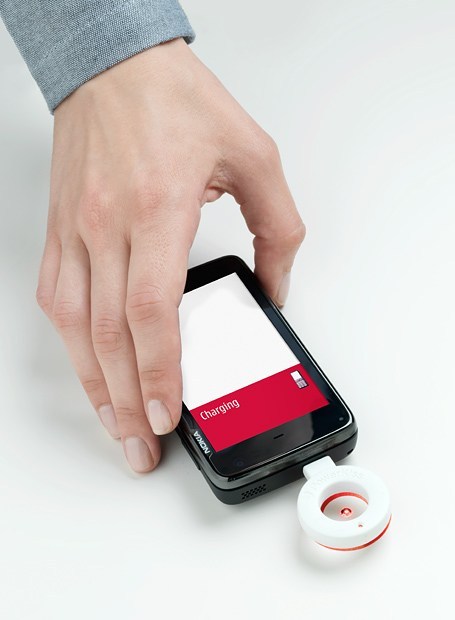
Wireless charging technology has been around since Nikola Tesla came up with the idea. In that sense, Finland startup PowerKiss is no different. Put the receiver (the Ring) into your phone and then place it on top of the power transmitter (the Heart) which is designed to be attached or built into furniture.
But unlike Powermat, which markets itself as an end-to-end solution that you buy for yourself and keep in your home, the folks at PowerKiss are marketing themselves to cafes, hotels, and airline lounges as a service that they can offer their customers. Power as a service, elegant battery top-up as a value add.
The idea is that the traveler borrows a receiver from the business when they walk in (the receivers cost about 10 EUR each) and plugs it into their mobile device and places it on a table that has the transmitter built in. No wires to trip up other customers, no crouching around looking for a spare outlet.
Clean, elegant, utterly Finnish. The PowerKiss chargers currently support Nokia phone 2mm jack, the microUSB, and the iPhone/iPad format too. Their site also says they have a laptop charger in the works.
Launched last year, the company now has 15 employees in Helsinki situated in the Aalto design factory. Here’s a video interview with the founder, Maija Itkonen.
I love Japanese design, everything was looking great about this latest concept model from Sharp. The concept was really cool (you can read more about it on WirelessWatch Japan) until I heard the name. What’s that in your pocket again?
HTC announced two phones with dedicated buttons for Facebook. The touchscreen Salsa and ChaCha (pictured below).
Running Android Gingerbread 2.3.3, HTC modified the Sense UI to integrate the Facebook into the experience. According to the HTC press release,
The Facebook button on HTC ChaCha and HTC Salsa is context-aware, gently pulsing with light whenever there is an opportunity to share content or updates through Facebook. With a single press of the button, you can update your status, upload a photo, share a Website, post what song you are listening to, ‘check in’ to a location and more. For example, you can take a photograph of friends on your phone and upload it instantly to Facebook by simply pressing the button. Or let your friends know what song you’re listening to by pressing the button while listening to music on the phone. The track is automatically identified and shared on Facebook.
Dedicated hardware keys are nothing new (see Yahoo button on Japanese feature phone below) but HTC has taken advantage of the phone sensors and software to give this button multiple uses, as long as your preferred social network is Facebook.
Shipping in Q2 2011 across Europe and Asia and launching exclusively with AT&T “later this year.”
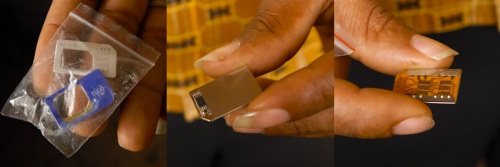
Nokia Researcher Younghee Jung has an fascinating two-part post about how people are hacking their phones to support multiple phone numbers.
We found a service offered by a local mobile phone dealer (Mobile Phone People, one of the Nokia authorized dealers) in Ghana. It costs 15 euros to have the two SIM cards combined into one. There is an even more advanced operation, which requires a special SIM card imported from Finland. This card can host up to 16 SIM cards into one, but costs 40 euroes. Either of these operations costs considerably high for the market, as it is more than purchasing a mobile phone. Therefore the clientele is mostly business people who do need to have two or more numbers but do not want to go through the inconvenience of switching SIM cards or carrying multiple phones.
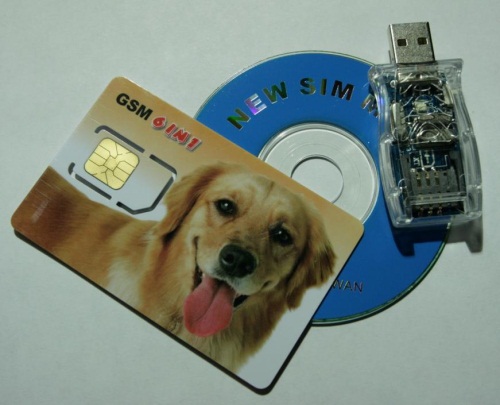
I did a little research and it turns out the 16 in 1 SIM cards are no longer available but you can still pick up a 6 in 1 backup kit for $50 and clone your existing SIMs onto a single chip. Features include:
Fast number switching, normally takes less than 30 seconds (phone dependence)
Dual speed (9600/19200bps) USB SIM reader/writer, allow scanning old SIM card which can’t be scanned with high speed.
Allow to edit SIM card name for easy identification of which SIM is being used
Allow to show either SIM name, operator name or SIM + operator name on the phone. (phone dependence)
Super large phone book capacity with 250 contacts and 50 SMS
Supports English, Traditional and Simplified Chinese user interface
Manage SMS and contacts in PC with “SIM Editor”
6 in 1 SIM chip
*It should go without saying, that cloning your SIM most likely violates your agreement with your mobile provider.
Cookie Consent
We use cookies to improve your experience on our site. By using our site, you consent to cookies.
Contains information related to marketing campaigns of the user. These are shared with Google AdWords / Google Ads when the Google Ads and Google Analytics accounts are linked together.
90 days
__utma
ID used to identify users and sessions
2 years after last activity
__utmt
Used to monitor number of Google Analytics server requests
10 minutes
__utmb
Used to distinguish new sessions and visits. This cookie is set when the GA.js javascript library is loaded and there is no existing __utmb cookie. The cookie is updated every time data is sent to the Google Analytics server.
30 minutes after last activity
__utmc
Used only with old Urchin versions of Google Analytics and not with GA.js. Was used to distinguish between new sessions and visits at the end of a session.
End of session (browser)
__utmz
Contains information about the traffic source or campaign that directed user to the website. The cookie is set when the GA.js javascript is loaded and updated when data is sent to the Google Anaytics server
6 months after last activity
__utmv
Contains custom information set by the web developer via the _setCustomVar method in Google Analytics. This cookie is updated every time new data is sent to the Google Analytics server.
2 years after last activity
__utmx
Used to determine whether a user is included in an A / B or Multivariate test.
18 months
_ga
ID used to identify users
2 years
_gali
Used by Google Analytics to determine which links on a page are being clicked
30 seconds
_ga_
ID used to identify users
2 years
_gid
ID used to identify users for 24 hours after last activity
24 hours
_gat
Used to monitor number of Google Analytics server requests when using Google Tag Manager
1 minute
You can find more information in our About Me and .