Category: Work

  • Subscription Bundles

    Subscription Bundles

    Very interesting experiment over at the Chicago Tribune.

    The Chicago Tribune will at last begin charging for its online content through an innovative scheme that will also give readers access to a premium package of third party content, the newspaper has told paidContent. Under the plan, readers will see selections from the Economist and Forbes magazines included in a new paid section, which will also include Tribune content that has been newly designated as premium. – paidContent, June 26th, 2012

    Bundles are the obvious way to add value and therefore charge a premium. This is common in the print world. The Japan Times did a deal with the International Herald Tribune and would include several pages of their international coverage within their weekly paper, the Wall Street Journal makes it’s business news and Weekend Journal available for other papers to license.  I’m not talking about the AP, Reuters, or other wire services that make a business from licensing their content – I’m talking about visibly branded bundles where the reader recognizes they are getting two publications for the price of one.

    I’m sure I’m missing something but I can’t think of an example of this happening online with any premium news sites. Sure, Yahoo bundled in brands such as ABC and CNBC into news.yahoo.com, that’s not what I’m talking about – I am talking about instances where a group of online publications get together to share subscription plans so their customers get the benefit of multiple brands with a single subscription.

    I’m interested in this because it’s the next step in something that I first wrote about last year. Once you have the concept of a subscription bundle, the next step is to get sponsors to underwrite these bundles.

    But the most visionary thing and something I keep coming back to is will.i.am’s vision of the next generation internet. It’s a world where brand “alliances” pool together to subsidize content producers. A world where, “chips talk to chips” without a middleman to make the free flow of content seamless and automatic. In this new world, a collection of devices will marry themselves to a library of content and work seamlessly together. – this blog, Feb 23, 2011

    Imagine a perk for all American Express Platinum members that includes annual subscriptions to wsj.com, nytimes.com, the iPad app for the New Yorker, Spotify, and a Netflix account. Maybe they give you an iPad as a bonus for signing on today. Wouldn’t that be a compelling benefit? That would speak to me better than free access to airline lounges or free hotel room upgrades.

    Besides iTunes or Amazon, is there a business out there pulling together online subscription bundles that isn’t tied to hardware?

    Further Reading

    Chris Dixon describes how subscription bundles maximize revenue.

  • Compromising with Lawyers

    Compromising with Lawyers

    True Story.

    A large consumer internet company where I worked sent in a team of lawyers to check over the fledgling social network I was building. The registration flow concerned them. There needed to be a check where the person registering was required to submit their date of birth so that we could ensure they were over 13.

    The advice of the lawyers was to throw an error if someone underage tried to register.

    “What kind of error?” I asked.

    “A generic error, something like, Your registration has failed or The system is down for maintenance.

    As a product guy, if there is one thing I hate more than a generic error message it’s a deceptive one. I want to give the user a specific error message that tells them what went wrong.

    “Can I just tell them that they are too young to use the service?”

    “No, then they would just adjust their date of birth and re-register,” said the legal department.

    We all know this is what happens anyway, it’s one of the great collective nod and winks of the internet along with checking the [I understand and grok completely] boxes on the End User License Agreements we find across the web.

    I argued that we must give them a more specific error so it doesn’t look like our service is broken. Legal didn’t want me to tip our had too much. What to do? We compromised.

    The new error message? The agreed upon language?

    You cannot use this service . . . at this time.

  • Scaling to 50M users – OMGPOP’s crazy ride

    Scaling to 50M users – OMGPOP’s crazy ride

    I’ll be the first to admit that I’m not a big gamer. I never got into flash game sites, Farmville, Zynga, or any of the games you can download to your phone. Yeah, I’m kinda boring that way. I first noticed OMGPOP’s Draw Something on the train when I saw someone trying to draw a Monopoly board on their iPad. The next morning, I noticed two more people drawing things on their phone. I began to recognize the UI colors and noticed more that evening.
    Then the Facebook invitations started to come in. It was so easy to start, intuitive to play, and oh so viral. What better way to connect with long-lost Facebook friends than to send them a pictionary scribble? I had my kids playing and I’m sure I confused Anil Dash when my son sent him a rendition of his avatar on the cover of a book as a drawing for the word, Facebook.

    All this is a lead-up to explain how this game burst onto the scene, blew up overnight getting the company acquired by Zynga from start to finish in less than two months.

    So what’s it like riding a rocket ship like that? What’s it like spinning up 100+ servers in the middle of the night? What’s it like getting calls from your service vendor threatening to rate limit you because, “you’re too hot.” All these questions and more are answered by Jason Pearlman CTO of OMGPOP and one of the three systems team that was there manning the servers during their incredible growth.

    “So there we were, 1 a.m. and needing a completely new backend that can scale and handle our current traffic.” – they re-wrote the backend in Couchbase and pushed it live by 3am.

    “At one point our growth was so huge that our players — millions of them — were doubling every day. It’s actually hard to wrap your head around the fact that if your usage doubles every day, that probably means your servers have to double every day too. Thankfully our systems were pretty automated, and we were bringing up tons of servers constantly. Eventually we were able to overshoot and catch up with growth by placing one order of around 100 servers.”

    “I think at one point we were up for around 60-plus hours straight, never leaving the computer.”

    To date, Draw Something has been downloaded more than 50 million times within 50 days. At its peak, about 3,000 drawings are created every second.

    All this was done with the knowledge that if the site was down for even a few hours, it would have meant the end. Draw Something was not their only game, OMGPOP had been at it for many years, with multiple games, before hitting out of the park with this one. It’s a great story of holding things together during a hard tack in their history they made it and are now well on their way to success.

    Scale Something: How Draw Something rode its rocket ship of growth


  • The Interest in Pinterest

    The Interest in Pinterest

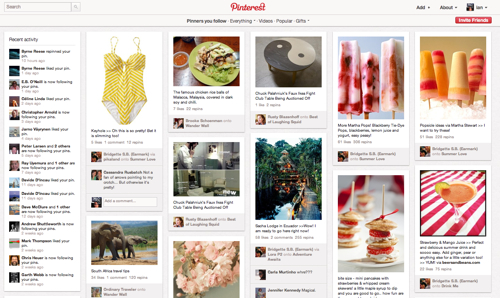
    By now I would imagine you’ve all heard of Pinterest. The latest site to cater to our need to collect and curate the world around us has boiled down the act of clip-n-share to it’s most basic form, the image. If a picture is worth 1,000 words, then the endless scroll of the Pinterest front page is the modern web’s newspaper.

    The site has been around since 2010 but only recently has it jumped into the forefront after a lengthy nurturing period with the Etsy-crafter-design set. Their strategy was smart. Close attention to detail allowed the small team to grow the service naturally and allow the community to gain a voice. Since late last year the site has been growing by leaps and bounds as the Silicon Valley set has taken to the site in droves and driven user growth through the roof (52% growth from January to February to 17.8M uniques according to comScore).

    Along with growth comes a host of real world problems. Spam, copyright complaints, user backlash one (affiliate links), and user backlash two (design changes). Even the US Army is on Pinterest. But the Pinterest folk are smart people. They’ll survive and if they do right by their core users, they’ll make it through. The service reminds me of the early days of flickr and I wish them the best of luck.

    As a product guy, what is interesting to me is how the Pinterest design motif has popped up overnight. It’s almost as if every site out there is re-thinking itself and the designers all have dynamic grid filters on that only allow them to re-arrange content on the page into floating block-sized chunks. I would argue that what we’re seeing today is as significant as the AJAX-ification of the web we saw in 2005.

    Several design trends are converging that are helping along the pintrification (gosh, I hope that doesn’t become a word) of the web.

    Tablets – the tap and swipe interaction of tablet devices lends itself to interaction via the visual box metaphor we see today. As a navigation device, it’s a lot easier to tap on an image than a headline so why not make the thumbnail image the thing to click to open up an article?

    Metro UI – When Microsoft put on their thinking caps to reinvent the phone ui for their Windows Phone 7, the Metro UI was their primary breakthrough. Inspired by transit system signage, the UI emphasized grouping similar tasks into squares so you would drill into related sub-tasks instead of scrolling through a hierarchical list of folders and files. This same UI is now being adopted in the next version of Microsoft Windows, Windows 8.

    jQuery plugin Masonry – comments on a recent CNET article give credit to Masonry as the catalyst of many WordPress themes that took on the grid look.

    CSS3 and Responsive Web Design – Since Ethan Marcotte’s manifesto in 2010, and thanks to the evangelism from sites such as Media Queries, we’re seeing more and more sites embrace responsive web design including, most famously, The Boston Globe and Good Magazine.

    The conversion of all these trends & technologies will cause an explosion of dynamic grid designs this Summer. Like swoosh logos, rounded corners, brushed aluminum, and all the glossy icons that came before, this new trend will take the web by storm. If you’re interested in turning your own blog into a tablet friendly grid, check out Pressly or Onswipe and join the party.

    If the growth trajectory of Pinterest is any indication, the service is off to a great start. Because of it’s growth and because imitation is the most sincere form of flattery, the dynamic grid is here to stay.

    Pinterest doubled traffic to over 17M in February


  • Location-based DRM

    Location-based DRM

    Reading news of the Loopt acquisition this morning got me thinking. What if someone were to build a service that would check your location and use it as a way to unlock content that would normally sit behind a paywall? Here are a couple of the use case.

    Starbucks could do a deal with the Wall Street Journal or New York Times and sponsor free reading when you are within range of a Starbucks. If you check in to pass your location or attach to their wifi then all access will go direct instead of via the paywall. Or maybe the publisher asks for an email address for access and then Starbucks and the publisher can do a revenue share on new subscriber revenue.

    Nintendo fans using free wifi outside a store in Tokyo. Stores sponsor free game characters that can only be downloaded from the store's wifi.

    This location-based DRM could extend to any publisher:

    • Games that you can only play while you are within a store as a way to trial the experience or enhance existing games.
    • Music that you can sample via Spotify while you are shopping at Target.
    • Apps that can only be downloaded from specific stores.
    eBay has some pieces of the puzzle with the combination of PayPal and Where. Match this with Where’s patent on geo-fencing and you have a nice suite of solutions that could build a platform that any publisher could plug into.

    Microsoft has a specific patent for Location Based Licensing, I wonder if they’ll ever use it?

  • People Discovery Apps, a Cautionary Tale

    This was the weekend everyone signed up and joined Highlight or Glancee. TechCrunch has written about it and Robert Scoble has been going on about how viral these location-based services are. No doubt about it, these new apps which run in the background on your phone and let you know when someone you know (or might like to know) in in your proximity, are going to be all the rage at SouthbySouthwest.

    Highlight

    If you don’t know the details of how these services work, read Scoble’s review (The Two Hottest Apps You’ll “Run Into” at SXSW) where he goes into depth on both Highlight and Glancee. These “people discovery apps” (Scoble’s term) have been around before (Sonar and Loopt to name a few) but I would agree with Scoble that the timing is right this year for the early-adopter types descending on Austin next week to take these services to the next level.

    I’ve been using both apps for a few weeks and can see how they could be useful while travelling and open to meeting new people. They are especially powerful when there is a compelling reason driving you to make new connections. Trade shows and conferences are a prime venue for this behavior. This was what was on my mind when I was with the MyBlogLog team and we developed our own version of the people discovery app to show off our API at an O’Reilly eTech conference in 2008.

    You can read about “Meetspace” on TechCrunch or ReadWriteWeb. It was a small java app that ran on a Blackberry or laptop. It was tied to your YahooID and would pop-up a little notification that another MyBlogLog user was nearby. As Highlight does today, we added a feature that would compare your  profile interests with the other person’s and give you shared interests (“talking points“)  that you could use to strike up a conversation.

    Glancee

    Because Meetspace used bluetooth, not GPS, to detect proximity, the range was shorter compared to Highlight and Glancee. This worked to our advantage because, at the conference where we released the app, it allowed us to track when you were in the same room as someone as opposed to in the same general area. We kept a running log of the total time spend in the proximity of others and let users see who they spend the most time with over the course of the conference which usually meant they were the people attending the same tracks as you. Combined that with basic details of their company and interests and you had quite a powerful social networking tool.

    Now for the cautionary tale. Meetspace was launched as an experiment. It was designed to show what you could do with the MyBlogLog API and while we didn’t plan on it being a new feature, we thought it might be an interesting way to bring the virtual social network into the physical world if it caught on.

    It never had a chance.

    Shortly after the eTech conference I received a call from the legal department at Yahoo. I forgot who was on the phone but he basically opened the call with, “You are going to shut Meetspace down, right?” as if it was beyond debate. I gave him my arguments for why we should let it run, (it was opt-in, it was innovative, it helped demonstrate our API) but all this fell on deaf ears.

    The trump argument by legal was that if anyone were to be harmed in any way, and if the police were to require discovery to see if anyone else were around while harm was being done, the police could use the Meetspace app as reason to require Yahoo to turn over their user logs. Yahoo did not want to run the risk of having to turn over these logs to the police. End of story. Game over.

    Hopefully it’ll be different for Hightlight and Glancee this time around.

  • SOPA in Plain English

    This post is for me to point folks to who are asking about why all those black “Stop SOPA” banners are popping up all over the internet. In a way, editing the DNS infrastructure of the internet in order to disappear sites suspected of pirating is the same as people who wash out their kid’s mouths after they swear. It ain’t gonna clean up their foul language.

    Even better, Cory Doctorow posted a great rant on how this is just one part of a larger arc that he’s been following. In the post is a great paragraph that helped me explain SOPA to my 12 year old son.

    If I turned up, pointed out that bank robbers always make their escape on wheeled vehicles, and asked, “Can’t we do something about this?”, the answer would be “No”. This is because we don’t know how to make a wheel that is still generally useful for legitimate wheel applications, but useless to bad guys. We can all see that the general benefits of wheels are so profound that we’d be foolish to risk changing them in a foolish errand to stop bank robberies. Even if there were an epidemic of bank robberies—even if society were on the verge of collapse thanks to bank robberies—no-one would think that wheels were the right place to start solving our problems.

    It’s worth reading Cory’s whole post over on BoingBoing, Lockdown, the coming war on general purpose computing.

    The time is getting short to let Congress and Senate know where you stand on this important issue. To contact your representatives, go to http://www.contactingthecongress.org

    UPDATED:

    Looks like the tide has turned and the discussion around SOPA and it’s sister bill PIPA has been postponed. For another excellent, plain English intro to these bills, check out Clay Shirky’s talk which brings some historical perspective to this conversation and how this is just the beginning. More to follow.

  • Jack Dorsey the Zen Master

    I had a great day yesterday at the GigaOM Roadmap conference. The agenda had a number of great speakers including Brian Cheskey of AirBnB and Tony Fadell of Nest, the red hot company that is re-defining what a thermostat should look like.

    The thesis the conference explored is one that Om Malik (now my boss) has put forth a number of times. If you think of the steam engine as the PC of our age and the portable version of this technology, the locomotive, as the mobile phone, what does increasing bandwidth and the enabled mobility mean for society and businesses going forward?

    Each speaker chipped away at this thesis with their own slant but Jack Dorsey, as he described how Twitter has enabled empathy on a global scale and how Square has removed the barriers of a Point-of-Sale system and the, “massive counter” that sits between a customer and the vendor, more than anyone else opened my eyes to the incredible transformation going on around us.

    Yet, in light of all these incredible transformations, Dorsey challenged us to maintain a balance between the “sleek, modern perfection and the rustic, zen-like chaos” and to build products that maintain this “balance in-between”. He referenced the Japanese design aesthetic of wabi-sabi (if you want to read a great book about the topic, I highly recommend Wabi-Sabi: for Artists, Designers, Poets & Philosophers).

    In the end, Dorsey advised all product managers to guide themselves with these two principles.

    1. Simplification, work real hard to get technology down to its essence (of an interaction). Take away the “conceptual debris”
    2. Make things fun, remember to be human, relate, “have some whimsy” in your application and make it human.

    The whole interview is worth a listen.

    [There was a video embed below but it’s been lost to the sands of time. You can find a short transcript of the interview on this Forbes article.]

  • Textbook 2.0

    I’ve written a few times about the future of publishing. Once to highlight concepts by Bonnier, another time to highlight a talk given by Steven Berlin-Johnson. I now work at a publisher, GigaOM produces reporting on the tech industry and GigaOM Pro produces long-form research reports. The long-form research reports are an interesting challenge. Because they are research, they do not lend themselves to all the digital portability that comes with a blog post coming out of a modern CMS. While it’s pretty easy to get a good discussion around a timely blog post, either on the site or across the social web, it’s harder to do so around a longer piece such as a research report.

    Which is what makes the video below of a GigaOM reporter Colleen Taylor getting a demo of Inkling’s new 2.0 version of their digital textbook product.

    More info and links on Colleen’s post, Hands-on with Inkling 2.0, the iPad textbook.