GigaOM posted the audio to a fascinating session at last month’s paidContent Live conference. In it, there’s a great insight/throw down by Bob Bowman, CEO of MLB, Advanced Media. Right around the 15-minute mark Bob calls those that read metered sites such as nytimes.com without subscribing, rooting around their 25 articles/month limit are, “professional freeloaders” of no interest to advertisers. He goes on to state that mlb.com gets 4X the CPMs for ads served to their paid subscribers than the CPMs served to free, logged out users.
Bob’s argument is that media sites that have a paid audience are more valuable to advertisers. While the audience of subscribers may be smaller than the audience of drive-by readers via the social web & Google – it is the subscribers, the true fans, that are more valuable to a media company. While CPMs on non-paywalled sites are driven downwards by the infinite number of impressions on the public web, subscription audiences get better CPMs because advertisers know that subscribers have a relationship with the site on which they are running their ads. There is an opportunity to further increase CPMs by taking an editorial interest in making sure the advertising compliments, not competes, with the editorial, making the advertisements even more relevant.
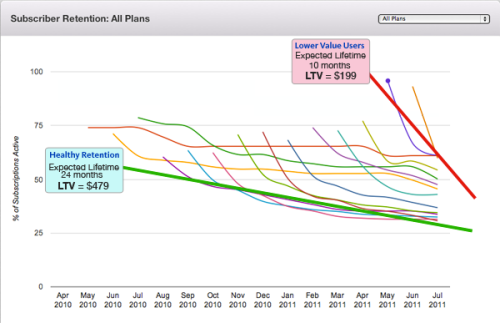
Screenshot from Recurly, popular subscription management service.
The challenge for a subscription site is how to gain new subscribers. You will always have churn so you need new subscribers to come in and replace those that are lost. Free sites do not have this challenge. Paid sites always have a bar that new readers will have to clear to read their content and the broader question is how much do you show before you require a potential reader to pay? Give too much and they don’t realize the value. Give too little and they never scratch around enough to try.
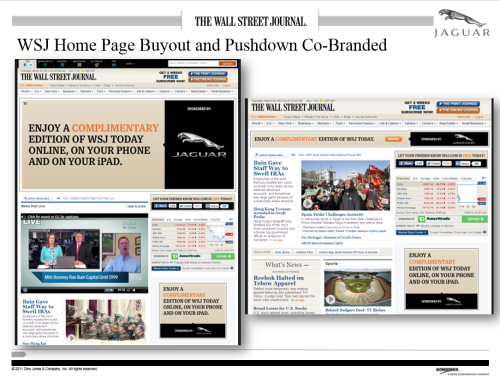
One innovative method a desirable subscription site such at the wsj.com can try to bring more potential subscribers in the door is to have the occasional open house where paywalls are dropped and the public invited in to poke around. According to the presentation from where the slide above was pulled, advertisers have been pleased with the campaign delivering 126% of the impressions anticipated. While the profile of those that see those impressions may not be as well-defined as the logged in subscriber, they are still an attractive segment of aspirational readers and therefore suitable proxy for the core audience. I have not heard of other publications using this same tactic and how effective it is in gaining new subscribers. A paidContent piece written about the Open House concept suggested that the benefits may be primarily for advertisers but I’d be interested to hear how effective they are in gaining new subs as well.
I watched Mad Men last night and as I DVR’d through the latest three episodes it struck me that the regular spots of Lincoln and Johnnie Walker featuring Roger Sterling and Joan Holloway blurred the lines between content and advertising. The brands are as much a part of the identity of the series as the characters. The two compliment each other perfectly so it makes perfect sense to have them underwrite each episode in just the same way it fits that Jaguar would invite me to enjoy 24 hours with The Wall Street Journal.
Bloomberg said the functions that allowed journalists to monitor subscribers were a mistake and were promptly disabled after Goldman Sachs complained that a Bloomberg reporter had, while inquiring about a partner’s employment status, pointed out that the partner had not logged onto his Bloomberg terminal lately.
There is no excuse for what the Bloomberg reporter is accused of doing, but it doesn’t surprise me that Goldman Sachs was the one to complain. Back when I was a Product Manager of Factiva.com, a news database where Goldman was one of our clients, I remember an IT person at Goldman telling me that they would run 100 different searches against our database, throwing all but one which was what they were really interested in. The other 99 were chaff.
There’s no doubt that the lines are fuzzy when a media company (including my employer, GigaOM) reports on the news while also running a website where they can see who is reading what. Secretive companies involved in funding, acquisitions, and IPOs have every right to be paranoid. Several times the product team at GigaOM has been briefed on upcoming features that we were under NDA not to tell our colleagues on the editorial desk. In this new world where lines are blurry, your honor & word are all that’s left to keep that ethical line straight and true.
I remember thinking, when the GigaOM Principles were published, that I’d hate to have Om invest in my company because that means that he would never write about my company. But it’s the right thing to do, there’s no other way to look at it.
Many start up Product Managers are lone wolf types. They work alone, part of a team, but the only one in that team doing what they do. Shuttling between engineering, design, sales, marketing, management and other constituents, they are the glue that ties the team together, the universal joint making sure all the momentum in one group transmits cleanly to the next so all the pieces move in unison and things get done.
Because they work alone, Product Managers have developed their own set of tools that work for them and their company. Tips and tricks on how to organize teams and set priorities are passed around like folklore on blogs and Quora posts but it’s rare to find an event that gets a room full of PMs sharing what works in real-time.
Perhaps it’s a sign of a maturing industry legitimizing a role but over the past several weeks, I have had the good fortune to attend three (!) events specifically for the modern Product Managers.
Each of these events were great in their own right but it was this past Friday’s How to Build Great Products hosted by Ty Ahmad-Taylor of Samsung and Josh Elman of Greylock Partners really knocked it out of the park.
Ever. RT @brendanbaker: Congrats @joshelman on the highest signal conference I've been too in many years.
Many PMs fell into their role before they realized that they were doing it. Especially at small start ups on a hyper growth trajectory, the PM is the first to jump in to rally and organize and bring teams together and ends up creating their job.
PMs need to have a singular focus on what needs to get done to make their product successful. This means sometimes going against corporate objectives. Hunter Walk, when he was a PM at YouTube, put priority on supporting Facebook login over Google’s own competitive Open Social login initiative. You need to look at the market as a consumer and make the choice based on what’s right for the customer, even if it sometimes goes against larger corporate initiatives.
PMs need to be entrepreneurs. Faced with a limited amount of resources, you need do whatever it takes to get things done. This often means you need to think creatively. Hunter also mentioned “learning to draft ascending ecosystems” – take an objective look at the market and if there is a way for you to bundle or integrate your product into another product on the rise. By focusing on getting the YouTube icon added to the default iPhone deck, all other conversations with carriers turned from YouTube chasing them to the carriers calling YouTube. Picking the ascending leader early was a bet that paid off.
Trust Your Strategy. Allen Blue, the co-founder of LinkedIn, described the first year of nominal growth (2,100 users after one week, 80,000 after 7 months). They reserved a bottle of whiskey for when they hit 1 million users but ended up drinking at 500,000.
PMs are problem solvers, give them meaty problems to chew on. Like Allen, many PMs come from varied backgrounds. Allen came from the theatre. Because of their non-traditional training (Hunter Walk too, was one of the few PMs at Google without a CS degree), a PMs can be the source of a unique perspective and often solution. One useful technique to use when drilling down to the essence of a problem is by using the 5 Hows which is a derivative of the 5 Whys, designed to lead you to a solution, not causality.
Srikanth Rajagopalan on building the Chrome Browser
“Speed is a feature.” This is often ignored when prioritizing tasks. Do not forget that simplicity, and it’s cousin, speed, are silent feature requests that should always be potentials for any roadmap discussion.
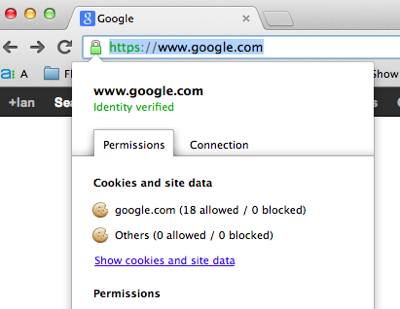
Build for the average user but do not ignore your super fans by hiding power user features. Chrome has a number of geeky features (Keyboard shortcuts that one could only appreciate if you, “grew up with vi”) but they are tucked away and do not get in the way of the basic user’s core experience. Deciding how to add an advanced feature is difficult. Putting it into Settings and letting the user choose is lazy. Did you know Chrome has a detailed Site Info box?
Chrome Site Info
There was a panel discussion about user growth where I unfortunately had to step out for a bit but I did catch Elliot Shmukler talk about the power of shared metrics. During his days at LinkedIn, he pulled together the most important metrics into an information radiator so that everyone gets a realtime view of these metrics with just a glance. But one must not forget to focus on the right metrics. Too often a dashboard is swamped with metrics where it’s too easy to drown in data. Pick 3-5 metrics and use those to test intuition. Be careful which metrics you chose because those will be the ones you optimize for.
A funny anecdote Elliot shared was coming in one morning to find, “Belgium on fire.” User acquisition spiked overnight because an engineer, after looking at these shared metrics, fiddled with some of the contact importing settings for users in that country to see if it would move the needle. It did. That is the power of shared metrics.
Dan Olsen gave an entertaining talk about his time at Friendster during their meltdown and subsequent loss to MySpace. See slide 21 which shows how he came up with the concept of the viral loop (no one was doing this kind of stuff then) and how different points in that loop have different amplification values.
Despite succeeding in rolling out several new features that helped in user growth, we all know the story about poor database optimization that ultimately ruined the experience on Friendster so that the more users joined, the slower the site became. Dan’s learnings were that, for social networks, a large user base is a feature. People used MySpace because that was where the majority of their friends were which lead to, um, a majority of their friends being on MySpace.
Fred Sigman, an Art Historian & Photographer, gave an thoughtful talk about the influence of nearby atomic bomb testing on the neon signs of early Las Vegas. As a post-lunch talk, professor Sigman’s talk was perfect as the, “palette cleanser” talk before we got to the. . .
Ian Mcallister
Ignite talks. These are lightning round, Pechakucha-style presentations where the slides self-advance. Highlights for me were Ken Norton’s How (not) to work with Engineers and Ian McAllister’s talk about the User-Driven Development which I’ve written about before.
Joe Zadeh from AirBnB spoke about the hiring process at his company. Forgive the fuzzy resolution but it’s the nut of his talk which explained that all PMs that are interviewed are invited in to present on a topic given to candidates in advance. This allows them to evaluate all the candidate along a baseline for a number of things simultaneously,
Can they communicate effectively?
What’s their design skill like? Do they understand spacing, fonts, color, use of graphics?
Are they nervous presenting? How do they respond to questions, pressure?
Did they have a fresh approach? Are they an original thinker?
Joe Zadeh on how to interview a PM
If the interview is for a Product Manager, they may make it about a specific problem they are trying to solve. When they were looking into adding a payments processor in South America, they asked prospects to speak that topic. By the end of the interviews, they had not only a good sense of who knew what, they also got six different approaches to integrating payments processors.
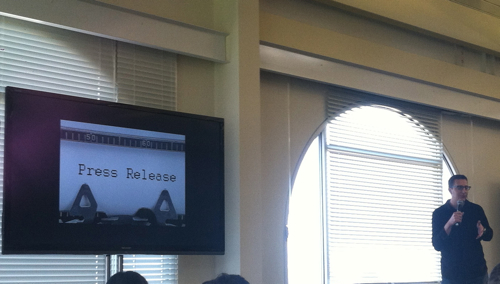
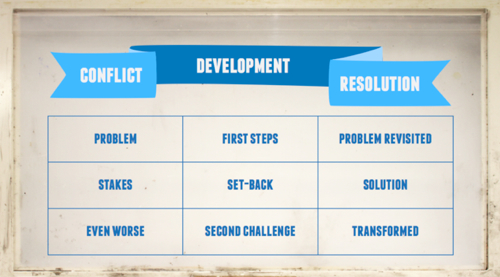
James Buckhouse from Twitter gave an great talk about storytelling. @buckhouse came from Dreamworks and tells stories for twitter and shared his formula for how to tell a good story. It’s all about the journey to a transformation. He writes about writing on Medium at Design Story.
James Buckhouse on storytelling
The final talk of the day was with Tom Conrad at Pandora. No slides, just a simple discussion between Josh Elman and Tom about the early days of Pandora and it’s inspiration (“I loved to recommend music to people. Building a service was a lot easier than inviting people to my dorm room.”) but also included a varient of the “let’s go shopping” style of roadmap prioritization.
Every 90 days, wipe your roadmap clean.
Ask everyone in the company what things the company would be crazy not to do. This includes projects that used to be on the roadmap but are now off it.
Summarize each idea on one slide. Work with engineering to come up with a thumbnail estimate for how many days it’ll take for each project. If a project will take one weeks’ development by two developers, that’s a $10 project.
Print out each slide and stick them up on a wall.
Sit with Engineering and decide how many developer man-days you have for the next 90 days. If it’s 60 working days and you have 2 developers, and you need to reserve 10 days for maintenance, that means you have 110 developer man-days. This would equal $120.
Invite a cross-representative group of people to a product prioritization meeting. At Pandora, this included someone from HR. Give each person a different colored post-it note with equal amounts that they can allocate towards projects. If there are 5 people in the room, then that’s $24 each.
It will be a long meeting but, by the end, you’ll clearly see which projects are “fully funded” and those will be the ones that you take on for the next 90 days.
Everyone leaving that room will have a clear view of what engineering is going to be working on better than any Roadmap document could tell them. There will be no need to brief people on what each project is because they will have heard the description of each project in that meeting.
I hope you found this post useful. I’m gathering these tips and tricks into a collection. If there are some that you feel should be included, let me know.
With the announcement of the sunsetting (never did like that word) of Google Reader, a discussion was kicked off at work over what features would make up an ideal RSS reader. Everyone at GigaOM is a voracious reader so we like to compare information processing tools and techniques like foodies discuss recipes.
Here’s my short list:
Must be able to import an OPML file. The easiest way to get started is to load up your existing collection of feeds.
Must export OPML. Never trust a platform that doesn’t support data portability.
Must keep track of what you’ve read.
Must have a mobile version that syncs what you’ve read with on the desktop, mobile, or anywhere else
Must support pubsubhubub so news is pushed and realtime if the feed supports it.
Must be able to browse by feed or as an aggregated, reverse-chron sorted river of news
Must support browsing by headline, excerpt, or full-text
Must support rich media so the reader can be used to browse video, podcasts, and photo feeds. Bonus points if you can output a photo feed as a screensaver.
Then there are the extra features are what would put one reader above others
Provide search across all feeds. This is your slice of the best of the internet after all.
Add the ability to star or otherwise mark items for simple re-tweet behavior. Let people publish a feed of these curated items so others can follow your information exhaust. Even better is to re-create the “share with note” feature in Google Reader and you’ve got a light-weight tumblr network.
Add the ability to follow other people and add their feed bundles to your collection. This was the single best feature of Google Reader and the one that, when taken away, killed off the future of the product.
Decay. Add a natural decay to feeds that do not get a lot of your attention. Provide a bookmarklet that lets you grab and add feeds as you find interesting posts across the internet but feel safe in the fact that if you let a feeds’ post go unread, that the feed itself will eventually drop off your main view, keeping things clean and focused.
In the day and age of Twitter & Facebook, have a pre-set filter that reads your social feeds and parses out all the links you add and puts them into a folder which you can search across or curate & share back out.
Finally, there is the uber-geeky-cool feature that I built with the MyBlogLog team, the Interest Engine. The vision was that you would pipe all your feeds through the reader and the tags on all those feeds and shares would feed the algorithm to improve what bubbles up in your aggregated newsfeed. If you subscribe to a bunch of blogs about “fly fishing,” use that as a signal and focus posts from other, more generic feeds on your interests so that if a story about Fly Fishing flows across your New York Times feed, it gets higher placement.
So that’s my list of MVP features & nice to have differentiators. Did I miss any?
UPDATE:
Some choice words from Chris Wetherell, one of the original engineers on Google Reader, on the effervescent business opportunity of the GReader community.
Dave Winer shares his thoughts on how he would build RSS anew. Centralized OPML profiles (as were offered by GReader) are key.
All joking aside, the internet of things is a technology looking for a use. The geek in us tells us that connecting devices together is a good thing. Networks are better than the sum of it’s parts. Choice is better than none at all.
Back in the day, I had a friend who set up a macro on his Palm V to wake up each morning and emulate his remote control and turn on and tune his TV to the morning news. Sure he had to remember to set his Palm on the coffee table each night so the IR sensor could reach his television but the combination of a simple cron entry and an IR emulator added value not only to the Palm but also to the TV which had a new purpose as an alarm clock.
Let’s run through some of the previously inanimate objects that now can be addressed by a network. I’m not including things such as a computer or the Arduino which is like the breadboard for the internet of things. I’m focused more on single purpose devices or sensors which can be networked. A partial list includes,
“I believe in the human element of news,” says Matt Galligan, the co-founder of circa, the hot news curation app released for the iPhone a few weeks ago. Matt was speaking about circa with Founding Editor Dave Cohn, at a Hacks/Hackers meetup in San Francisco, where circa is based.
The service is quite extraordinary in how hand-crafted it feels. Optimized specifically for the mobile device, the app aggregates news into a series of snippets and photos organized by topic. Aggregate is really the wrong term because each topic is manually curated by an editor who scans their online news sources and pulls apart source material to separate fact from “fluff.”
It is the presentation which makes this app shine. The care in how the images are carefully cropped and manipulated to the clever imitation ruffled edges on the screens to emulate newsprint give the app an artful feel.
Users of the app are presented with a series of topics to read, all editorially chosen. You can dive into a topic and scan through what Matt describes as a series of cards (flash cards were an important design inspiration) which highlight key facts, quotes, images, or other information that adds to the topic. Each fact that is brought in is referenced so that the reader can drill down to the originating piece should they want to read further.
The entire experience is designed for mobile. The snippets of a story are presented like snacks that you can nibble throughout the day, while waiting for the bus, between meetings, or over coffee. It is your news, broken down.
Additionally, you can Follow a topic much as you would subscribe to an RSS feed or follow a hashtag on twitter. Big news stories such as Hurricane Sandy have “arcs” that develop over time and a key feature of circa is that you can pick up and follow any thread you want to watch closely and, if you opt in, get push notifications of updates whenever a new fact is added to any thread you are following. Following developing stories is a key use case around with circa was designed. Often when following developing stories in the mainstream media, follow on stories often include prior material for the uninitiated. Circa gathers only the new material and tacks it on to it’s thread, dropping readers where they left off.
This Follow signal is particularly interesting. A Google search or Facebook like are signals of intent but they are fleeting. When someone opts in to getting push notifications of a story, that is a very strong signal of interest that will help the circa team understand what stories to follow in the future. This symbiotic loop will help improve the service over time and the early usage and engagement figures show strong engagement that bodes well for the service and its future.
John Herrman wrote that, “Twitter is a fact-processing machine on a grand scale,” when he was describing how news about Hurricane Sandy, both real and fake, was quickly shared, distributed, and verified via tweets. Circa takes a different approach. Positioning itself as a meta-source that can be trusted, it’s editors are taking the care to pull in the most important stories of the day and updating only when something is significant. It’s a human powered approach that limits their scale but they seem ok with that.
The app was a germ of an idea in December 2011. Back then it was called Circuit and was about the “closed loop” relationship between news that is read driving an algorithm that gave you more of what interested you. They started building the app in March and launched six months later as circa, a name which reflected the evolution of the product into something which was approximately around or about the news but not necessarily in it. The formal name of the company is circa 1605, the year of the first newspaper.
The team is small. 11 editors which cover 22 of the 24 hours a day (they have an editor based in China). There are three engineers, an iOS developer, their CTO who built their custom CMS, and a third engineer working on the APIs and data. The investor team is a hot shot lineup of media wizards so they have a strong wind with lots of experience from companies such as Tumblr, Facebook, and Al Jazeera behind them.
But, as Matt shared, launch day was difficult. Just 15 minutes after their app hit the iTunes store, a rouge server took down their service and for the next four hours. Those that had the app couldn’t use it while others couldn’t download it. The team answered over 1,000 tweets and were greeted to over 100 one star reviews once they recovered. But they did recover and within the next four hours after coming online they shot up to be the #1 news app in the iTunes app store, beyond the NYT and CNN.
The app is only a few weeks old but going strong. The Follow feature has a magnetic pull to bring you back into the app as stories develop over time. The team has purposefully chosen to go after areas where their approach to curation will have maximum benefit. Big news stories such as the Election or Hurricane are perfect for circa as you can follow along with out drinking from a firehose. They are next going after the tech news vertical where the typical earnings announcement or product launch story varies little from outlet to outlet.
Monetization options remain to be seen but Matt did share that their engagement numbers are very strong and, with the Follow feature, it’ll be easy to target readers with advertising or premium subscription topics. iPhone only for now but both the circa app and the team shows promise.
What if we follow Augmented Reality to it’s ultimate conclusion. Daniel Suarez’s vision of a layer of information and meta-data transposed upon the physical world may be the science fiction of last year but we all know if Google’s Project Glass gets it’s way, it’ll be here soon enough.
But what if we took this further? What if the commercial pressure to monetize our new experience pushes the development to it’s ultimate conclusion? What would that world look like? Behold.
There is a great interview with Thomas Peterffy on NPR’s Planet Money podcast this week. Mr. Petterffy is credited with bringing computers to Wall Street. In the clip below, he talks about how he cut the cord to his NASDAQ terminal and patched it into the back of a computer so that his trading algorithm could automatically buy & sell shares based on the the numbers it was reading off the feed. NASDAQ noticed the volume of trades coming over the wire from his company, and when they realized that all these trades were being executed by one computer, they pointed to a line in the user agreement that said that all trades needed to be entered, “using the keyboard.”
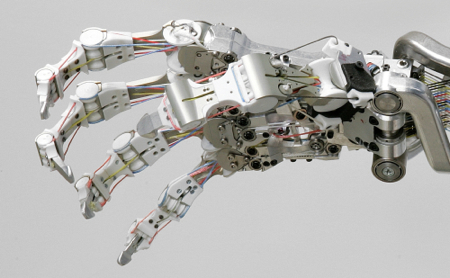
Peterffy and his engineers then devised a “rubber hand” attached to the computer that got around this absurd rule. The robot entered all trades via the keyboard in order to comply with the rulebook but, as Petterffy notes, on busy trading days the clacking of the robot hand on the keyboard got so loud that people in the office had to wear earplugs.
This story brought back memories of a similar, absurd set of rules that I witnessed at the Osaka stock exchange. The Nikkei future contracts were traded on the Osaka stock exchange and they had a strict set of rules that said that you could only trade these futures if you had a seat on the exchange and had staff in an office within a certain distance of the exchange. This was enforced by a rule similar to the NASDAQ rule that prohibited digital quote feeds from the floor. The only feed you could get was a video feed showing the prices and this feed could only go a certain distance from the Osaka Stock Exchange (OSE). This was, no doubt, a way to force high net worth financial firms to keep an office in Osaka. The problem was, the Morgan Stanleys of the world had a hard time convincing anyone to live in Osaka to work the Futures floor.
I worked for a US Securities firm based in Tokyo at the time and we got around the OSE rule in a clever way, not too unlike Peterffy’s robot hand. We rented a small office across the street from the OSE and installed one of their proprietary video terminals that they give to those with a seat on the exchange. In this office (which was essentially a closet), we put a camera trained on that terminal screen. We then had a computer parse that images from the camera and used software to read the numbers and turn them into digital bits which we then sent to our Tokyo traders via a leased line connection. With this home grown digital ticker feed of the futures contract numbers, our traders could run their trading desk remotely from Tokyo.
The only issue was earthquakes. Whenever there was a strong temblor, someone from the IT department (where I worked) would have to get on a bullet train to Osaka (about 3 hours away) and go to that small office to adjust the camera and re-calibrate the software that parsed the video signal and turned numbers into a digital feed.
The digitization of analog content transforms every business it touches. When you turn a musical performance into an .mp3, a movie into an .avi , or a newspaper into an .html file, it can be duplicated and transported at no cost. We think digitization is a recent phenomena but the interview with Thomas Peterffy reminds us that this transformation hit the financial services first. Shortly after the Peterffy robot, NASDAQ lifted its rule restricting computerized trading and today, more than 50% of all trades are entered automatically via computers running trading algorithms.
The robots are taking over. As we look at events such as the Flash Crash of 2010 and the Knightmare of 2012, we should be taking notes to see how the pursuit of efficiency may impact other industries that are turning to automation.
Over the weekend I posted a question wondering why no one has done what Spotify has done for music and Netflix for movies. The fact that no one has stepped in to offer a bundled subscription for another “old media” type, the magazine & newspaper, seemed like an opportunity to me that made economic sense.
Yesterday, Next Issue, a company that had been doing exactly that on the Android platform jumped up with the launch of their iOS app which brings together all you can read from almost 40 magazines, for one monthly flat fee.
The publications are from their investors Condé Nast, Hearst, Meredith, and Time (full list of magazines on offer and their parent companies are listed on paidContent). Their basic plan is for $10/month while for $15/month you get access to additional “premium” magazines such as The New Yorker, People, and Sports Illustrated.
Now that the solution is here, would you go for it? The reception seems mixed. A shortcoming that my colleague at GigaOM has noted is the lack of social features. The web has forever changed the way we read. Both in how we discover what to read and again in the way we share what we’ve read. I think I saw Dave McClure wearing a shirt once that said, “If you can’t share it, it doesn’t exist” – this is the future, this is the way to growth.
It’s not clear to me how Next Issue will be able to roll in social into their subscription-only product. As with other paywalled sites, sharing of Next Issue articles will not work unless they get creative because subscribers will know that they’re sending out dead end links to their non-subscriber friends.
Social sharing will work if enough people can access what you’re sharing so a network effect kicks in. This is starting to work with Spotify because they have a free, ad-supported subscription so all you need to do is register and install the app to listen. The hope is that after enough listens, you’ll get hooked on the product and up-sell to their ad-free subscription product.
Without sharing, there will be no social discovery. Without social discovery, you’re stuck with what’s on the newsstand shelf and how the articles are presented to you by each publication. This is the way it used to be, this is the way to stagnation.
So how can Next Issue grow it’s subscriber base so that social sharing can kick in and drive further subscriber growth? I suggest two options.
1. Create an ad-supported freemium client that lets those that follow links put out by Next Issue subscribers get a taste of the product. They have a 30-day free trial but it requires a credit card, that is too high a barrier, it needs to be totally free and dead easy to install. This is probably not an option as there is almost no reason to convert to a paid subscription if such a free product exists. That leaves the next choice,
2. Do a deal with a major brand such as American Express or Microsoft to underwrite enough subscriptions as a membership benefit so that you get an install base large enough to encourage broad sharing between subscribers and a community of “haves” that are sufficient to encourage those without to sign up either with the sponsor or Next Issue directly.
The future is with sponsored subscription bundles. Not only for Next Issue but for Spotify and Netflix, all these services will take off when the media buyers put together deals which pay for these memberships. I have a bunch of United Airlines miles but would much rather use them to pay for my Spotify subscription than another cramped trip in a tin can on an airline.
Sponsored subscription bundles. That’s my big bet. It’s the future of the subscription business model and the future of brand advertising.
Cookie Consent
We use cookies to improve your experience on our site. By using our site, you consent to cookies.
Contains information related to marketing campaigns of the user. These are shared with Google AdWords / Google Ads when the Google Ads and Google Analytics accounts are linked together.
90 days
__utma
ID used to identify users and sessions
2 years after last activity
__utmt
Used to monitor number of Google Analytics server requests
10 minutes
__utmb
Used to distinguish new sessions and visits. This cookie is set when the GA.js javascript library is loaded and there is no existing __utmb cookie. The cookie is updated every time data is sent to the Google Analytics server.
30 minutes after last activity
__utmc
Used only with old Urchin versions of Google Analytics and not with GA.js. Was used to distinguish between new sessions and visits at the end of a session.
End of session (browser)
__utmz
Contains information about the traffic source or campaign that directed user to the website. The cookie is set when the GA.js javascript is loaded and updated when data is sent to the Google Anaytics server
6 months after last activity
__utmv
Contains custom information set by the web developer via the _setCustomVar method in Google Analytics. This cookie is updated every time new data is sent to the Google Analytics server.
2 years after last activity
__utmx
Used to determine whether a user is included in an A / B or Multivariate test.
18 months
_ga
ID used to identify users
2 years
_gali
Used by Google Analytics to determine which links on a page are being clicked
30 seconds
_ga_
ID used to identify users
2 years
_gid
ID used to identify users for 24 hours after last activity
24 hours
_gat
Used to monitor number of Google Analytics server requests when using Google Tag Manager
1 minute
You can find more information in our About Me and .