Last week certainly was interesting. On Wednesday morning I was abruptly informed that, along with my VP and two engineers, that our services were no longer needed at Gigaom.
While unravelling my personal social profiles from the various company pages I had set up for Gigaom, it was Facebook’s robotic bit of micro-copy that really brought it home, “You no longer have a role on Gigaom.” Harsh.
Japanese has this wonderful phrase, iro iro (いろいろ) which means roughly, “lots of things that I’d rather not go into now but feel free to ask me over drinks” and I’ll leave it at that. Nothing dramatic, just a sudden shift of course that made it clear that it was time to move on. I’ll leave it at that.
I had a great run at Gigaom and I thank Daniel Raffel for the introduction and Paul Walborsky and Om Malik for their support while working there. I joined when Gigaom was a collection of blogs with a nascent premium subscription business. Gigaom Research is now a major driver of revenue. As a Product Manager and later Director of Product the team tackled a number of projects of which I’m proud.
redesigned the gigaom.com post page and front page (twice)
rolled out a major re-brand across all properties
re-configured the Gigaom Research subscriber acquisition funnel
launched Analyst Connect, a simple way to connect to Gigaom Research analysts
launched Data Connect, a charts-centric view into Gigaom Research
launched Gigaom Search, a faceted search engine across the 15 year archive
launched Gigaom Alerts, a free tag-based notification service
In addition to the projects above, I am also pleased with my contribution to setting up how the Product Team is run. As the company grew through the critical 50 employee mark where unstructured cross-department communications begin to break down, the daily stand-up, weekly Dev Diary, Friday Show-and-Tell presentation, and quarterly Product Roadmaps all played an important role in keeping things on track. The methodology was simple and I think that’s what led to its success.
The engineers greased communication even further by migrating off our group Skype chat into HipChat rooms with integrations into GitHub and a script that could spawn a Google Hangouts on demand. We even had a Sonos-driven alarm that would play Bob Marley’s Get Up, Stand Up on queue to remind us all when it was time for our daily check-in. Sometimes it’s the little things.
It’s always bittersweet to leave a place of employment, like the breakup of a band. There’s a lot of talent there and I’ll miss working with them. I will also personally miss the vortex of activity that comes with working at an organization that takes in the news of the day and validates, organizes, and distributes it back to its readers.
Gigaom is a premium content business with increasingly valuable content and services made available to customers at its higher tier customers. I often tell people that the most valuable content is in the internal Gigaom newsfeeds, the price of which is full time employment. As of now, I am unsubscribed.
Silicon Valley has replaced Wall Street as the preferred destination of fresh graduates. The pursuit of short term wealth on Wall Street in the 80s is replaced with other short term data points which, when pursued with a singular focus, can skew one’s moral compass.
“If Google’s primary weapons are relevancy and speed, then Uber’s are cost and speed.” What I didn’t say: They are fairly similar in their inability to deal with consumers at a human level. That is the challenge of our times.
In this data-driven world we must keep in mind what is being measured and remember that organizations instinctively optimize for those metrics. During this Thanksgiving break, think of alternative, long term metrics such as Lifetime Customer Value, Renewal Rates, and Net Promoter Score as important KPIs for your business’ success in the long term.
In 15 minutes, CPG Grey’s Humans Need Not Apply paints a bleak picture for anyone who thinks that the coming robot revolution will free everyone up for more creative pursuits. Trouble is, poetry and painting don’t pay the rent.
Transportation, driving things & people from point A to point B employs millions of people today. What will happen to these people when self-driving transport is perfected? In the Great Depression 25% of the workforce was out of work and unable to feed itself. Pointing to a list of the jobs in danger of automation Grey argues,
This list above is 45% of the workforce. Just what we’ve talked about today, the stuff that already works, can push us over that number pretty soon. And given that even our modern technological wonderland new kinds of work are not a significant portion of the economy, this is a big problem.
This is not something that will happen sometime in the future, this is something that’s already happening. Amazon’s Robot Army was mobilized two years ago. It’s a re-occurring theme, robots taking over and turning against their maker. Coming soon to a theater near you in October, Autómata.
I’m not too worried. According to Derrick Harris (who writes about this kind of stuff)
Building an AI system that excels at a particular task — even a mundane one such as recognizing breeds of dogs — is hard, manual work. Even so-called “self-learning” systems need lots of human tuning at every other step in the process. Making disparate systems work together to provide any sort of human-like concept of reality would be even harder still.
Before AI systems can communicate with each other and learn, we’ll need standards. As long as creation of standards remain in the hands of human-based, quasi-governmental international organizations that take ages to agree on anything, we’re safe
Ever since it began selling ads 10 years ago, Facebook has been combating doubts about its value to marketers. Search engines like Google offer advertisers a direct link to people seeking out particular products, while television remains the dominant way to reach a mass audience. Now, Facebook claims, it can provide the best of both.
Facebook stock sailed past analyst expectations last month and its stock hit an all time high. It looks like brand advertisers are coming on board now that Facebook has the audience to fulfill the promise of hitting targeted demographics, at scale.
This should be cause for concern at Yahoo (not mentioned in the NYT article) who was the traditional online goto for brand advertisers. The market has since spoken.
Running a start-up can be a lonely. What is glamorized in media are the high points, revenue and usage going up and to the right, the launch party, the high-fives when you close a big deal, the opening of your first office.
The reality is more gut wrenching. The late night realization that you may not make a revenue target. The early morning notification that your server is offline. The sinking feeling when a key prospect tells you they cannot work with you. The difficult meeting with an employee when have to tell them you have to let them go.
The life of an entrepreneur is a series of peaks and valleys that can whip you from euphoria to depression and back again in the course of a few days. But it’s when you’re starring into the abyss that you find out who your true friends are, when you find out if you picked the right group of investors, that believe in you and will help you work it out.
After spending two days at Stanford University with 250 other individuals who work at True Venture portfolio companies, I have a new appreciation for why someone would want True Ventures as a backer.
Once a year, True, an investor in my company, Gigaom, hosts a True University for its portfolio companies. It’s an incredibly generous offering. Two days rich with talks and workshops on how to run a business. A sample of the sessions include:
Steve Blank talking about how to develop a business model and product/market fit
Army Major Aram Donigian talking about negotiation tactics learned while in Iraq
Robert Brunner, the designer of Beats headphones, talking about design experience
Reverend Cecil Williams and his sharp as a tack wife Janice Mirikitani talking about the mission of GLIDE
Design should be more than just a phase between marketing and engineering – Robert Brunner
And that’s just the highlight. In between were smaller workshops with folks like Hooman Radfar (the right and wrong way to let someone go), Lars Nilsson (how to set up and run an inside sales team), and Braden Kowitz (how to run a design sprint).
Negotiation Lessons Learned from West Point
But it’s more than talks and workshops. I came away with a feeling of community. True University is an environment of complete trust and collaboration. I spoke openly about challenges I was facing and shared with others lessons I have learned. We were all working to build something and we wanted each other to succeed. True Ventures is more than a collection of investments, it’s a platform from which tomorrow’s leaders can take a leap and know that you’ve got a community of like-minded folks are behind you.
True Venture’s Jon Callahan speaking on trust and risk
Thank you True Ventures for being an investor and thank you for an amazing couple of days!
Further: videos from past True University sessions are posted at on TrueTube
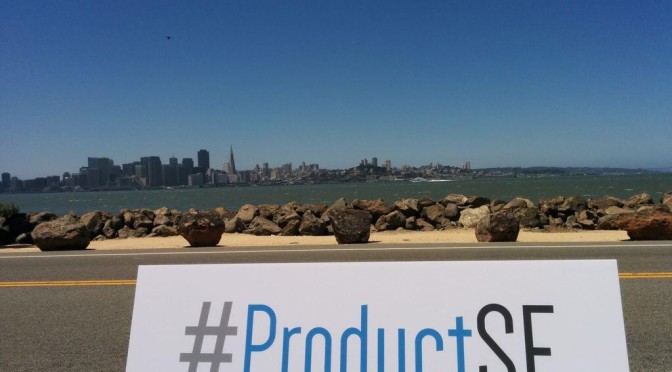
Last week I attended the 2014 edition of Building Better Products, an invitation only conference hosted by Ty Ahmad-Taylor of Samsung Electronics and Josh Elman of Greylock Partners. As with last year’s conference, it was an agenda packed with interesting speakers that came to share their perspective on the role of a Product Manager at a tech company, sharing lessons learned and what it takes to succeed. The format was updated to include a mix of pechakucha-style lightning talks interspersed with longer presentations and panel discussions.
Because of a morning SFO drop-off run, I missed the “palette-cleanser” talk that kicked things off for the day (a history of Treasure Island) and Julie Zhuo‘s talk on how to work with designers. I’m sorry to have missed Julie’s talk but you can read her many excellent talks about the design process on her Medium page.
I took notes on some of the presentations and here were my favorites.
Mina Radhakrishnan shared her experiences as one of the first Product Managers at Uber during their first international expansion and the growing pains the company went through to develop a process which now lets them spin up multiple locations each week. We learned of design challenges as the nomenclature for hired cars vary from city to city. An SUV in London is a “big car” while a private car is a “black car” but tabs for “Big” and “Black” don’t really work so other solutions were needed.
A template that might work in one country falls apart in another so you need to, “design for flexibility” and use templates that can be adopted to fit local needs. Because of the need for speed and scale, these templates need to be designed in a way that local operations teams can unleash their “operational creativity” without having to check in with headquarters.
What struck me most was the intense drive and ambition of Uber CEO, Travis Kalanick, enabled the team to roll over technical and legal challenges that would have sidetracked most companies. In the drive to launch Uber in Paris in time for Le Web, they slammed a product together that had to be re-built from the ground up post-launch. It is rare to find a start-up that would knowingly build something they know they are going to tear apart and build again and support for that way of working has to come from the top.
The Ubercade in Paris
While talking about Uber’s various publicity stunts (ubercade, uber ice cream, uberkittens) Mina reminded us that Uber is not strictly a transportation company and that their mission, “to get you where you want to go” should be interpreted broadly.
Vince Maniago from Mint gave an abbreviated version of the talk embedded below to explain specific actions he took to improve sign-ups. As a financial service, his challenge was to get people to connect their banking accounts with the mint.com aggregation service. By putting his name on follow-up emails to anyone who didn’t complete this action, he was able to significantly improve completion rates and get people over the trust factor.
Some other tips Vince shared included use of Amazon’s Mechanical Turk service for user-testing and Mental Notes cards (note: sold out) as inspiration for the types of message variations you can test.
David Hahn, who was at LinkedIn during the early days, spoke about the freemium business model upon which that service is built and the evolution of their landing pages. The page has gone through many iterations but each time they have tried to add something new, they have found that the obsessive simplification of the erroneous was the best contribution to their conversion rates. “The best optimizations are getting rid of things.”
Wook Chung works with brand advertisers for Samsung and shared humorous anecdotes about working with Madison Avenue and the importance of continually checking in with your customer whose needs are like Heisenberg’s Uncertainty Principle. Advertising trends are continually in motion so freezing requirements and then going off to build them will, by definition, obsolete anything you launch. Better to involve your customer at each stage and get them invested in your solution and inform your development.
A series of short talks followed. Ken Norton (Google Ventures) on using Don Lowry’s True Colors rubric to build teams and modulate communication. Ian Spalter, UX Lead at YouTube, gave a rousing comparison of UX/Product archetypes as Game of Thrones characters and reminded all of us to, “respect the craft” when giving feedback.
During the panel discussion on Product Development in the Enterprise Sol Lipman, who was CPO at TomFoolery, shared lessons learned as a start-up trying to change enterprise software (“we made consumer-grade products for the enterprise”). One of their early lessons (and we’ve heard this before) is that you need to focus on utilization because, “just because someone is going to pay you doesn’t mean their people are going to use your product.”
One other tidbit was Sol’s singular vision that the all products for the enterprise should be built “sideways” to allow collaboration across traditional networks. Do not build your product around a company domain and allow for self-defined networks which will be how workgroups form in the future (think Dropbox). Email, which is usually dominated by company domains, is not a useful unique identifier as it locks each customer into their silo. On the other hand, a cell phone number, which everyone has and usually carries from job to job, allows for infinite connections which will persist and retain their viral effectiveness.
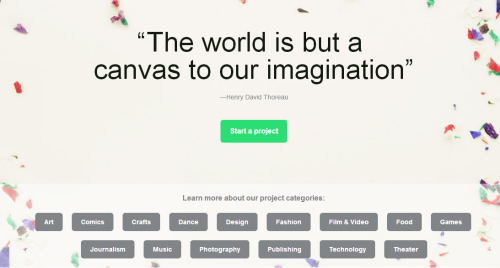
Ellen Chisa from Kickstarter shared the eight-month journey to a new start page. Reminding us all that Kickstarter is primarily a platform for artists so the founders were concerned less with a metrics-driven design process and more with the embodiment of a vision. If forgot the name of the poet she quoted but, to paraphrase, if Kickstarter was going to set out to build a ship, they would not instruct them the details of woodworking, they would, “teach men to yearn for the sea.”
Kickstarter Landing Page
In the end, there were 11 major designs for the front page with hundreds of iterations in between until they found a design they felt worked. But all was not lost, many of the ideas hashed out made their way into other areas of the product. Perhaps less efficient, the Kickstarter way was more holistic.
Shiva Rajaraman, from YouTube, gave a great talk, “Product Management: From Meh to Awesome” that was not about use cases or tips and tricks but about approach. A Product Manager is the one that has the spotlight. No product is the result of a single person’s output and the PM should take pains to shine attention to all those that work on the product. And with a community-driven product such as YouTube it is especially important to point out what’s awesome about your community.
Check out the Likes/Dislikes on the Futurama Neutral Response clip below. Finding out that there is a community of people that obsessively maintain this delicate balance, “made his week.”
Equalized thumbs up & thumbs down
Thinking of YouTube as a platform transformed the way they have approached music companies and brands. Music fingerprinting and content ID was originally developed to go after copyright violations but when flipped around from a negative to a positive, it helps musicians understand how and where their music is being played. Harem Shake got such tremendous exposure through the fan videos that when it debuted on the charts, it was #1.
Shiva tells the story of Molly Kate Kestner who recorded her self-composed song on a broken iPhone that, within weeks becomes a top single on the iTunes charts. An open platform allows these stories to write themselves and a good Product Manager will look for them and hold them up for others to celebrate.
Thank you Josh & Ty for organizing a great day of talks, picking a great venue, and, as always, keeping everyone on schedule.
Michael Lewis published an fascinating look into the world of high frequency traders on Wall Street in the New York Times. He goes deep into the shadowy world of private exchange “dark pools” and unregulated private networks. As someone who follows technology news and the debates over network peering and net neutrality, Mr. Lewis’ tale of what happens when you let the established players extend their advantage with direct network connections in the world of finance is another argument for net neutrality.
First some background.
As the big financial firms moved their trading online, the speed of the transactions became a competitive advantage. Firms that connected directly to the exchanges gained an advantage as they were able to execute their trades milliseconds faster than the competition, staying ahead of large market moves, shaving pennies that added up to millions at their enormous volumes.
The pursuit of speed reached ludicrous with the launch of projects such as Arctic Fibre which was offering to connect European and Asian markets under the North Pole ice cap to reduce latency.
Artic fiber CDN
When I was working at a securities firm in Tokyo, rumor was that one US firm had used superior hardware (Sun Workstations at the time) that could calculate the Nikkei 225 average a few milli-seconds faster than the mainframes at the Tokyo Stock Exchange. Futures for the 225 were traded in Osaka on the OSE so by running the calculations in Tokyo and sending orders over a high-speed network to Osaka, this firm was able to make a bet on where there market was going with 100% certainty. That gravy train lasted for a few months until the OSE caught on and then someone put something on to that firm’s feed that slowed their signal down just enough to erase their advantage.
These kinds of shenanigans are par for the course in the world of finance which is always looking for the greater fool. Technology has always been used to gain visibility into the market whether it’s counting delivery trucks as an early indicator of business results or Paul Kedrosky’s ladder index, traders are keen to optimize on the latest silver bullet.
So it comes as no surprise that Wall Street brokerage firms used their high-speed trading platforms to trade in front of their customers and skim razor margins off the top to keep for themselves.
Katsuyama and his team did measure how much more cheaply they bought stock when they removed the ability of some other unknown trader to front-run them. For instance, they bought 10 million shares of Citigroup, then trading at roughly $4 per share, and saved $29,000 — or less than 0.1 percent of the total price. “That was the invisible tax,” Park says. It sounded small until you realized that the average daily volume in the U.S. stock market was $225 billion. The same tax rate applied to that sum came to nearly $160 million a day. “It was so insidious because you couldn’t see it,” Katsuyama says. “It happens on such a granular level that even if you tried to line it up and figure it out, you wouldn’t be able to do it. People are getting screwed because they can’t imagine a microsecond.”
When you move from analog to digital the line of a signal gets chopped into samples. The gap between the sample and the raw signal grows imperceptibly narrow the more frequent the sampling. The profit of the high-frequency trading firm is made within those gaps.
Digital Sampling
High-speed fiber optic networks and global exchange liquidity centers are the latest tools of the trade. Co-location of your execution servers in the cage next to a stock exchange drop point in a data center guarantees that you can jump in and out of financial instruments faster than the next guy allowing you to trade in and around that gap between the bid and the ask.
This is a parable for what will happen if Netflix and other big media companies do deals with ISPs to guarantee bandwidth for their content. It undermines net neutrality and the level playing field for all media companies. Smaller, disruptive media companies are shut out, unable to compete with entrenched incumbents. Fast, direct connections creates an unfair advantage for those with the resources, both in the online media world and in the world of finance. If you’re able to deliver a better price or cleaner video signal, it’s all due to bandwidth. In the digital age, bandwidth truly is the new coin of the realm.
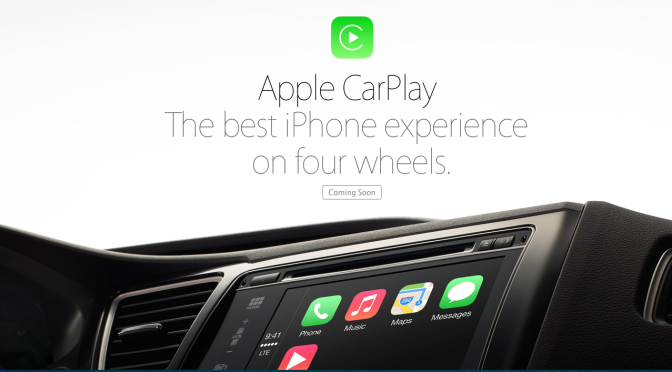
Announced at last year’s WWDC, Apple revealed today that CarPlay, the integrated iOS platform for in-dash entertainment and navigation will be shipping in 2014 models by Ferrari, Honda, Hyundai, Jaguar, Mercedes-Benz and Volvo. Notable in its absence was Tesla.
The ecosystem will limit apps to approved partners so it’s Siri for voice and Apple Maps for navigation. Music is open to 3rd party alternatives to iTunes with icons for Spotify, iHeartRadio and the newcomer Beats Music. Missing at today’s launch is Pandora.
While a touchscreen launches each app, Siri is now front and center as the main way to interface with each application. I’ve been using Siri to text short messages to my wife while driving and have been pleased with the results.
Automakers have largely failed to open up their APIs and create any sort of developer ecosystem around applications that interface with their cars. The Prius had a healthy hacking community but it was mostly fringe forum chats about hidden menus and easter eggs. People seem reluctant to brick their Teslas.
Will the app ecosystem play into which car you’ll buy next? We all wait for Apple’s entry into the battle for the living room but the opening shots in the battle for the dashboard have just been fired.
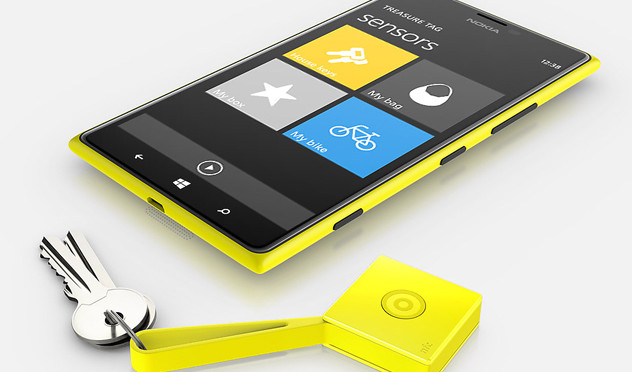
Nokia announced, the Treasure Tag, new hardware to go with their Lumia phones sporting the latest update. The tag is a small piece of hardware that communicates with the phone via bluetooth and an app on the phone that monitors proximity, alerting you when the device falls out of bluetooth range from your phone. Until you turn it off (which you can do via the app) the connection between the phone and a paired Treasure Tag is constantly monitored. Nokia says a battery can keep the Tag running for up to six months.
Each phone can support up to four Treasure Tags. The idea is that you attach a tag to something you want to have close-by. Keys, purse, whatever.
The Nokia Treasure Tag app description mentions that you can use, “Audio alerts to find a tag, or a tag to find your phone” but I’m not clear on how a phone can activate the audio on a tag or visa versa if either is out of bluetooth range.
Nokia Treasure Tag
What would be cool is if the Treasure Tag could broadcast GPS coordinates much like an iPad or iPhone can when you activate the Find My iPhone feature on iCloud. Unfortunately, such functionality would be cost & power prohibitive on such a small device that retails for $30. As a work around, the Treasure Tile can put a pin on a map and show you where it last had a connection with it’s phone. Useful if you misplaced an object but useless if someone’s walked off with your purse.
The Tile is taking a different approach. Instead of looking for a paired device, the Tile can pair with any device running the Tile app. For example, if someone’s walked off with your bag and ends up at a party where someone else is running the Tile app, their app will send time and location of that occurrence from their phone to yours via their phone’s GPS. This is, of course, useless again if the thief discovers the Tile and throws it in the trash but the approach is innovative in its crowdsourced approach. There needs to be a critical mass of people running the Tile app for it to be truly effective but one can imagine the Tile being able to tie into the iOS Beacon sensors in every iPhone & iPad as a quick way to get to scale.
The Tile is also different is a couple of other ways. There is no replaceable battery. A tile lasts for a year, then you replace it. It also features a, “where you last saw it” function that pushes a pin into a map so you can figure out where to begin your search. There is also an audio signal that you can activate to find a Tile that might be hidden under your sofa cushions or in your laundry. Finally, there is an on-screen feature on the app that gives an indicator when you are getting closer or further away from an item when you’re within 150-50 feet of the item.
I’m not sure which approach wins here. The goal is to sell a small accessory that you can attach to an object that lets you keep track of an locate it. Each has its own strengths but my gut tells me that form factor is pretty important. If the prime use case is attaching a sensor to your keys, wallet, (or, as my daughter said, television remote), size is pretty important. While the Tile wins on size, it’s unfortunate that you have to landfill the tag every year and would keep me from buying a set.
Cookie Consent
We use cookies to improve your experience on our site. By using our site, you consent to cookies.
Used to distinguish new sessions and visits. This cookie is set when the GA.js javascript library is loaded and there is no existing __utmb cookie. The cookie is updated every time data is sent to the Google Analytics server.
30 minutes after last activity
__utmc
Used only with old Urchin versions of Google Analytics and not with GA.js. Was used to distinguish between new sessions and visits at the end of a session.
End of session (browser)
__utmz
Contains information about the traffic source or campaign that directed user to the website. The cookie is set when the GA.js javascript is loaded and updated when data is sent to the Google Anaytics server
6 months after last activity
__utmv
Contains custom information set by the web developer via the _setCustomVar method in Google Analytics. This cookie is updated every time new data is sent to the Google Analytics server.
2 years after last activity
__utmx
Used to determine whether a user is included in an A / B or Multivariate test.
18 months
_ga
ID used to identify users
2 years
_gali
Used by Google Analytics to determine which links on a page are being clicked
30 seconds
_ga_
ID used to identify users
2 years
_gid
ID used to identify users for 24 hours after last activity
24 hours
_gat
Used to monitor number of Google Analytics server requests when using Google Tag Manager
1 minute
_gac_
Contains information related to marketing campaigns of the user. These are shared with Google AdWords / Google Ads when the Google Ads and Google Analytics accounts are linked together.
90 days
__utma
ID used to identify users and sessions
2 years after last activity
__utmt
Used to monitor number of Google Analytics server requests
10 minutes
You can find more information in our About Me and .