Category: Work

  • To Give and Not Receive

    To Give and Not Receive

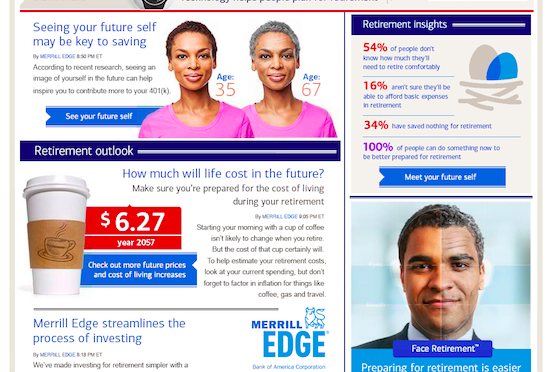
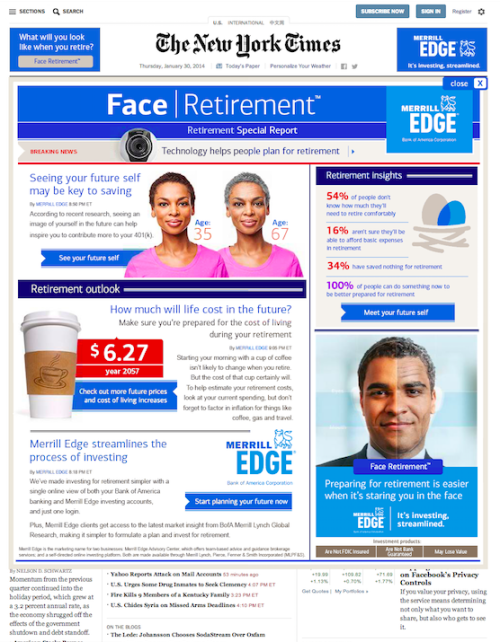
    This afternoon New York Times readers were assaulted by a full page takeover that unfolded across the front page effectively roadblocking the news of the day with a “special report” layout that was both interruptive and offensive. If this is where they are going with their native advertising, I do not like.

    All publishers need to make a buck and, as someone that works in online publishing, I encourage experimentation but the fact that an institution such as the New York Times would stoop to running such an amateur-looking infomercial hints of desperation. While the Face Retirement campaign is innovative (the landing page asks for access to your computer’s camera so it can take a photo of you and “age” you), there page curl takeover is as old as the hills and takes me back to the Dancing Mortgage Man remnant ads we used to joke about at Yahoo. These ads take more than they give.

    The add was frequency capped so it only ran once per unique visitor but the CPMs must have been pricey. But I can’t help but think that the hundreds of thousands spent by Bank of America to run this ad could have been better spent in other ways. Instead of invading your senses, wouldn’t both the audience, publisher, and advertiser have been better served by underwriting an open house for heavy users of the site? What about granting a free subscription to the paper for three months in return for some personal information that helps you better market your retirement planning services with glossy mailers? There are so many other ways that you can spend $250k, throwing up roadblock banners just seems lazy all around.

    https://twitter.com/ryangonnaryan/status/429047144377372672
    https://twitter.com/Steve_Katz/status/428994284050608128
  • this yor folt

    this yor folt

    The Reply Allpocalypse is something everyone who has ever been on a large email list (NYU, Columbia). It’s an amateur mistake but it starts out with someone send an email to the entire list but is then compounded when people on the list (the larger the initial list, the more chances they’ll be some jokers in there that don’t understand how email works) start to reply and, instead of replying to the sender, decided that everyone on the list needs to see their response.

    As the thread continues, everyone’s inbox starts to fill up with further replies of things like “unsubscribe” or “stop spamming me!!” that are also sent to the entire list. This can spiral out of control and bring a mail server to it’s knees and totally take out any mobile mail clients that are frantically trying to keep up.

    At some point, people begin to realize that the list is a way for anyone to push a message to everyone at the entire company so you get and “open mike” situation where everyone who has had anything to stay will jump on the bandwagon with their own one-liner they just had to share.

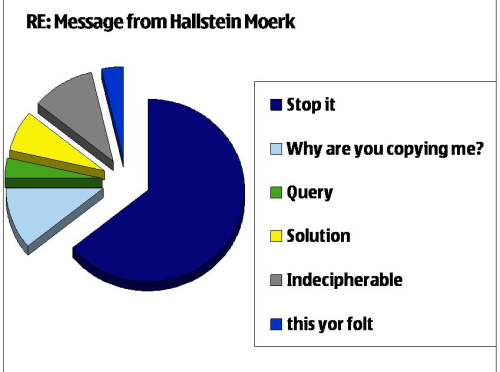
    The graphic above is from one such incident that happened while I was at Nokia. I don’t even remember the initial email but it was sent to a large list, could have been the entire company which I think is over 100k souls. As the Reply Alls started to pile on, everyone’s inbox was momentarily taken over and then someone helpfully decided to make an infographic of the type of responses that piled up.

    Most famously was the “this yor folt” which came from someone in one of the Central European offices. English was obviously not his first language but his one-liner kicked off a whole new thread of people who started a new thread to poke fun at his butchering of the language as a representation of the folks who kept hitting Reply All to vent and complain,  not realizing that they were actually compounding the problem.

    If you’re going to send out a mass email, the BCC is your friend.

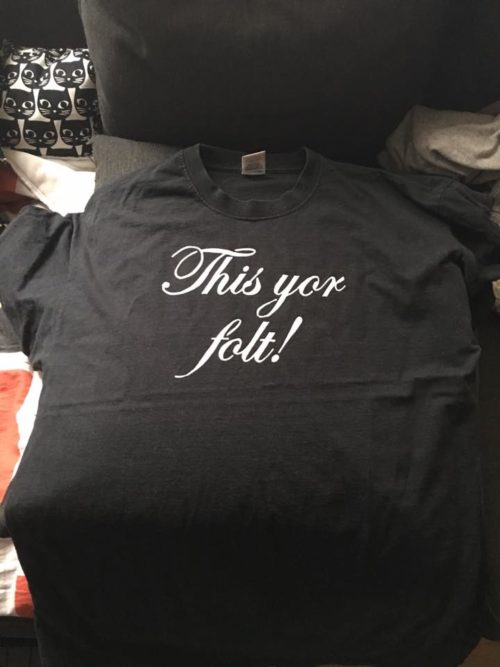
    Commemorative T-Shirts!
    and mugs too!
  • Blogs as Personal Aggregators

    Om blogged some thoughts after 12 years of blogging and came to the conclusion that one’s blog is one’s digital home. It is not only where you start new conversations, it should also be where you aggregate and archive the fruits of conversations you participate in out on various social web platforms.

    And while I embrace every new social platform with gusto, I find it frustrating that my point of view is spliced across various networks. I think the blog is the one that ties it all together — a central location where you fit together all the Lego pieces.

    – Om Malik on the role of blogs, In 12 years of blogging, the more things change, the more they stay the same

    Most blog platforms support widgets which can bring in streams of your updates from various services. It started with flickr, delicious, and last.fm but soon all the other social services joined in. Twitter widgets are the latest incarnation of the sidebar social widget which you can install today.

    Before Facebook arrived to suck out all the oxygen from social aggregator services there were a number of services, most famously FriendFeed, which would pull in all your updates from across the web on to one page. MyBlogLog was another.

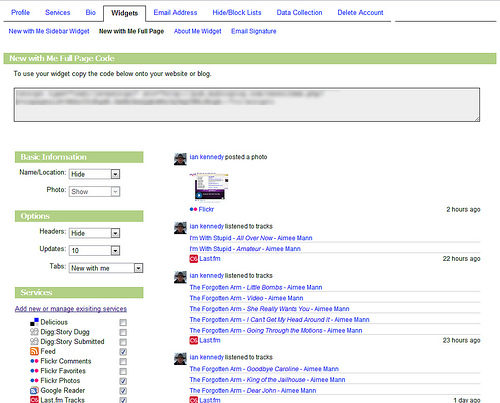
    While I was working with the MBL team we were hard at work pushing forward the aggregation feature but with one unique twist. While you could go to your MBL page and see anyone’s profile along with their newsfeed (we called it “New with you”), we also gave you the option to grab the javascript that let you run this widget on your site as a “full page widget”

    MyBlogLog full screen widget configuration page

    I have yet to see a suitable replacement for this code. I run a plugin called Social Stream on my site but it’s doesn’t quite do the trick. Efforts such as the Locker Project and it’s hosted cousin Singly seem to have lost momentum.

    The web is a collection of digital artifacts. Text, photos, sound files are by-products that are digitized and indexed. We use search engines to locate these artifacts but no one has built a way to tie all these artifacts back to their owner. Until you tie the collective digital artifacts of a person together in a unified way and follow it over time, you don’t really know that person.

    I’ve written about this before but the pendulum swings back and forth between the convenience of social networks on the one hand and the independence of owning your own domain/blog on the other.

    Which Network do I Use?

    • Instagram Direct vs. Snapchat
    • Facebook vs. Twitter
    • AIM or Yahoo Messenger or MSN Messenger

    Once the commoditization of the latest communication protocol has proliferated, the pressure to consolidate identities pushes the updates to a neutral platform which is always the blog.

    This is why I always maintain my own domain and host my own archives. Everwas.com is a digital representation of my life, my virtual self. I have posts about my marriage, my children, my career, observations on places I’ve lived – all other matter of stuff. It’s too important to put under another brand’s name, it’s too precious to be held ransom by anyone’s monetization strategy.

    Go ahead, play around with the latest social shiny thing but be sure to save the best for your blog. You’ll be thankful you did.

    Further reading:

    #indieweb

  • Reach out and touch someone on Instagram Direct

    Reach out and touch someone on Instagram Direct

    One line stood out on today’s announcement about Instagram Direct.

    Photos and videos that you receive from people you follow will appear immediately. If someone you’re not following sends you a photo or video on Instagram, it will go to your requests so you can decide if you want to view it.

    This is an open invitation for marketers to participate on Instagram in a more personal, direct way with Instagram users. Sure, the service is limited for you and I who can only send a direct message to up to 15 people at once but wouldn’t Instagram/Facebook open this up to the right partners to send to more people as targeted advertising? This is more subtle than the advertising program announced earlier this year. It’s an invitation to connect.

    Louis Vitton in Venice

    A couple of weeks ago I saw a full page Louis Vuitton advertisement in the New York Times with a QR code in the corner inviting me to install the LV app where I would gain access to exclusive content. It was the image in the advertisement that captured my attention and on a whim I installed the app which came bundled with links to behind the scenes footage from their Venice mini-site. It’s easy to imagine brands using Instagram Direct as an invitation to interact with a brand. What if the image above came via Instagram Direct with a discount code (not that LV would ever discount) and a link to the nearest LV shops?

    Brands are trying to evolve their marketing methods to match the way people communicate today. We’ve moved from a broadcast world which was well suited to mass marketing, a single, highly produced message designed for maximum distribution. Think Super Bowl ad. Facebook and Twitter are experimenting with Sponsored posts/tweets that brands use to segment their audience and customize messages for each segment. Even Google Ad Sense is experimenting with new ad units that are designed for sharing.

    Many view Instagram Direct as a copy of Snapchat’s point-to-point messaging feature but I think that misses the point. Instagram Direct messages are not ephemeral, they stick around . They are conversations hatched around an image. As you open and view images from brands, they enter into your social feed. Instagram Direct is an important step towards transforming your social feed into the likeness of a traditional magazine complete with large, glossy brand ads from companies that you have invited in to participate and an important way for Facebook to go after monetizing it’s increasingly mobile audience.

  • How I Started Blogging

    Blogger Con

    Dave Winer posted a call for co-remembrances of the BloggerCon conferences he held in 2003/2004 which got me thinking about how I started this blog and kicked off a series of events that brought me to California to work at a blogging company and catch a wave that I’ve been on ever since.

    I attended BloggerCon II in Boston in 2004 on a hunch. I was working at Dow Jones, publisher of The Wall Street Journal, for the Electronic Publishing division (only a newspaper company would have such a division) and was working with enterprise customers integrating news into corporate intranets. Most companies at that time were using large portal software packages such as Plumtree or Microsoft Sharepoint to drive their portals so blogs for corporations were very much under the radar. At the time, I was a regular reader of John Battelle’s Searchblog and Joi Ito and was playing around with Blogger so I could see the promise. My gut told me that the blogger community was something worth investigating.

    When I got to Cambridge, where BloggerCon was held, I immediately knew that I was in the right place. The unconference format was very natural to me and the sharing openness of the attendees was a welcome change from the competitive world of enterprise software.  Each session included an IRC chat and seeing the IRC scrolling on the screen behind the speakers was a philosophical shift that echoed the shift of the conversation from the publisher to the community that was taking root with blogging. I think their was some kind of streaming audio for remote viewers as well. I recall someone typed something into the IRC that made the entire room erupt in laughter,  that person then typed “Cool, I just made the room laugh.” It was a powerful learning moment for me, to listen and include your audience. It was a pre-cursor to what we see today when the twitter/hashtag feed serves as a back-channel commentary to the podium. The community could drive the agenda. This was in 2004, before the Kryptonite/Bic Pen video and all the other Social Media fails that were to follow.

    I had been pretty much all alone in corporate-ville trying to explain the power of this new self-publishing platform but most of my talk was falling on deaf or pretentious ears. Meeting others at BloggerCon helped me put more eloquent words to what I was trying to say and emboldened me to spin up a few initiatives of my own.

    I was a always struggling with the best way to get the word out to our more developer-minded customers. All communications were filtered through the Marketing and PR departments where things I wrote were watered down and stupefied to the point where they didn’t make sense. We sometimes had outages and by the time my post-mortem communications were approved and made it to the customer, it was too late and only served to remind them of something they had already forgotten about.

    I launched a product blog for my product and gave the address to a small group of customers that I knew would appreciate it. On that blog I would give them a head’s up on new features and asked customers questions about future product direction. They left thoughtful comments and the knowledge shared in the commentary helped everyone who read them. It was a lightweight community, an alternative to more formal “focus groups” which cost a lot to set up and required people to travel in order to participate.

    I was nervous because I was going around the Marketing Department so after a couple of weeks I mentioned to the VP of Marketing what I was up to and his response was, “Don’t tell me anything more. I don’t want to know what you’re doing but keep doing it.” From that day on the die was cast and I was off and running. Within a year, convinced of the power of this form of communication, thanks to an introduction from my sister, I had a long, animated conversation with Anil Dash who had already moved to California to work at Six Apart, an early blog software pioneer. Within a few months I joined my sister, Anil, Andrew Anker and others as the company geared up to launch Six Apart’s hosted blogging platform, TypePad.

    The rest is history. Since BloggerCon, my career has always leveraged lessons that were put into motion that weekend in Cambridge. Every job I have held since has involved an appreciation of the social media community that started at BloggerCon. Thank you Dave for giving a home to the early pioneers and setting me on a path that I am still blazing down today. It’s been a glorious ride.

  • Google’s Android Dream

    Google’s Android Dream

    Wired’s man on the ground at Google, Steven Levy, has an in-depth look at the turnaround story of the Motorola Mobility team purchased by Google for $12.5 billion two years ago and how they produced a phone which, on the eve on iPhone’s expected upgrade in September, is currently the talk of the Valley. As far as specs, it’s not running the latest and greatest but that’s just fine as the target audience is not the high end gadget freak, they are elevating the bar so that the masses can experience the fully integrated Google vision.

    But the defining feature of the Moto X is it’s a virtual ear, always straining to hear its owner’s voice say three magic words that will rouse it to action: “Okay, Google Now.”

    Here is a phone that is always waiting, ready to spring into action even faster than Apple’s Siri. Sure it’s always listening to you but in return you get a phone that can predict your needs with Google Now-enabled prescience. All that stuff that we technologists all dream of but ultimately fail at because of competing standards, incompatible platforms, and flaky APIs are now possible because Google owns not only stress-tested services in the cloud but also the end device.

    • an instant signal when you walk in a restaurant that starts a stream menus and reviews
    • warn you to end a meeting because it knows that traffic is so snarled, you might not make your next one in time
    • Only fools don’t protect their phones with a password, but it’s a pain in the neck to punch it in a few hundred times a day. Motorola plans to ease that pain (though not available at launch) by selling plastic tokens that can clip onto clothing—if the tab is within a few feet if the Moto X, no password necessary. (The tokens use NFC technology, built into the phones.) The Moto X will also let you set up password-free “safe zones” like your car.

    These are just a few examples quoted in Levy’s piece. A few more were discovered by my colleague who is testing out a demo unit,

    • the phone uses its GPS to determine when you might be behind the wheel of a car. Assuming that you are, this function can read aloud incoming text messages automatically. It can also send an auto-reply in this situation.
    • Meeting mode works off of your Calendar events. When the phone sees you’re in a meeting, it can automatically silence the handset. You can allow Meeting mode to ring the phone or auto-text replies to favorite contacts or if anyone calls twice in a five-minute period.
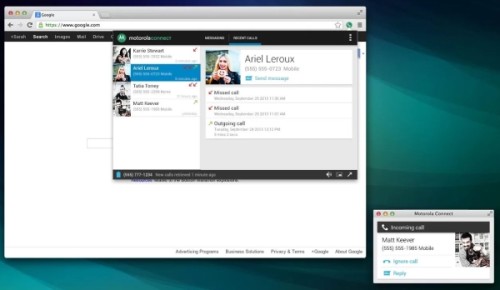
    • You link your phone and your Chrome browser through an extension so you can get caller or text information when on your computer. No need to pick up your phone for that data and you can also choose not to pick up the phone if you don’t want to take the call. You can also reply to text messages from your computer browser.
  • Ten Types of Facebook Likes

    Ten Types of Facebook Likes

    The Facebook “like” is a simple social action loaded with meaning. The act of Liking something online while sitting alone at the kitchen table in your boxers is, on the face of it, a solipsistic act, but it’s really much more complex. One click on that link causes a complex web of behaviors that ripple outwards across your social graph. By Liking something you are not only pushing a social signal to the author of the post, you are also signaling to all others that view the post that follow.

    Social signals are often misunderstood online so it’s important to remember that a Like is not always just a Like. It could be any one of the following types of Likes.

    I Saw It Like – this is the most basic type of Like. You want to let the author know that you saw their 49 photos of their trip to Costa Brava and therefore do not need to be reminded when you see them next. A simple click here allows you to cut off the conversation with a quick, “Oh yes, I saw them,” so you can move on.

    Pile On Like – we all tend to swarm around causes. The Pile On adds your name to a long list of people as a way to add weight to someone’s mission. A friend posts how she was indignantly treated by the pizza delivery guy. Quel dommage! This is the perfect opportunity to add your name the pile. Satisfyingly non-commital. We feel your pain.

    Like To Remember – we live in a busy world and our newsfeeds are always in motion. How to remember that clever t-shirt folding video that you saw? With this type of Like, it’s more because you want to retrieve it later, not really because you “liked” it. It’s a one-click ReadItLater link.

    Lazy Like – this is another common type of Like. Writing something witty, especially when you’re late to the game and the one snappy comeback you had ready was hidden under the View More link – your wrung out but still want to contribute – it’s late, you’re lazy – Like.

    Shine a Light Like – it doesn’t happen too often but every now and then something drifts across your feed that you just know no one else will see unless you breath some social air onto it by clicking Like. Maybe it’s that brilliant one-liner from your long lost surfer buddy from Chiba who usually only writes in Japanese. You want your friends to know him and his brilliance. You could Share but that feels like robbing him of something so you click Like.

    Ironic Like – sometimes something is so awful that a Like is in order as the online equivalent of the Hardy Har Har. Someone listening to Katy Perry’s Firework Death Metal overdub? Like.

    Like My Shit Like – God Dammit! I was so excited when I finished work on a animated mockumentary takedown of Sean Parker’s Redwood Wedding that I posted it at 3am as soon as it was done. Everyone was asleep so they missed it and now some big sports event is going off so all the conversation has pushed your video even further down somewhere below the copyright notices. It’s a last resort and a real noob move but you’re clicking Like on your own stuff just to put it back into rotation.

    Condolences Like – while most times Facebook seems like a Happiness Competition, sometimes sad things happen and people post about them. Everyone knows you don’t “like” the fact that someone lost their job or didn’t get into their top choice school but you are sending good vibes and “I’m thinking of you’s” their way. That’s a Condolences Like, not to be confused with a . . .

    Mercy Like – remember that loud PR girl you met in Austin that was discovering social media for the first time? She was so into you and was so grateful for all the tips and tricks you were sharing with her. She took out a little notebook and wrote down a bunch of URLs that you told her and she went home and got that dream promotion she told you about. She’s so grateful, a kid who just got the hang of her bike without training wheels. It’s such an *interesting* world out there! Did you know Samsung paid off their settlement to Apple with 30 trucks of nickels? Even though you know it’s not true, it’s easier just to click Like. Go get ’em kid!

    Absence of Like – what does it mean? You know someone saw your post but they didn’t like it when you specifically shared it because you knew they would like it. . .but they didn’t. Existential Cognitive Dissonance.

    Thanks to Adam Kazwell for sparking the conversation over lunch and all the folks on the Dev team at GigaOM for the extended exploration of Katy Perry overdubs during a lull in the action.
  • Unintended use for Microsoft Kinect

    Unintended use for Microsoft Kinect

    I ran across this interesting use for Microsoft Kinect by an MIT Researcher who was featured in the latest issue of The Red Bulletin, a print sports lifestyle magazine that magically shows up on my doorstep every month. The article (I cannot link to it because I cannot find it online), which profiles urban planner Carlo Ratti, had this description of an upcoming urban hack he’s releasing in Madrid, Spain.

    Spanish cities have what they call puntos limpios, collection points where you can drop off bulky waste like old sofas or a washing machine. We have converted a Microsoft Kinect sensor, which is usually used to operate a game console, to scan this waste. Then the system automatically tweets: “I’m a couch. Come get me!” This allows other city residents to see what is being thrown away, and they can save it from the dump. In this way, everyone is better off – it’s free furniture, the waste management company saves on costs, the local authorities promote cohesion in the community. The waste disposal service we are working with wants to try it in Madrid.

    – The Future of Our Cities, The Red Bulletin, July 2013

    Wall-E

    If you live in the US, there’s Freecycle – a Yahoo Groups community split up into local chapters that is similar. It’s usually the quickest way to clear out your garage. Go online and list something you want to give away for free and, usually within hours, someone will reply and take it off your hands. Carlo Ratti has managed to automate the listing part of it.

  • Patently Ridiculous

    I had a listen to the second part to This American Life’s excellent two part series on patent trolls (the first part is here) and how the use of weaponized software patents is squashing innovation.

    The podcast outlined the plight of entrepreneurs too afraid to start business for fears of being sued out of existence by shell companies that own broadly defined patents for no other purpose than to shake down founders too cash strapped to defend themselves. While listening, I recalled an episode that took place while at Yahoo where we were the victim of exactly this type of attack. Here’s how it went down.

    It was late-2007 when Todd Sampson, the co-founder of MyBlogLog, the small social network acquired by Yahoo earlier that year, contacted me to tell me that we (Todd and I worked together at MBL while I was at Yahoo) had been contacted by a small company in Israel called Girafa notifying us that the screenshots used on the site were in violation of a patent owned by Girafa.

    It was a classic shakedown. Girafa explained that they were preparing a lawsuit in the amount of $5 million but there was an out. We could avoid litigation if we licensed their software. The price? $5 million.

    MyBlogLog thumbnails

    You can imagine our surprise. Todd has tied together a couple of open-sourced software packages to create a screenshot process that ran on an old PC that literally sat under one of the engineer’s desks. The software was a bit temperamental and would sometimes fall over. We would get complaints for users that their website needed a refreshed screenshot which was our queue to go over and restart the screenshotter machine. It happened enough times to be a minor pain in the neck so we were open to licensed software or web service that was a bit more stable but $5 million was certainly more than we were willing to pay.

    Yahoo legal was on the case and they told us that not only MyBlogLog but also delicious and Yahoo Bookmarks were named in the suit along with Alexa (part of Amazon) as well as a few other companies were also part of the suit. All during the course of the lawsuit, we had to have several meetings with the legal team at Yahoo (who were great) but also had to keep copies of all our correspondence and take care when we eventually moved the machine to a Yahoo data center to ensure the screenshot software was not integrated with any other parts of the Yahoo infrastructure to ensure that other divisions in Yahoo couldn’t get ensnared in the lawsuit. At some point Todd had to give a deposition and he even spent an afternoon over at the Internet Archive looking through the Wayback Machine archives to locate old screenshots from HotWired which we remembered used to take screenshots of sites back in late-90’s.

    I left Yahoo before I heard what happened so, after listening to the This American Life podcast, I poked around to find out the rest of the story.

    I am not a lawyer but from what I can tell, the lawsuit was initially thrown out in late-2008 but documents and paperwork continued to be filed (in hopes of continuing the suit?) all the way into late 2010. The Girafa nonsense tied up the courts for a solid three years. Think of the untold wasted hours!

    In June of 2011, Google swooped in and purchased Girafa’s patents, supposedly as insurance against any action against Google’s use of thumbnails in their instant preview search results feature. Let’s hope the Girafa patent will stay dormant where it is and not be unleashed again by its new owners to cause a new round of havoc and hand-wringing.

    If you go to girafa.com there’s a sad notice that the service has been discontinued. A sad final chapter for a service that caused nothing but pain and consternation.