Category: Work

  • Steve Jobs, Master of Delivery

    Watching Steve Jobs introduce new technology is a wonder to behold. He doesn’t bash you over the head with hyperbole nor run circles around you with facts and figures. Instead he walks on stage in jeans and sneakers and pulls something out of his pocket like a wandering hiker might pull out a beautiful stone to share with friends around a campfire. He’s a seeker that’s come back from a journey with something wonderful to show us, he excites us to think of what’s possible and how we might join him on his journey of discovery.

    Look at how he introduces the first iPod. We may laugh when we see the goofy fonts and hear about the 5 GB capacity but to hear how he casts his spell over the crowd gathered in what looks like a local high school auditorium is no different to how Steve has always delivered his latest innovation.

    Flash forward to 2005 and we see him introduce the iPod Nano with what has to be my favorite Steve Jobs unveil, “Ever wonder what this pocket is for?”

    Steve Jobs had a style that was all his own and I’ll miss him. The internet is awash with a collective group hug at the news of his resignation as we all reflect on the departure of a man who helped define why we enjoy tech. Here’s a sample of some of the best recollections (and one future prediction) I’ve had the chance to read:

    And then there are Steve and Apple: a leader and a company not afraid to take the long view, patiently building the way to the future envisioned for the company. Not afraid to invent the future and to be wrong. And almost always willing to do one small thing — cannibalize itself. Under Steve, Apple was happy to see the iPhone kill the iPod and iPad kill the MacBook. He understands that you don’t walk into the future by looking back. – Om Malik, Steve Jobs and the sound of silence

    The company is a fractal design. Simplicity, elegance, beauty, cleverness, humility. Directness. Truth. Zoom out enough and you can see that the same things that define Apple’s products apply to Apple as a whole. The company itself is Apple-like. The same thought, care, and painstaking attention to detail that Steve Jobs brought to questions like “How should a computer work?”, “How should a phone work?”, “How should we buy music and apps in the digital age?” he also brought to the most important question: “How should a company that creates such things function?” Jobs’s greatest creation isn’t any Apple product. It is Apple itself. – John Gruber, Resigned

    So, who is this man? He’s the anchor baby of an activist Arab muslim who came to the U.S. on a student visa and had a child out of wedlock. He’s a non-Christian, arugula-eating, drug-using follower of unabashedly old-fashioned liberal teachings from the hippies and folk music stars of the 60s. And he believes in science, in things that science can demonstrate like climate change and Pi having a value more specific than “3”, and in extending responsible benefits to his employees while encouraging his company to lead by being environmentally responsible. – Anil Dash, What they’re “protecting” us from

    It was at the iMac launch where he was showing off the modern line that is on my desk today “look at the metal on the back, isn’t it beautiful?” he told me. It was. But all the other CEOs didn’t care about the back of their products. They cared, instead, about shaving cost from them instead. – Robert Scoble, A front row seat to Steve Jobs’ carreer

    We know there is such a plan — there has to be, Apple’s moves have been too deliberate, if inscrutable, to be some executive random walk.  But nobody near the top has ever tried to explain where the company is going, preferring to be mysterious instead.  Bill Gates had Nathan Myhrvold write his book for him, but Steve is classier than Bill. I believe Walter Isaacson’s book will also function as Steve’s technology manifesto, part of his legacy. Once we have the grand plan, then it may make more sense just who should lead that plan’s execution during what will clearly be Apple’s best quarter in its 34 year history.  Steve Jobs is setting-up this (and us) for another grand reveal… just one more thing. – Bob Cringely, Cupertino Two-Step

    UPDATE:

    I had to include this photo I took at the iPhone launch event. Note the look of wonder and open-mouthed awe.

  • New Job, Two Weeks In

    A friend from Finland asked how things were going at the new job which nudged me to put some thoughts down. Here are some highlights from the past two weeks,

    • was introduced to everyone via a broadcast message to everyone in the office as, “the guy who helped get the MSFT/Nokia deal done.”
    • made my first edit on pro.gigaom.com, albeit an FAQ page.
    • manned the live, on site chat for a few hours where I was promptly asked “how can I build a life-sized Optimus Prime out of Lego?” I suspect one of my new colleagues.
    • met Om Malik who approved of my sense of humor.
    • was met with stunned silence when I asked if someone could, “provision” my new work laptop – everyone sharpens their own knives here.
    • after reading snarky comment about a low-res version photo of contributor, contacted them in New Zealand on Skype, was given a new image, cropped and uploaded the same and fixed the issue, all in less than 5 minutes.
    • drove to Napa to attend VIP party for WordPress customers. Met Matt Mullenweg and his fine crew to enjoy wine, sunset, and the future of publishing.

    If you’re wondering where I work, here’s a short video describing the service. I work with the dev team pulling levers and twirling knobs to keep things running smoothly.

  • Back to Base

    Back to Base

    Today is my last day at Nokia. The great mobile adventure is over. More accurately, the need to define a mobile web as something other than the internet at large has mostly vanished.

    I left Yahoo for Nokia with a vision of building services to connect the social web to phones that knew more about you and the world around you than a desktop PC could ever hope to know. I built a few prototypes and white-boarded many more. The potential is rich and the rush of apps and services that are “location aware” is only the beginning of what we will see in the years to come. In many ways it feels like 1995 all over again and we’re all re-discovering developing for the web browser. All that’s missing is a “View Source” to bring in the masses.

    It’s been an amazing experience highlighted by a two year assignment to Helsinki which gave me, my wife, two kids, and our little dog Mimi an experience of a lifetime. Nokia is a global brand and the multitude of languages and cultures that you bump into day-to-day in the hallways and canteen is mind-boggling. Helsinki is a global hub with many families moving in and out of Finland exposing us to a broad group of people from all over who became our friends. We hope to continue to keep in touch with as they move around the world. My Finnish colleagues too were gracious in taking in this relatively bombastic Californian, tolerating my bubbly “Good Morning!” greetings and gently instructing me in gentler, more subtle methods of salutation.

    But now we’re back in California. While the new Nokia offices in Sunnyvale are beautiful, the commute is not. While I learned heaps from Nokia about the mobile phone business, particulars in mobile UI (design for the one-handed strap-hanger in Bangalore), as well as unique aspects of localization (make room for long German place names, right-to-left Arabic script, and currencies in Europe use a comma, not a decimal), the excitement for me is further up the stack with the applications.

    I’ll take a few days off then start anew at GigaOm on Monday where I have accepted their invitation to be Product Manager of their premium subscription product, pro.gigaom.com. In many ways this is a return to my roots when I was a PM for Factiva.com – another premium news subscription service. Coming full circle from a time when content was screaming to be free, we are entering an age of content factories where well-edited media and curated content will be something worth paying for. Anyone can sit and read everything coming through on ReadWriteWeb, TechCrunch, and yes, GigaOm and branch out to regional tech sites such as Arctic Startup and Asiajin that do an excellent job of covering their region but who has the time to read it all? Algorithms are getting better (check out Summify) but social networks that mix up family, friends, and professional contacts are getting muddy as filters and we all run the risk of building filter bubbles around ourselves.

    There is a market for summaries and curation and I want to build a platform that enables that. The internet has made infinite distribution available at little to no cost. The challenge (and opportunity) is for publishers to maximize revenues by offering ever greater premium upsells to their True Fans on a steep value curve so that everyone wins. The folks I’ve met at GigaOm totally get this and I’m psyched to get cracking on building out  features to meet the demand. This is going to be fun!

  • Excellence In Advertising

    I was asked the other day to name my favorite advertisement. In terms of effective engagement, I think branded apps are the best combination of free-to-the-consumer utility and on-going engagement for the brand. I recently downloaded an app to help me find the closest Chevron gas station because my dealer said that their special gasoline is best for my car. It’s a single purpose app (shows you the nearest Chevron based on your phone’s location) but Chevron took to the time to add information about the gasoline and also insert a feed of online coupons that can be redeemed at their gas station.

    While I was a Yahoo, I kept a running feed of links pointing to clever advertising campaigns and used those as case studies when speaking with advertisers and agencies that were always coming to Yahoo for advice and collaboration. Today I ran across this clever idea using your mobile phone to control a giant game of Pong! on a billboard in Sweden. What is unique is that it uses your phone’s web browser to find your physical location and as long as it determined that you were in the proximity of the billboard, it would let you enter a code to on the web browser to control the game.

    No app. No downloads.

    Engagement is measured by those that click through to the coupon screen where they get a free drink or snack at the local McDonalds. It’s not clear from the video if this coupon was just on your browser’s screen or if it get’s sent to you via SMS or email. If it’s the latter, then not only are they able to measure conversions, they are also capturing phone or email addresses for future campaigns.

    Oh, if you want to browse the archive of other clever advertising campaigns of note, I have a list on my Pinboard link feed.

  • MyBlogLog → OneTrueFan

    MyBlogLog → OneTrueFan

    Remember those subscriber cards you found tucked into magazines that asked questions about your income, education, sports you liked, where you traveled or what newspapers you read? The editors and advertisers of that magazine were trying to find out more about their readers. Except for the folks that took the time to write in, an editor of a print magazine knew very little about the people who read their magazine.

    Imagine if Henry Luce had access to a tool which could give him an insight to the readers of Time Magazine? What if he knew not only who was reading his magazine but also which particular articles were hitting a chord? Not only that, what if he knew what else they were reading in other magazines? Which articles did his most faithful readers found elsewhere that his reporters did not cover? This type of data would have been pure gold to the late Mr. Luce.

    Click for full screen image

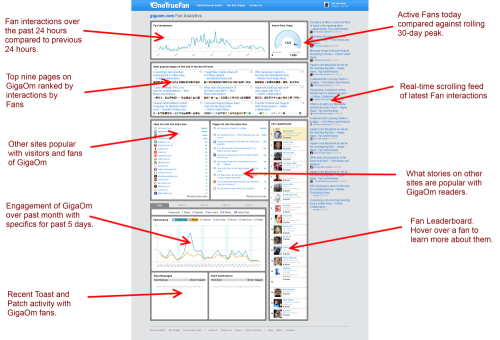
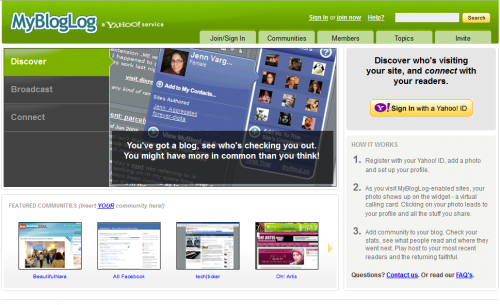
    MyBlogLog had some of this data but it was site-specific and the service has been since scuttled by Yahoo.  The team has re-grouped and pulled another rabbit out of their hat launching Live Fan Analytics (aka: Fan-alytics) as a new approach to site metrics. MyBlogLog required site owners to install a widget on their site to reveal users that have opted in to showing up on the MyBlogLog sidebar. OneTrueFan spins that approach around and asks the readers to add an extension to their browser in order to send back their browsing behavior on any site for aggregation and show a bit of extra love for the sites they frequent.

    What’s in it for the Fans? Browse the web and have at your disposal an instant view of the last 10 fans who visited the site and articles on that site that have been shared by those readers. Also look at the top fans who visit the site the most often and see what they have shared on the site. As you browse, your history (minus any sites you choose to exclude), is fed into the OneTrueFan “panel” that helps site owners and other OTF users find interesting content. It’s like being a Nielsen family for the modern age. But there’s a bit of fun too as you’ll find yourself on the leaderboard for your favorite sites vying for the title of the OneTrueFan of that site.

    What’s in it for the site owners? Real-time reading behavior. If you install the widget, (as I do on this site) the activity of your readers is aggregated from not only browsers hitting your site but also sharing activity on social sites such as twitter and facebook. You get a more complete view of how your content is shared beyond your site and a sample of what your most avid readers like to read, in real-time.

    If your site is publishing multiple stories a day and, as editor you are always looking for the next trending story to cover, the OneTrueFan analytics dashboard is an invaluable tool to help drive your daily editorial calendar. Most blog packages allow you to “pin” a story to the top, above the fold. The dashboard will quickly tell you which ones to push to the top and which ones to let slide down on the scroll.

    As social sites begin to drive a greater portion of traffic to your site, it is vital to understand which topics resonate with your readers enough to drive them to share via these networks. OneTrueFan gives you not only quantitative stats but also the qualitative insights that you can only get from browsing the names, faces, and twitter & facebook profiles of your most avid readers. Author Kevin Kelly has a theory that any business is sustainable provided it knows how to take care of it’s most avid fans. He calls it the “1,000 True Fans” rule. OneTrueFan is a tool that will help you cultivate your true fans.

  • MyBlogLog Memorial Screenshot Gallery

    MyBlogLog Memorial Screenshot Gallery

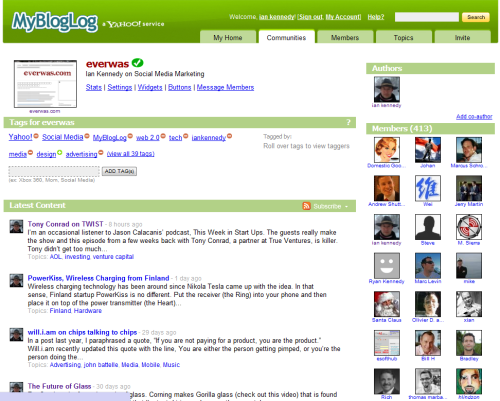
    A couple of weeks ago I grabbed a bunch of screenshots off of MyBlogLog.com. MBL is one of the services on the infamous “sunset” slide and today there is a notice on the site saying that Yahoo will pull the plug on the service on May 24th. I worked on the service before coming to Nokia and much of what I know about Activity Streams and Context Filters is informed by the work done by the excellent team there.

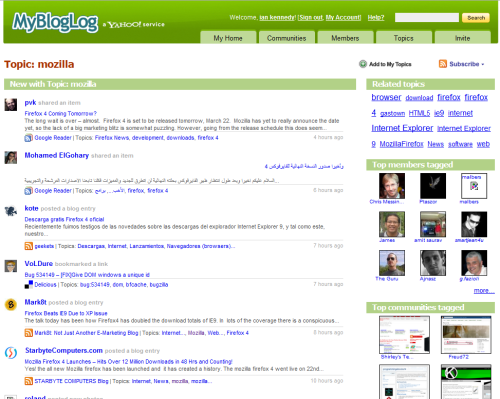
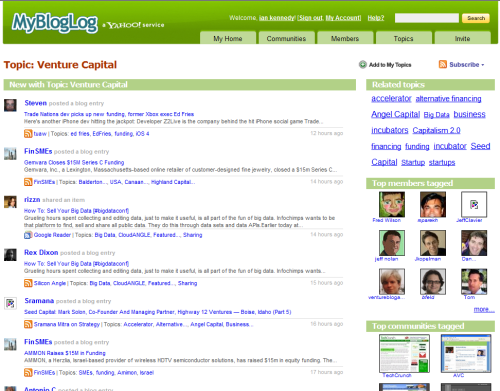
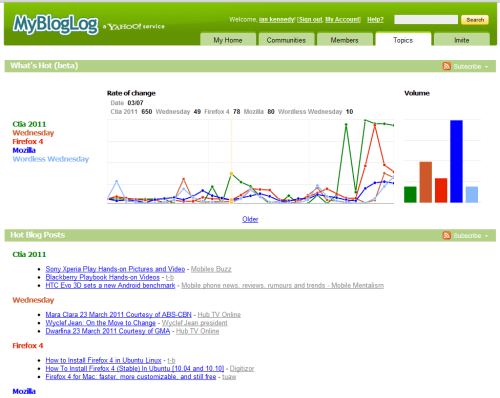
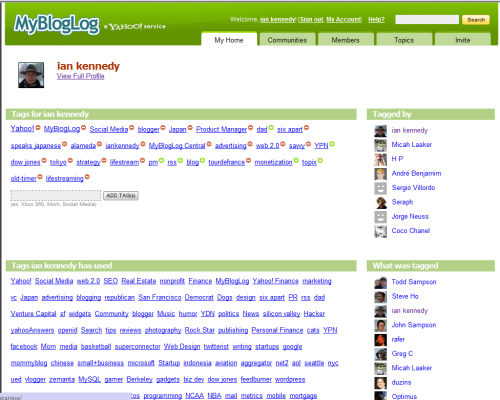
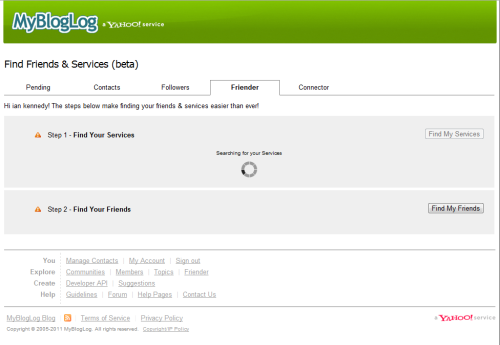
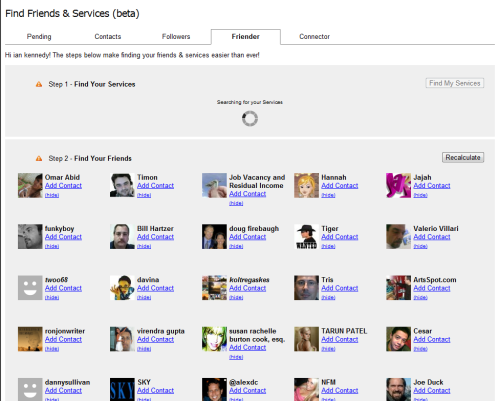
    The gallery below is mostly for my personal notes but I figured I’d share it as a walk down memory lane. I’ve annotated the screenshots to explain what’s going on for future reference.

    The core of MyBlogLog was its sidebar widget that you could put on your site. When a registered user visited the site, their profile photo would show up in the widget. As you visited different sites, you’d start to see familiar faces on sites that you shared an interest making the web a much smaller, more personal, place.

    MyBlogLog users would add their RSS and social network feeds to their profile and we would pull the tags off of each post and gather them together into profiles that would also feature a “tag cloud” of related topics, a list of bloggers and blogs that posted about the topic most often. We also experimented with ways to visualize which tags were trending across everything we were seeing.

    The end result of gathering all this data was a data rich profile page that gave us the idea for the tagline, You are what you Feed. On the profile, which was public, you could see all your social network activity gathered together in several newsfeeds.

    New with Me was all your own activity, New in My Neighborhood was an aggregation of all your friends and New in My World was an aggregation of the collective posts from the entire MyBlogLog network filtered by tags that were trending in your latest posts.

    Going to other people’s pages and seeing what was New in their Neighborhood or their World was a great way to “look over the shoulder” of people you followed to see what they were reading.

    Other elements on the profile included a list of my connections on MyBlogLog, links to my blogs and social network profiles, and blogs I visited frequently.

    We played around with the profile quite a bit and built out a page for your blog and your profile which allowed any MyBlogLog user to attach and vote on free form tags as a user-generated “folksonomy” that was all the rage back then.

    There was surprisingly little problem with spam or harassment. The web was a kinder/gentler place back then. These tags were used to build a WordPress plugin which would dynamically suggest content on a site related to your interests. For example, if Harley Davidson motorcycles was a stated interest of yours on the profile page, posts tagged with Harley Davidson would show up in the widget when you visited a site. We called it Just for You.

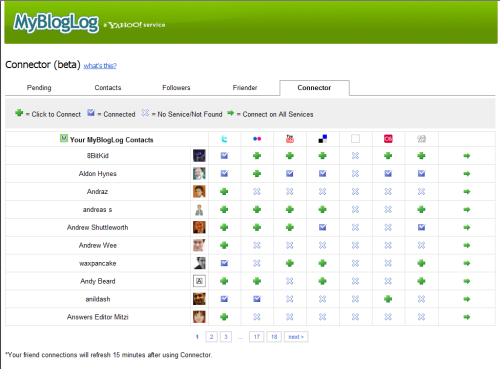
    One of the cooler things we built (and only possible when these services were more open) was the Friend Finder. If you added all your social network IDs it would then you the social graph of the service to look up your friends across services. For example, if you and Bob Jones both added all your social network IDs, it would show where you were connected and invite you to connect on other services where you were not.

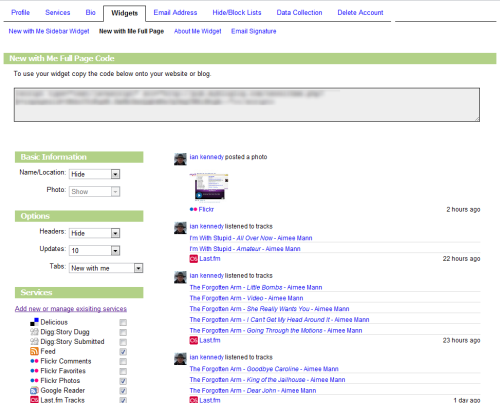
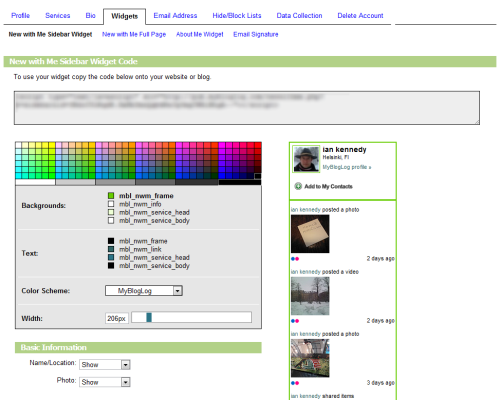
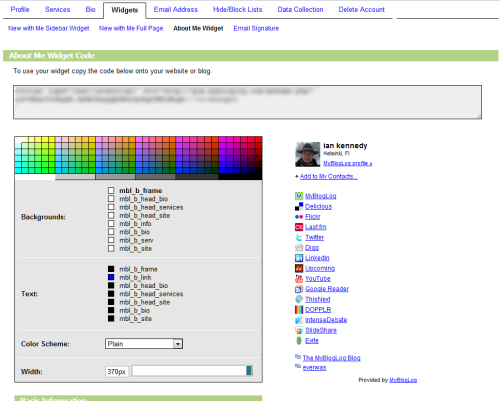
    We also fully embraced the distributed web with sidebar and full-page widgets which you could embed on your site to display portions of your MyBlogLog profile that you might want to share on your site.

    As a Yahoo acquisition, we had to convert all our users to use the YahooID which took a lot of time an effort. We did get to feature our API on the Yahoo Developer Network, build a retro 404 page, and have a little fun with the opt-out page.

    Tired of twirling in stasis while Yahoo re-org’d itself, the team disbanded to go their different ways with me getting lured to Finland by Nokia and the others kicking around on their own projects (Gnip, Zentact, The DJ List to name a few).

    The team has now come back together on OneTrueFan, a browser plug-in that is similar to MyBlogLog but turned inside-out. Instead of tracking who visits your site and leaving a trail of avatars in sidebars across the web, OTF tracks which sites you visit and collects other peoples’ avatars into your browser bottom-bar so you can see who else has been to the sites you visit. I owe the guys a post on my thoughts but in the time being, check out Louis Gray’s write-up.

  • It’s not that bad

    The inevitable layoffs announced today at Nokia (where I work) were not as bad as expected. The trick of how to keep the Symbian development teams churning away when you’ve already announced that you’ll be ramping it down was solved by shifting a block of 3,000 employees over to Accenture where they can continue to work or re-deploy their talents on to other Accenture projects.

    Nokia CEO Stephen Elop did an great job on Finnish TV this evening easing worries, popping conspiracy theory bubbles, and boosting confidence. The entire 20-minute interview is on the YLE site. YLE is the state-funded broadcast network, similar to Japan’s NHK or the BBC in the UK.

    Addressing dead on the nagging concern Symbian engineers had about future employment is a brilliant tactical move. This takes the wind out of Finnish employees and press who were bracing for bad news or worse, something suspiciously too optimistic. This keeps the teams’ eye on the ball which is to ship 150 million devices, not look for work elsewhere.

    Finns love to rally around stories of the bleakness and unfairness of life. This is something Jim Jarmusch nailed in his 1991 movie Night on Earth clipped below. I encourage you to watch both parts if you want to get an insight into Finnish culture.

    Back in 1997, when Apple was $4 a share, the CEO at the time, Gil Amelio, left journalists unsatisfied with his half-answers to their burning questions.  It took Apple years to find it’s way again and only then, with the return of their iconic co-founder. Hopefully Mr. Elop’s transparency and directness will shortcut the process for Nokia’s return.

  • Media Distillery

    Media Distillery

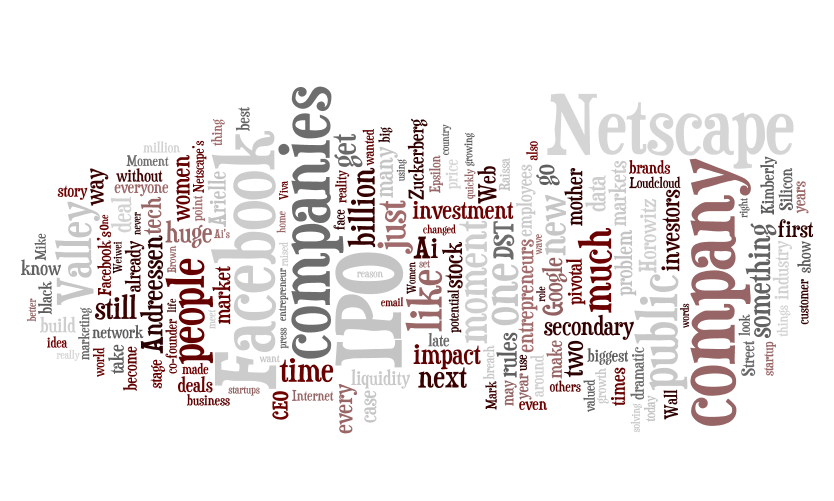
    Fooling around with wordle.net here is what I get when I post the entire text of the top four articles referenced by three leading social, news aggregators.

    • http://paper.li/iankennedy
    • http://www.linkedin.com/today/
    • http://summify.com/iankennedy/

    The top four articles, which got top billing across all three services, were:

    A quick glance at the wordle tag cloud analysis and it looks like wordle favored the lengthy Sarah Lacy piece on Facebook/Netscape. A longer piece means more words which would explain why Facebook, IPO, and Netscape are so big in word cloud.

    Is such a view useful? Is there some way to improve this?

  • The Modern Media Stack

    All eyes are on SB Nation who will play host to a new gadget site powered by eight staffers hired away from Engadget over at AOL. Former Engadget editor, Joshua Topolsky, describes being attracted to SB Nation’s vision which is equal part passionate writing (no one ever reads an “objective” sports column) and sophisticated real-time technology.

    Our platform is a modern media stack focused on empowering rapid publishing, effective distribution and quality community in equal parts. – SB Nation describing their Media platform

    The way SB Nation has evolved from a focus on fan-specific blog communities (which only engage on the colloquial level) aggregated up to the national level so that fans get the right mix between news about their favorite teams up to news about their favorite sports, on up to news important to sports fans everywhere describes, in general, the problems national media sites are facing today as they try and find that perfect balance between local, national, and international news.

    It sounds like SB Nation has something akin to a “media carburetor” that can be tuned to find the perfect mix between local and global to provide the explosive engagement needed to drive growth today.

    Topolsky is betting that the same secret sauce that powers finding the perfect mix for sports fans may also work for Gadget News. If he’s right, perhaps this same formula can be applied to other verticals as well – fashion, celebrity news, music, gamer news, financial news, on down the line. Any vertical who’s community can generate a strong enough signal at the “local” level should be able to feed into the model.

    Further Coverage