Year: 2006

  • Happy Friday – Good Reading

    I’ve been busy so have fallen behind on my reading. Scanning through some older posts in my reader I ran across these two excellent posts by some fellow Yahoo’s that make me proud to work here. Enjoy!

    Searching for what doesn’t exist – Bradley Horowitz talks about answers.yahoo.com. Existing search engines point you to the best match on pages that exist. Answers is the first service that coaxes knowledge from the collective smarts of Yahoo’s pool of half a billion monthly users.

    Beat to death with a Rosetta Stone I’m not a coder but JR Conlin’s comparison of the different programming languages is so well written (an hilarious) that I can really appreciate what it’s like to be one.

    The fashion of business – Matt McAlister writes that compared to the British and Japanese, Californians actually do have a sense of style, just not in clothes. “Americans may not be dressed as smartly as Europeans, but their business sense is acutely tuned to fashion in the markets in a way that is still unmatched around the world.”

  • digg vs.nytimes

    The share of page impressions for the NY Times was 19 times greater than for Digg. . . While Digg is certainly growing in popularity, particularly with the blogosphere set, and its move into more news categories is a good one, it is still an early-adopter site and will take some time to gain traction with mainstream internet users.

    Hitwise on digg & nytimes.com

  • The Power of the Web

    TechCrunch covers teambuy.com.cn, a “group buying” site based in China,

    co-ordinate large numbers of consumers interested in buying the same products. People agree on a place and time to meet, then enter the store in crowds of up to 500 people at once. The crowds tell the store owners that they all want to buy, say a TV or a stereo, but everyone wants 10 to 30% off the retail price.

    I remember Stewart Brand writing about this concept being applied to groups of people interested in buying the same model car in his book about the MIT Media Lab.  

  • Amanda Signs off from Rocketboom

    amanda.JPG

    June 16th

    Andrew Barron, owner of 51% of mega-popular video blog show, Rocketboom posts on his blog about the CBS and Dan Rather parting ways,

    I always liked Dan Rather and feel as though he made one mistake that pales in comparison to all the worth he brought the world over the years. I’d like to see him drop CBS and his PR agents to create an online video news site.

    July 5th

    Saying that, “Andrew no longer wants to be my partner,” Amanda Congdon, the host and face of Rocketboom, says that she will no longer be on the show

    Coincidence?

  • When the world zigs, Gawker zags. Parsing Nick Denton

    Nick Denton announced that Gawker will be selling two sites from it’s fifteen site blog network. Sploid and Screenhead are both out having not made the cut. In Nick’s words, there are a number of reasons for this sudden change;

    Nick Denton by Matt Haughey

    1. advertising is a fickle thing. . . Better to sober up now, before the end of the party. Better to switch to water now, there’s money to be made while everyone gets silly.

    2. operational costs are increasing. For editorial talent, we now pay within the range of mainstream media. They’re onto me, people no longer thank me for hiring them to work for slave wages.

    3. it’s easy enough to start a site; increasingly tough to attract attention. One way to boost circulation is to write about how hard it is to boost circulation.

    4. it’s hard to turn around a site. They’re either hits or flops, As much as some think it’s a brand new world, blogs still abide by the business laws of old school media.

    5. even successful sites can settle into comfortable habits. . .We want always to be open to new editorial talent. Nothing like a reorg to put the fear of God back into your staff and a cap on those pesky expenses.

    This could have been a more private re-shuffling of the deck but instead, it’s been played out all over the blogosphere. Ever in love with the contrarian, the reorg story has been picked up smartly by mainstream media so they can play it out over the long (eg. slow news) weekend. Nick is a really smart player. He has simultaneously told the market that it’s time to take some chips off the table while also tipping his hand to show how much he’s still worth. All the while, he’ll be putting his house in order for the long run.

  • Digg 3.0 – stats and cool visualization

    I missed the Digg 3.0 launch party earlier this week where they previewed a cool new visualization tool that will be launching later this month. I was alerted to it because of the Diggnation podcast and am thankful to the infosthetics.com site for pointing me to a video which shows this new visualization.

    GIF image of long-lost video

    More details on Digg 3.0 with some interesting stats from the TalkCrunch interview with Kevin Rose and Jay Adelson. Notes from the podcast below.

    Digg prototype built back in October 2004 in 2 weeks for $1200.

    Launched December 5th, 2004. First big story on Digg was about Paris Hilton’s cellphone getting hacked. Both Yahoo & Google pointed to Digg as the nubmer one source of information on this story bringing down their servers.

    Digg 2.0 launched in July 2005.

    As of today, 1500 – 2000 new stories submitted each day. Between 30 – 50 stories make it to the front page.

    700-800k unique visitors/day, 8.5 million unique visitors/month, doubling every two months. Adding 1,000 to 1,500 new registered users/day. On the average day, anywhere from 1/5 – 1/3 of the users are active on the site.

    9.5 million pageviews/day – bigger than slashdot, maybe even bigger than the New York Times. A majority (95%) of this traffic is from the US with most of the non-US traffic from the UK and Japan.

    Majority of traffic to TechCrunch come from Digg. More than Google.

    Some interesting perspective of digg v. the new Netscape.com and Reuters’ view of blogs in general and social news sites in particular.

  • Media Consumption in Middle America. TV still king but web not far behind.


    I attended the presentation of the Online Publisher’s Association latest research report on media consumption at the Four Seasons in San Francisco this morning. Details on the report can be found within the OPA press release. The research was interesting in that it was unlike most reports which (a) are limited to what participants report in and, (b) usually are limited to a single media type such as web (ComScore) or TV (Neilsen) and rarely multiple types.


    In this study, conducted by the Ball State Center for Media Design was observational. What this means is that researchers sat with 350 subjects for, on average, 13 hours a day tracking with a PalmOS powered handheld, every 15 seconds, what their subjects were looking at. Yes, every – 15 – seconds.


    Some highlights:


    Cross media study surfaced concurrent media use and how online & offline media compliment each other.


    TV still rules in terms of reach (90%) and duration (300 minutes) but there is a large variation in duration across age groups with young males spending the least amount of time on TV.

    If you look at reach over the day – TV rules the evening but throughout the day, the web is only 15% behind TV in reach and less than half the amount of time.

    It’s come a long way though, used to be less than an hour/day in 1995 (remember, this is before flat rate internet access)


    16% of all web use occurs while watching TV.

    4% of all web use is immediately before or after TV viewing.


    Combining the web with TV or print media ads significantly to an advertiser’s reach. Imagine the impact of an integrated campaign that runs a spot on the Lost TV show and then, runs sponsership across the thelostexperience.com web site.


    Web has an at-work presence that exceeds all other media (not many people get to watch TV at work) but radio is a surprising second. I guess if you’re an auto mechanic in Muncie, IN, then yeah, radio would make sense.


    Online drives offline and offline drives online. One of these days I’m going to count the number of times my local NBC affiliate news program says, “for more information on this, go to our website”


    Offline media brands bring consumers online. The qualitative research videos mention The New York Times, USA Today, Sports Illustrated as the sites that cause people to go to their computers in the first place. No one said they went online specifically to watch YouTube, etc. I would imagine this would be different if they were covering those under 18 which were not part of this study.


    Best Question of the presentation was from someone questioning if the researchers impacted their subject’s viewing habits in any way. Having someone with a clipboard peering over your shoulder and tapping something into a palm pilot every 15 seconds is bound to have some impact after all.


    Dr. Michael Holmes, the coordinator of the research project, said that their figures are within just a few percentage points of other research findings so they feel they are accurate. While Dr. Holmes did confirm that the good people of Muncie, Indiana are good, clean folk, he did think it odd that in over 6,000 hours of data there was not a single observation of pornography media. That’s for another study I guess.


    UPDATE: OPA posted the slides from their presentation.

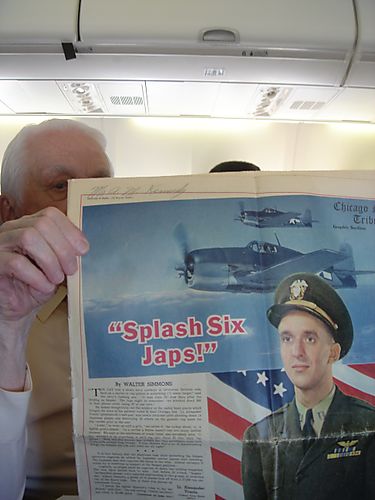
  • Alexander Vraciu, the original Top Gun

    Alexander Vraciu, the original Top Gun

    On my way back from a day trip to LA, I sat next to a quiet old man who was settling in for the short flight back home to Oakland. I asked him how his day was going and was kind of surprised to hear him say he’s been really busy. He then told me he just got through with his interviews for a segment of the History Channel about WWII fighter pilots.

    I put my book down and then prepared to listen to what I knew would be a fascinating tale. At first I had to draw it out of him a bit but once he got going he was full of stories. He was not the bragging type – he told me a little of this, and a little of that about his activities during the war but as the time went on I later realized that I was talking to one of the top aces of the Pacific War.

    Alexander Vraciu flew Grumman Hellcats during the war and shot down 19 enemy aircraft over the course of the war and was the fourth-ranking Naval Ace of the war. During this time he served on six separate carriers (two were torpedoed) and was shot down over the Philippines where he parachuted to safety and spent five weeks with the guerrilla forces in the jungle, leading command of 180 of them through Japanese lines to link up with General McArthur’s advancing forces.

    Alex came home to Chicago a war hero later taking command of a jet fighter squadron in 1951. As one of the top naval pilots, he was sent a congratulatory message from then Admiral Stump, “delighted to hear that you are top gun in jets” which is the first known use of that phrase.

    Despite his age (he’s 88), he was sharp as a tack and you could see his eyes sparkle as he swooped his hands through the air, recounting his famous dogfight where he took out 6 Japanese planes in the space of eight minutes. “It was my personal payback for Pearl,” he said.

    I didn’t have it in me to break in and say I’m half-Japanese.

  • Ergo Sum in the Digital Age

    Steve Rubel calls it Picture-in-a-Picture marketing, Fergus calls it widget marketing. As the traditional walled garden web blows apart, more and more small, loosely joined pieces are made available to re-configure themselves into new combinations.

    Call it mashups for the rest of us – your blog or MySpace profile is a platform where you mix & match services like an events badge and content such as your linkroll. Mix it all together and add a spice of CSS for your new digital persona.

    In the future, will we be defined by the services running on our pages? Will these pages continue to update even after we’re gone taking on a life of their own?

    UPDATE: Sue Mernit and I were laughing. We both came up with almost the exactly same meme but she added a biblical spin also adding the exciting and important development of Yahoo Local’s support of Microformats.