A derivative work surfaced the other day, helpfully linking itself to it’s source material.
Obi-Wan Kenobi Is Dead, Vader Says


This is Mad Magazine territory.
a blog by Ian Kennedy
A derivative work surfaced the other day, helpfully linking itself to it’s source material.
Obi-Wan Kenobi Is Dead, Vader Says
This is Mad Magazine territory.


The New York Times R & D group (nytlabs) has a sexy demo video up on their site showing off a new tool they are using to visualize how their content is amplifed and shared via the Social Web. In their words:
This first-of-its-kind tool links browsing behavior on a site to sharing activity to construct a detailed picture of how information propagates through the social media space. While initially applied to New York Times stories and information, the tool and its underlying logic may be applied to any publisher or brand interested in understanding how its messages are shared.
Hit the mini-site for Cascade and check out the video. It would be great to learn more about the nuts and bolts of how Cascade works. The video only mentions twitter and bit.ly but I’m sure there’s more.
More coverage on Neiman Labs blog, The New York Times’ R&D Lab has built a tool that explores the life stories take in the social space
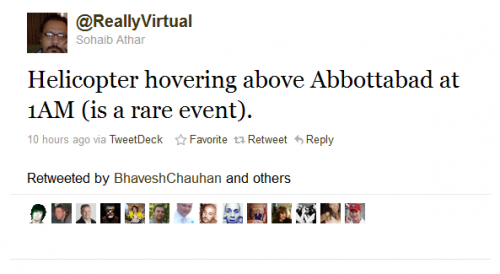
The global nervous system that is Twitter caught wind that something was up at 1AM in Abbottabad, Pakistan. Within minutes, the world triangulated sources and concluded that what Sohaib Athar was hearing was a raid on Osama Bin Laden’s compound. This is how news breaks today. Twitter is having it’s CNN moment.
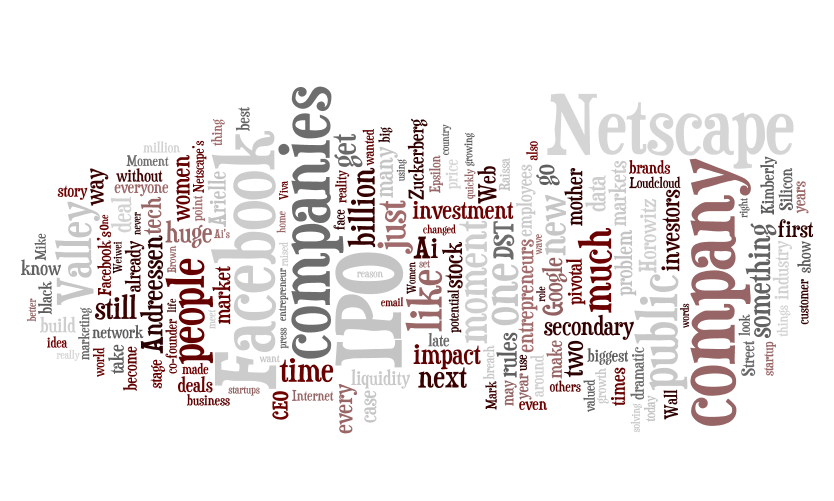
Fooling around with wordle.net here is what I get when I post the entire text of the top four articles referenced by three leading social, news aggregators.
The top four articles, which got top billing across all three services, were:
A quick glance at the wordle tag cloud analysis and it looks like wordle favored the lengthy Sarah Lacy piece on Facebook/Netscape. A longer piece means more words which would explain why Facebook, IPO, and Netscape are so big in word cloud.
Is such a view useful? Is there some way to improve this?
All eyes are on SB Nation who will play host to a new gadget site powered by eight staffers hired away from Engadget over at AOL. Former Engadget editor, Joshua Topolsky, describes being attracted to SB Nation’s vision which is equal part passionate writing (no one ever reads an “objective” sports column) and sophisticated real-time technology.
Our platform is a modern media stack focused on empowering rapid publishing, effective distribution and quality community in equal parts. – SB Nation describing their Media platform
The way SB Nation has evolved from a focus on fan-specific blog communities (which only engage on the colloquial level) aggregated up to the national level so that fans get the right mix between news about their favorite teams up to news about their favorite sports, on up to news important to sports fans everywhere describes, in general, the problems national media sites are facing today as they try and find that perfect balance between local, national, and international news.
It sounds like SB Nation has something akin to a “media carburetor” that can be tuned to find the perfect mix between local and global to provide the explosive engagement needed to drive growth today.
Topolsky is betting that the same secret sauce that powers finding the perfect mix for sports fans may also work for Gadget News. If he’s right, perhaps this same formula can be applied to other verticals as well – fashion, celebrity news, music, gamer news, financial news, on down the line. Any vertical who’s community can generate a strong enough signal at the “local” level should be able to feed into the model.
Further Coverage
In the great content debate, the pendulum continually swings back and forth between the failure of that filter or intellectual stack overflow. Philip Sheldrake and illustrator Nic Hinton set out to capture the evolution of content in an amazing infographic from which I have captured only a small detail below. The poster appears to be a promotion for the mobile aggregator, taptu but their relationship with Philip is not quite clear. (see comment from Philip below.)
Who would have thought thirty years ago that the Internet would go mainstream and the World Wide Web would transform content business models (and many other business models come to that) so radically?
Who would have thought twenty years ago that the average Joe would carry handheld devices as powerful as the Apple and Android devices?
Who would have thought ten years ago that consumers of media content could also, just as easily, be producers of media content?
Who would have thought five years ago that each and everyone of us could, with a stroke of a touch screen, design their own content channel and publish it.
I am fascinated with the history of media and content, its present and its future, and being a communicator I wanted to share my awe in a way that would prompt others to share it with their friends and family.

You can get a hi-res version (42MB) as well.
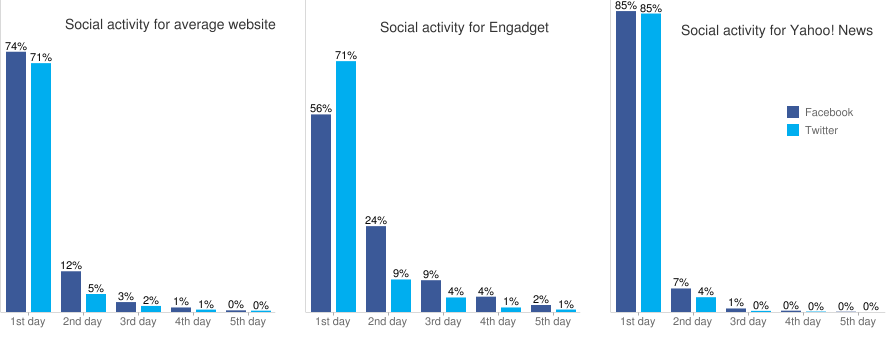
The money shot from yesterday’s Yahoo Research’s Like Log study is the social activity graph below showing how this activity drops off a cliff after the first 24 hours.

Looking at over 100,000 articles across 45 big media sites over the course of three months, Yahoo researcher Yury Lifshits found that a vast majority of the Facebook Like and Twitter Retweet activity. Broadly, 80% or more of the activity takes place during the first 24 hours following the posting of a story. No surprise here, News is about New.
The conclusion from Yury makes is that sites that put out more than one story a day actually run the risk of splitting their traffic if they can’t double it. Each additional story/day diminishes the return and may contribute to burnout of your audience. This runs counter to the leaked AOL way memo pushing for quantity over quality.
Gawker Revisits the Front Page
Gawker famously underwent a redesign that reinforces the conclusions made by the Yahoo research. Look at the redesign before and after and you can plainly see. The image below is their traditional “blog” output which presents the latest story at the top with newer stories pushing the older ones down the page. The default Popular Now column on the right gives some counter-weight but otherwise it’s the standard, reverse chronological layout.

Now contrast this with their new look below. Notice how much more emphasis is placed on the images. This view is called their “Top Stories” view and they’ve taken away all timestamps on the stories as that is not the point of how things are laid out. This layout has an editorial touch to it, the Gawker editors are putting stories in front of you they want you to see.

Nick Denton, the founder of Gawker, posted at length on the thinking behind the redesign.
We need a few breakout stories each day. We will push those on the front page. And these exclusives can be augmented by dozens or hundreds of short items to provide — at low cost — comprehensiveness and fodder for the commentariat. These will typically run inside, linked by headlines from the blog column, so the volume doesn’t overwhelm our strongest stories.
and later,
A prominent “splash” slot on the home page — taking up the two-thirds of the page — can promote the most compelling gossip and scandal. But it also provides the opportunity to display our full editorial spectrum. The front page is our branding opportunity. It’s a rebranding opportunity, too, a way to demonstrate intelligence, taste and — yes, snicker away! — even beauty.
Back when I was selling the idea of blogs to media companies, I remember saying to them that the front page is dead and that people were coming in the side door to their sites via shared links and pointers from the search engines. This was why it was important for them to make sure each page could stand on it’s own as its own front page for their business.
It seems as we have come full circle with the larger blog sites now focused back on the front page, picking favorites to be their star headline stories for the day. Are we giving up on social mediation to solve the information filtering problem? Are we going back to a world where we start each day with a collection of bookmarked top sites we visit daily? Are we going back to appointment television? Do we abandon the firehose feed and stick to just the top stories?

In a post last year, I paraphrased a quote, “If you are not paying for a product, you are the product.” Will.i.am recently updated this quote with the line,
You are either the person getting pimped, or you’re the person doing the pimping.
will.i.am’s description of how the Black-Eyed Peas negotiated a new type of advertising unit for the Super Bowl and collaborated with Marc Benioff and Salesforce to promote Chatter.com through the mini-site thebabypeas.com is a glimpse at how switched on celebrities are using modern tools to manage their brand without the help (or interference or commissions) by an agency.
But the most visionary thing and something I keep coming back to is will.i.am’s vision of the next generation internet. It’s a world where brand “alliances” pool together to subsidize content producers. A world where, “chips talk to chips” without a middleman to make the free flow of content seamless and automatic. In this new world, a collection of devices will marry themselves to a library of content and work seamlessly together.
Extended further, it’s a world in which we no longer need the internet to connect us all. When you text someone next to you, why do you need to connect to a cell tower and send the message over a network only to round trip it right back again. If you extend the chips-talking-to-chips metaphor, why not just have the phone turn itself into the modern version of a walkie-talkie and beam the message right over? Bluetooth and NFC have started this vision but taken further, why can’t cellphones self-organize into mini-networks so that a group of phones together could share information without having to connect to the cloud?
Adam Gopnik has a survey in this week’s New Yorker running down a few of the recent books about the internet and divides them into three schools of thought:
- The Never-Betters believe that we’re on the brink of a new utopia, where information will be free and democratic, news will be made from the bottom up, love will reign, and cookies will bake themselves.
- The Better-Nevers think that we would have been better off if the whole thing had never happened, that the world that is coming to an end is superior to the one that is taking its place, and that, at a minimum, books and magazines create private space for minds in ways that twenty-second bursts of information don’t.
- The Ever-Wasers insist that at any moment in modernity something like this is going on, and that a new way of organizing data and connecting users is always thrilling to some and chilling to others—that something like this is going on is exactly what makes it a modern moment.
Seeing the title of this blog is everwas, I think you know where I come in. The arrival of the internet and hopes and fears that we collectively foist upon this new technology is something we’ve seen before.

The printing press, the telephone, the radio, the television, the internet, and now the cell phone. Each successive wave of communications technology push and pulls our society to new behaviors. I read somewhere when the telephone was first introduced, no one knew how to start a conversation with the person on the other end of the line. For a few years, “Ahoy!” was the commonly adopted opener, choosing to go with nautical terminology maybe to acknowledge the fact that we were all sailing into new waters together.
Eventually we adopt and assimilate the new technology into our daily life much like the body develops an immunity to a new virus. We grow stronger and learn to control our tools rather than let them control us. What was once shiny and new becomes less so. Gopnik continues to draw the arc of history,
Yet everything that is said about the Internet’s destruction of “interiority” was said for decades about television, and just as loudly. Jerry Mander’s “Four Arguments for the Elimination of Television,” in the nineteen-seventies, turned on television’s addictive nature and its destruction of viewers’ inner lives; a little later, George Trow proposed that television produced the absence of context, the disintegration of the frame—the very things, in short, that the Internet is doing now. And Bill McKibben ended his book on television by comparing watching TV to watching ducks on a pond (advantage: ducks), in the same spirit in which Nicholas Carr leaves his computer screen to read “Walden.”
Now television is the harmless little fireplace over in the corner, where the family gathers to watch “Entourage.” TV isn’t just docile; it’s positively benevolent. This makes you think that what made television so evil back when it was evil was not its essence but its omnipresence. Once it is not everything, it can be merely something. The real demon in the machine is the tirelessness of the user. A meatless Monday has advantages over enforced vegetarianism, because it helps release the pressure on the food system without making undue demands on the eaters. In the same way, an unplugged Sunday is a better idea than turning off the Internet completely, since it demonstrates that we can get along just fine without the screens, if only for a day.
Further Reading (I’ve added a few books of my own, feel free to suggest more in the comments):
Adam Gopnik, How the Internet Gets Inside Us, The New Yorker
Never-Betters
 – Clay Shirky
 – John Brockman
 – Kevin Kelly
Better-Nevers
 – Andy Clark
 – Robert K. Logan
 – Nicholas Carr
 – William Powers
 – Sherry Turkle
Ever-Wasers
 – Prof. Andrew Pettegree
 Ann Blair
 – Eric Raymond, Bob Young