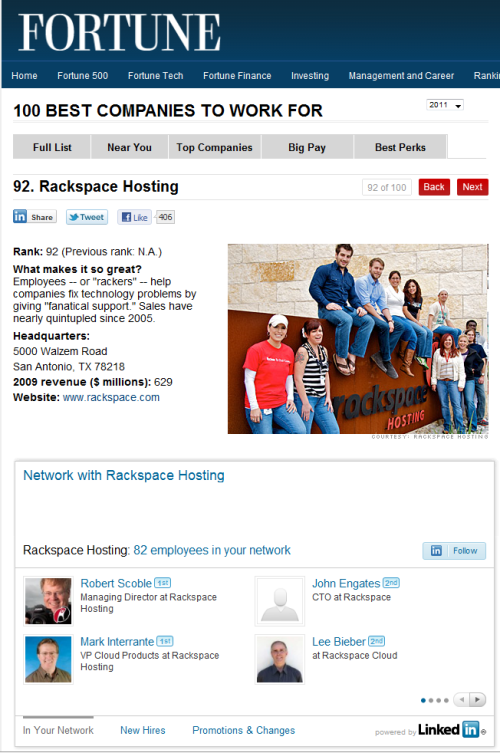
Congratulations to whomever is turning up the heat over at LinkedIn. It’s been just over a year since they opened up their API and now we’re really starting to see the fruits of this effort. The latest integration with Fortune on their 100 Best Companies to Work For demonstrates how a professional social network can add value to a web publication. Browse through this list while logged into LinkedIn and on each companies profile page you’ll see a list of any of your connections that work at that company. It’s like the old Six Degrees game but with a purpose. You’ll be surprised at who shows up (Hi Mark!)
The hackday-inspired Resume Builder takes the data you’ve already added to your profile and gives you a series of templates for a cleaner output in PDF format suitable for sending via email or printing.
LinkedIn Share buttons that you can add to your site works just like the Facebook Like button, crowd sourcing the curation of the web.
Integration with OneSource iSell product to combine their “triggers” with to help Sales teams connect with their prospects through existing relationships.
Bump integration making connecting via LinkedIn easier than ever.
A Microsoft Outlook social connector to add LinkedIn profile information to your email and contacts.
Ribbit Mobile integration resulting in a product they call Mobile Caller ID 2.0. It installs on your mobile phone (sorry, UK and US numbers only) and does a dynamic lookup on incoming numbers to see if LinkedIn (or other connected networks) has any information about who is calling and what they have recently shared on the social web.
LinkedIn Tweets, an application that has a cool, somewhat hidden feature, that creates a twitter list of all your LinkedIn connections that have twitter accounts and (and here’s the cool thing) will add new members to that list automatically as you add new connections on LinkedIn.
LinkedIn Tweets
All this is on top of heaps of new features they’ve added to the site including the faceted search UI and the ability to customize your profile to name just a few. Really stellar work.
LinkedIn 2009
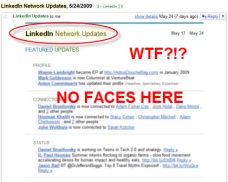
Finally, what prompted this whole post to begin with, and I’m not sure how widespread these emails are, was this customized visual that summarized who in your network has changed jobs. What a contrast to the old, text-heavy, anti-social LinkedIn of 2009 where “connections go to die” – the new LinkedIn is much more vibrant and connected with the world outside. Looks like they’ve taken Dave McClure’s advise from over a year and a half ago when he berated them and screamed, it’s all about the faces.
First I read through a longish piece outlining how Forbes is re-inventing itself into a hub that harvests it’s audience and transform them into content producers in a new media factory. Then I read about how Gawker is embracing the transformation of the web into a visual medium, prepping their web pages for the eventual living room, lean-back consumption model.
And now I click through (via twitter of course) to land on this abomination of design from MSNBC.
I count no less than twelve potential interaction points to share or otherwise spindle this piece back into the social-sphere. This isn’t even counting the 50+ links that are drawing me off this page. I guess what really sends me off are the four icons next to the scroll bar. Some genius thought that click through rates on those little gee-gaws increased engagement. Look at it, there are only two lines of the article above the fold!
All I can think of is that this site is looking like that kid in your neighborhood who would deck out his bicycle with fancy horns, reflectors, and baseball card/clothespins on the rear wheel to make his old Scwhinn look cooler than it really was.
I think we’re in the awkward, adolescent stage of Mass Media adoption of social media. Eventually more sane minds will prevail and attention and praise will flow towards more nuanced design. Less is more my friends, really.
So the results are in from our little experiment and the view is . . . you get what you paid for.
Just to review. Textbroker.com is a service which will write for you on the topic of your choosing. They have a four levels of service and pay by the word. For our experiment, we tried two levels on the upper end of the scale. The topic was “The History of Cream Cheese,” as a control, I added a third sample for the poll in which I copied an article from wikipedia and used some software to shorten the text using an algorithm.
For those of you who read through the samples on the earlier post, here’s what we paid.
Sample ONE, copy/paste from wikipedia, shortened using software algorithm
Sample TWO, 2.2 cents/word, 24 hour turnaround
Sample THREE, 6.7 cents/word, 5-day turnaround
The overwhelming choice (over 80%) was for the most expensive#3 sample. It’s pretty clear that the most thought was put into this text and at a total cost of almost $20, it was by far the most expensive sample to commission.
Textbroker is a pay-as-you-go version of companies such as Demand Media which are content factories that focus on, “optimizing high-quality content” for domain squatters and publishers looking for fill to generate pageviews for their advertising partners. What was interesting about to my Finnish colleagues is the thought they could use the service for preparing rough drafts. English skills are very good here but the hardest part for many is just getting started. Many that I talked to thought Textbroker would be a great way to jump start a first draft to get beyond the blank, white page.
My father, a former editor at Random House, is weary of this trend toward mass produced content. “This way lies madness,” was his one line reaction. The business model exists, of course, at the other end of the spectrum. For those that cannot afford their own ghost writer, there is a fellow going by the name of Charles Kinbote who is offering Bespoke Art Commentary specializing in critical analysis of your child’s artwork. For 190 pounds you get a beautifully framed original.
Here’s how he pitches himself.
And you are also busy, no? You may be keen to know what modernist artists your two-year-old son is referencing in his playgroup art, or perhaps what Renaissance works your three-year-old daughter mimics in her scribbles, but you nevertheless don’t have the time, or, let’s be honest, the talent to critique your children’s artistic endeavors the way a real critic would. Explaining any work of art is not easy. Explaining why a young, immature artist — a child, if you will — chooses to be influenced by Renoir rather than Richter is an almost impossibly complex maneuver, one for which you need an expert. I am that expert. The exploration of the meaning contained in the artwork of children is my life’s pursuit. I offer you my service. My name is Charles Kinbote…
Last week a colleague of mine tweeted about a new service that offers “exclusive written articles created to your specifications”
I replied that Udo might be stretching the definition of “professional” if we look at the quality of output. Cranking out “content” on demand for pennies a word, one has to wonder about the thought that goes into such work. Cheered on by the folks at @textbrokerUS we decided to test the results.
My kids came up with a topic general enough for anyone to judge and we figured it’d be fun to see what others would come up with too. The pricelist on textbroker.com shows a range of prices depending on the quality required. Three paragraphs follow:
Below are the results, use the poll below to pick what you think is the best quality. I’ll collect the results for a bit then share the source of each entry in a future post.
The topic was 300 words on the History of Cream Cheese.
ONE
Cream cheese (also called soft cheese) is a sweet, soft, mild-tasting, white cheese, defined by the US Department of Agriculture as containing at least 33% milkfat (as marketed) with a moisture content of not more than 55%, and a pH range of 4.4 to 4.9.
There are French references to cream cheese as early as 1651. According to the American food processing company Kraft Foods, the first American cream cheese was made in New York in 1872 by American dairyman William Lawrence. It can be a base to some spreads, such as yogurt-cream cheese topping for graham crackers, (10 oz cream cheese, and 1 cup yogurt, whipped.). It is sometimes used in place of butter (or alongside butter in a ratio of two parts cream cheese to one part butter) when making cakes or cookies, and it is also used to make cream cheese icing, which is similar to buttercream icing, (using a ratio of two parts cream cheese to one part butter) which is used to ice carrot cake. Furthermore, because cream cheese has a higher fat content than other cheeses, and fat repels water, which tends to separate from the cheese, stabilizers such as guar and carob gums are added to prolong its shelf life.
There are French references to cream cheese as early as 1651. It can be a base to some spreads, such as yogurt-cream cheese topping for graham crackers, (10 oz cream cheese, and 1 cup yogurt, whipped.). Cream cheese is difficult to manufacture.
TWO
Cream cheese, the most popular ingredient for cheesecake, is a smooth, white cheese made from heavy cream and milk.
Specifically the soft, unripened cheese is made from cow’s milk and by law must contain at least 33 percent milk fat and not more than 55 percent moisture. Light or lowfat cream cheese has about half the calories of the regular style.
Cream cheese is frequently used for spreading on bagels, raw vegetables and crackers and as an ingredient in appetizers, snacks and dips.
There are many different types of cream cheese such as Mascarpone, which comes from Italy and Quark which is a cheese from Germany that has a sharp flavor. In parts of Europe, cream cheese is called “white cheese.”
While there are French references to the origin of cream cheese around the 1650’s, the first American cream cheese was made in 1872 in Chester, New York by American dairyman William Lawrence, according to Kraft Foods. Lawrence distributed his cheese under the brand Philadelphia, now a trademark. The Kraft Cheese Company bought Philadelphia cream cheese in 1928 and still owns it today.
To make your own cream cheese, combine 2-3 cups of whole milk and 3 cups of heavy cream in a stainless pot and stir regularly. Mix 2 tablespoons of buttermilk thoroughly into the warmed milk-cream mixture and cover. Then stir in a quarter teaspoon of mesophilic starter culture, which preserves the cream cheese.
Add a quarter teaspoon of calcium chloride liquid and 2 tablespoons liquid rennet to the pot. Cover the pot and allow it to sit overnight at room temperature. The mixture will have gelled by the next morning, at which time line a large strainer with a sterile handkerchief and gently pour the product into the cloth and let drain for roughly 30 minutes. Transfer the cream cheese into a separate container and mix until smooth and creamy and then store in a refrigerator.
And while cheese can be traced back about four thousand years, the first recipe for cheesecake wasn’t recorded until 230 AD.
THREE
References to cream cheese can be found in France dating to the mid-1600s, though surely it existed long before that. The Greeks contend that cheesecake, made with a soft, creamy cheese, was served to athletes participating in the first Olympic games over 2000 years ago. From Greece, this delicacy spread to Rome and throughout Europe in the following centuries.
Neufchatel, the French soft, white cheese, was the inspiration for an American dairyman who developed what is recognized as cream cheese, the familiar, foil packaged uncured cheese. In an attempt to make a version of the French soft cheese, William Lawrence of Chester, New York, stumbled upon a unique creation in 1872, higher in fat due to the addition of cream to the recipe. The true French Neufchatel cheese is made only with whole milk; its fat content is a little over 20% while cream cheese’s is over 30%. Although controversy surrounds the invention of American cream cheese, with some saying a neighbor of Lawrence’s independently developed the same cheese, it was Lawrence’s version that evolved into today’s Philadelphia Brand Cream Cheese.
Lawrence began commercially distributing his new cheese in 1880. Wrapped in foil and named after the city renowned for quality products, Philadelphia, the cheese was manufactured by Lawrence’s own cheese factory in Chester and by C.D. Reynolds’ Empire Cheese Company in South Edmeston, New York. Philadelphia Brand Cream Cheese’s ownership passed to the Phenix Cheese Company of New York in 1903 after a disastrous fire reduced the Empire Cheese Company to ashes.
The J.L. Kraft Company merged with the Phenix Cheese Company in 1928, obtaining the rights to Philadelphia Brand Cream Cheese, still manufacturing it today. There are hundreds of other brands, but none as famous as the one originally invented by Lawrence.
Two concepts floated around in the past year envision the future of print on connected tablets such at the iPad.
Future of the Book, a video by IDEO, suggests three designs for an interactive book. Co. Design has some thoughts and link to an interview with some of the designers behind this concept.
Mag+ is a concept by Berg. The video was released in December 2009, a version of was released for Popular Mechanics in April and is available for the iPad.
Both of these concepts illustrate the power of additional information deep-linked into the text. These links can lead to interactive graphics as in the Mag+ example or discussion boards as in the IDEO example. Yet, each of these experiences, despite being more interactive than ink on paper, still feel packaged. One vector not explored in either of these concepts is that of reader’s context which is increasingly available via mobile devices. More and more apps are leveraging things such as location to customize the experience. What other contexts can be added to the reading experience and how would it change the reading experience?
Todd Sampson has a great take on publisher’s reaction to the text-to-speech feature on the new Amazon Kindle. Rather than view this feature as a threat to their existing Books on Tape business line, they should look at Amazon’s electronic distribution of their text as a potential channel for an upsell.
The quality of the voice is crappy. It’s bearable, and a major improvement, but it’s still crappy. It simply can’t compete with the quality of a professionally recorded audio book.
Ever the optimist, Todd challenges the book industry to charge extra to sell electronic versions of their books bundled with higher quality audio versions of their books as an alternative to the robot voice. Be confident of the quality of your goods and your true fans will support you. More simply, hold your chin up and stop whining if you want to run with the cool crowd.
Nine Inch Nails Ultra Deluxe Set
The band Phish has mastered the premium upsell on their site, livephish.com. In the tradition of all jambands, Phish allows their fans to tape their live concerts. They sell specially marked tickets for the tapers (as they are quaintly called) giving them access to a special section set up for them behind the soundboard where the sound is best. Despite the existence of high-quality audience recordings that are traded in a vibrant online trading ecosystem, Phish make available soundboard quality, non-DRM recordings of their concerts on their website as well.
The band is confident that their hardcore fans will spend extra to download high-quality FLAC recordings that come complete with pdf files of cover artwork formated to fit within the standard CD case. At a certain age, the $12.95 per show is easily worth it, especially if you went to that concert and want a memento of the evening. The Phish backoffice gets that too and now that they are back on tour, your online ticket purchase comes with a link to pre-purchase a recording of the show at a 15% discount. It’s like a futures bet on the quality of your evening.
Nine Inch Nails also understands the premium upsell. They are sold out of their $300 Ultra Deluxe Limited Edition version of their album Ghosts, an album that was available free for the download.
Then there’s Josh Freese who has taken the premium upsell and turned it into an artform for his album, Since 1972
* Signed CD/DVD and digital download
* T-shirt
* Go on tour with Josh for a few days
* Have Josh write, record and release a 5-song EP
about you and your life story
* Take home any of his drum sets (only one, but
you can choose which one)
* Take shrooms and cruise Hollywood in Danny from
Tool’s Lamborghini OR play quarters and then hop on
the Ouija board for a while
* Josh will join your band for a month … play shows,
record, party with groupies, etc.
* If you don’t have a band he’ll be your personal
assistant for a month (4-day work weeks, 10 am to 4 pm)
* Take a limo down to Tijuana and he’ll show you how
it’s done (what that means exactly we can’t legally
get into here)
* If you don’t live in Southern California (but are a
U.S. resident) he’ll come to you and be your personal
assistant/cabana boy for 2 weeks
* Take a flying trapeze lesson with Josh and Robin
from NIN, go back to Robins place afterwards and his
wife will make you raw lasagna
For a more detailed and way more informed view into the premium upsell (complete with graphs!) check out Strauss on Crystal Ball for Studio Execs or WWJD?
TechCrunch asks if twitter search gets us closer to being able to mine the world’s collective thoughts. We may be getting there as millions text their latest thoughts into their cellphones. With a simple text message, the hive mind has the potential for 4 billion nodes out in the real world (for comparison, the human brain has 100 billion neurons)
News junkies of the world turn to twitter as the latest source of raw, unfiltered information. Peering over the shoulder of various members of the House and Senate who twitter is a unique view into our government. What you see is a more intimate, human view of the people that make the news. Yet, how do you harness that noise and turn it’s output into information?
Twitter follows a long line of services which break through editorial filters, get at the source of a story so you can make your own judgements. Blogs occupied this space just a few years ago and real-time indexes such as Technorati rose to prominence as a way to get a jump on the news.
Sidenote: Alacra, admitting important news about companies breaks on the web, is launching Pulse which applies their analytics engine to extract company names from their hand-picked collection of 2,000 RSS feeds.
The need for speed is nothing new. Former Wall Street Journal newsman Craig Forman draws an arc that extends from the pigeons Baron Reuter used to deliver news of Napoleon’s defeat at Waterloo to the real-time newswires used in the financial world today . If there’s a way for someone to profit from the knowing something before anyone else, there’s always going to be people looking for a way to get at a scoop and others looking for a way to deliver.
We want to look to twitter for the scoops but we are doomed to learn the same lessons as we have in the past about authenticity. What we gain in speed and convenience, we lose in validation and measured fact-checking. Google’s PageRank, while valueable in sorting out the reputation and tossing the hucksters, is no good when applied to real-time news which is too fresh to build up a linkmap.
Working for Dow Jones in Tokyo, I would work with bankers and reporters who would use digital newswires to deliver them the latest news from around the world. As a systems engineer setting up their workstations, I would often be asked to set up their news filters to narrow the feeds down to something reasonable (the typical newswire delivers hundreds of stories an hour, most subsribe to several newswires). In the late-90’s the tools were crude and after getting frustrated by throwing in a few keywords, I would get called in to refine things using additional tools such as company ticker symbols, or a few undocumented codes from a taxonomy of subjects that varied from newswire to newswire.
Today the problem of information overload has spread to the greater population trying to derive value from the rushing torrent of updates coming out of twitter and facebook. How do I manage all this stuff and figure out what’s important? We use the tools we have but if you think about it, Google Trends and twitter search are just keyword searches with very crude resolution. We have a long way to go before such tools will let us tap into the collective mind.
Perhaps it’s time for a crude taxonomy for social networks to help sort out the types of messages flowing back and forth? Imagine if all your tweets, facebook messages, and friendfeed streams came pre-tagged with the following tags or categories?
look at me, I’m doing something cool
check this out, it’s funny
books, movies, music, food, or sports
this is touching and will change your life
gadgets and meta, technology post about using technology
weather and the natural world
babies and kittens
my obscure hobby
breaking news, OMG!
make money now!
What other categories would you add? Librarians of the world, what keywords would you put into your search filters to help grep out what goes where? Categorization is the first step towards ranking and with ranking you get useful filters.
For the past several years I have hitched my name to the phrase social media. I used it as a handle to describe the mix of blogs, photos, status updates, and other methods of personal broadcasting that I used to get the word out and solicit feedback on new ideas. In the past, there was a clear distinction between media produced this way, collaboratively, often by amateurs, and that which was popularly referred to as mainstream media.
We’ve reached a tipping point. In my mind the lines between social media and other types of media are so blurred that it’s not even useful to distinguish the two, just drop the “social” because all media is now social. Take these examples from just the past few weeks:
Along with others, I first heard about the crash landing of US Airways Flight 1549 in the Hudson via twitter. I was also amazed to see the twitpic photo featured on the network news stations – quality of composition was trumped by a camera phone that was in the right place at the right time. While the first reports were from twitter, more comprehensive coverage was to come later from the professionals but the twitpic and reader comments made up an important part of the overall package.
For the inauguration yesterday, CNN and Facebook shared a single URL. On the left side was a live video stream from CNN while on the right side was a stream of comments from Facebook.
cnn.com with scrolling facebook comments (via Steve Garfield)
While the video was very compelling, I have to confess that the real-time commentary from the peanut gallery on the right was absoultely captivating. If you measure media by the amount of attention given, most of my time was spent on Facebook feed. Mashable’s got more details on the numbers but it would be interesting to see a heat map of where people collectively spent their time on this page.
A couple years ago I asked how to define social media. In that post, Stowe Boyd said that is was defined by the, “annotations or social gestures left behind by active readers, such as comments, tags, bookmarks, and trackbacks.” Based on that definition, what we saw on CNN yesterday, and the ease with which people can create, reference, and annotate all media, it’s no longer useful to segment out something called “social media.”
There is no such thing as social media when all media is social.
Last year in April, I put out an open wager that one of the top 100 newspapers in America would stop printing it’s daily paper. The wager had a long horizon and the service changed hands from something called BluBet to dotblu so I lost track of it but a tweet from an old Dow Jones colleague prompted me to do a bit of research.
141 people joined me in my wager and 89% of them went along with my prediction that someone on this list would halt print operations. We were wrong on the timeline (compare 2005 & 2007 newspaper circulation figures) but The Christian Science Monitor announced in October that they would cease print operations in April 2009. Today we read that the Tribune Company, owners of the Chicago Tribune and Los Angeles Times (to name a few) is re-organizing under Chapter 11.
One under appreciated consequence to GM, Ford, or Chrysler going under is that the auto dealerships they support are a huge source of newspaper advertising revenue. My local paper has an entire section devoted to a couple of fluff reviews and many pages of automobile ads, both full-pagers for the dealerships and several pages for the classifieds. Without this subsidy, one wonders how the papers will carry on?
Is the daily paper a luxury of times past? Remember the 8-minute short, Epic 2014? There was a quote in there, “The New York Times becomes a print-only newsletter for the elderly and elite.” That quote was a flashpoint for me when I heard this back in 2004. The line that hits me today is,
Microsoft responds to Google’s mounting challenge with Newsbotster, a social news network and participatory journalism platform. Newsbotster ranks and sorts news based on what each user’s friends and colleagues are reading and viewing, and it allows everyone to comment on what they see.
Used to determine whether a user is included in an A / B or Multivariate test.
18 months
_ga
ID used to identify users
2 years
_gali
Used by Google Analytics to determine which links on a page are being clicked
30 seconds
_ga_
ID used to identify users
2 years
_gid
ID used to identify users for 24 hours after last activity
24 hours
_gat
Used to monitor number of Google Analytics server requests when using Google Tag Manager
1 minute
_gac_
Contains information related to marketing campaigns of the user. These are shared with Google AdWords / Google Ads when the Google Ads and Google Analytics accounts are linked together.
90 days
__utma
ID used to identify users and sessions
2 years after last activity
__utmt
Used to monitor number of Google Analytics server requests
10 minutes
__utmb
Used to distinguish new sessions and visits. This cookie is set when the GA.js javascript library is loaded and there is no existing __utmb cookie. The cookie is updated every time data is sent to the Google Analytics server.
30 minutes after last activity
__utmc
Used only with old Urchin versions of Google Analytics and not with GA.js. Was used to distinguish between new sessions and visits at the end of a session.
End of session (browser)
__utmz
Contains information about the traffic source or campaign that directed user to the website. The cookie is set when the GA.js javascript is loaded and updated when data is sent to the Google Anaytics server
6 months after last activity
__utmv
Contains custom information set by the web developer via the _setCustomVar method in Google Analytics. This cookie is updated every time new data is sent to the Google Analytics server.
2 years after last activity
You can find more information in our About Me and .