Great article in Ad Age about the significance of location-aware phones made the rounds yesterday. It’s not about the ‘text a Starbucks coupon when you walk by” type use case, it’s about engagement and brand utility.
“Everybody’s got a website, but nobody has a mobile experience right now,” he said. “Next year, probably the end of next year, if you pull your phone out and you’re in the Hilton hotel and it doesn’t tell you information about the Hilton, either your phone is broken or the Hilton’s broken. If you, as a business, own a location, you’ve got an interesting shot at reaching your customer.”
and
The promise lies in the realization that mobile isn’t just an ad play but an extension of the services and products businesses already offer. And location is one of the most important contextual clues a mobile phone can provide. “Mobile marketing will move beyond promotions and advertising,” said Kenneth Parks, senior VP-managing director at Digitas in Stanford, Conn. “It’ll be about mobile services that might be marketing but they’ll feel like services.”
and my favorite, from Dennis Crowley of Foursquare,
“There’s no such thing as information overload but filter failure,” said Mr. Crowley. “Location is one of those big filters we’ve been missing in a lot of stuff.”
Effective filters are topic near and dear to my heart and location is gearing up to be one of the best vectors we have to making this social/mobile web thing work.
Opera has a cryptic splash page on its site announcing something wonderful in the near future for mobile browsers. What will it be? Intomobile says that hints can be found in the source (I couldn’t find anything). What will it be?
If you want to read more substantive thoughts on the future of mobile browsing, check out Russell’s latest posts (one) and (two).
While each of these metropolitan pass cards have made life easier for those that use them, as you can see from the photo above (taken while getting on a Tokyo city bus), the card is really just another form of currency that needs to be carried around.
Hesinki’s public transit also has an RFID-based metro card. The Personal Travel Card (1.1 million in circulation) can be purchased for up to six months worth of unfettered travel on any of the region’s buses, trains, trams, subways, or ferries.
Of course, this is Finland so you can also SMS for a single fare. Just text “A1” to the HKL number and you’ll get a message back that you can show the conductor and is good for an hour. Somehow (I guess by reading your cell ID?) the message reads your location and the fare is good for your region. Fares go up late at night so if you’re texting for a ticket late at night, the fare goes up automatically. All charges go automatically onto your phone bill.
It would be nice if there wasn’t a premium (2 euros for a 1.65 euro fare) on SMS tickets. It might almost be worth it. The 6 month pre-paid pass that I bought is most certainly a waste because I don’t use it every day.
While Kevin’s friend walked the streets of Chicago with a broadband modem-enabled laptop, they homed in on the actual person who had taken their phone and confronted them.
“Have you got it?” I asked as I marched up to the guy, acting far more intimidating than I felt. Our iPhone-pilfering friend apparently works at the sketchy bar, and as he fished around in his bag, he gave a questionable alibi about having found the phone, intending to return it, but being intimidated by “all these scary-looking messages” that kept popping up on the display. “Um, yeah, those were from me,” I replied curtly. He pulled my phone out, totally unharmed, and handed it over. I resisted the urge to giggle.
Kevin acknowledges that this wouldn’t have been possible if the phone’s battery died
I’d been amazed that the phone had enough battery life to make it through the night and still beam its location; the moment its battery was dead, then it would be game over for our little scavenger hunt. I unlocked my phone and saw almost 20 missed calls. And then, at that very moment, the iPhone shut down and displayed the “Connect to power” icon. My phone’s battery literally hung on until the second it was in my hand. I wuv you, iPhone.
Beautiful.
UPDATE: There’s a Nokia version of this product too – a bit more geeky but if you know what you’re doing, quite powerful.
A common problem with the mobile web is that pages are not optimized for the mobile browser. Browsers are getting better but sidebar widgets and other social networking cruft often get in the way of viewing sites efficiently on a small screen over a wireless connection.
Combining both a URL shortening service and a service that optimizes pages for the mobile browser, Delivr makes it dead easy to bring pages over to the mobile web.
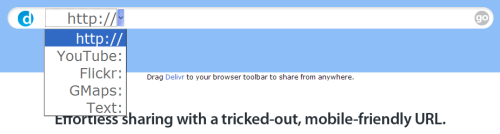
On the home page, a drop down gives you access to a number of options depending on the type of page you wish to share with your mobile friends. Choosing an option drives what data Delivr captures to create a mobile-optimized page.
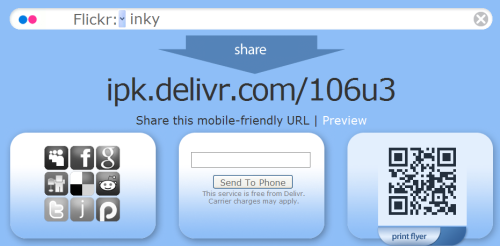
Sharing a flickr photo? The dropdown asks for a flickr username and Delivr will give you a gallery of the latest photos. Select the photo you want, add a title and message and off it goes the link as a text message (currently supports US numbers only) along with the shortened url.
Other content-specific options include a YouTube video, a map of an address on Google Maps (a great way for a business to shorten those long GMap urls), and the “text” option which gives you a whole slew of formatting options to create a mobile-optimized page. I hear from Deliver that more are options are on the way.
Besides texting a link, you also have options to send the link to a variety of social networking sites and (this I really like) they’ve even added a “print flyer” option to create a full page PDF with four postcard-sized cards complete with a QR Code that links directly to the page you’re sharing. Send this PDF off to the printer and you’ve now got a nice postcard to hand out to customers or prospects at the next conference.
Delivr strives to makes things as easy as possible. If you think logging into a site is too much of a pain, they have a bookmarklet that you can add to your browser bar. If even that is too much of a hassle, you don’t even need to have an account to check out their latest trick. Just add “delivr.com” in front of any url to transform it into a mobile ready page.
That’s all it takes to throw a URL over the transom an create a mobile-friendly version of that page that can be shared with all your cellie-toting friends. As with other URL shortening services such at bit.ly, delivr also provides analytics around each link you share, tracking where traffic is coming from (web, the unique print URL, or QR Code). Marketers are already playing around with the service to analyize where they can be most effective in getting the word out with Green Day currently running a promotion for their upcoming release on May 15th.
Every aspect of this service has been thought out carefully, the simplicity of the site is deceiving. Delivr has created a simple platform that can be extended any number of ways; into the virtual space through their series of mobile-optimized landing pages and into the physical space via the QR Coded PDF postcards. If you think that URLs are the currency of the web – Delivr is in a great position to be the central bank for URLs on the mobile web.
Jason Calcanis has a great post on 10 things the new MySpace CEO should do. All of them are good (buy a search engine, add casual games, virtual currency) but I particularly liked his comment about the wide open space for a successful mobile social network here in the US. Japan is leading the way, the US is just not there yet.
Let’s face the facts: Facebook is a much better platform on the Web. MySpace has a lot of work to do just to match Facebook’s offering. However, Facebook and MySpace both suck on mobile phones. Translation? Mobile SNS (social networking services) is up for grabs in the United States.
On my recent trip to Japan, it became very clear to me that the majority of social network activity was occurring on mobile phones–not desktop PCs. No one has built the ultimate iPhone and BlackBerry social networking tools, although some folks are starting to get there. Geolocation tools, combined with the social graph, are the Holy Grail of social networking.
I am not sure what to make of this. I’m all for making toys realistic and all but working at Nokia, we’re all about trying to make mobile mobile devices more playful and fun. So it’s weird to see a Leapfrog making a toy phone more, um, business-like.
CNN wonders if the Barak Obama’s new phone is the Sectéra® Edge™ (love the multiple super-scripts in the product name!) by General Dynamics. Features include a “classified key” that you flip when you want to jump on the Top Sekret network for calls, email, or browsing.
Click on the image above and check out the one-line “trusted display.” Just the thing to check in on twitter.
Not exactly a svelte device (it’s a little bulkier than a Palm Treo), this thing runs Windows Mobile. Goes with the territory I guess. It’s been reported that the White House PCs are running a six-year old version of Windows.
Featured at last week’s Japanese iPhone Developer’s reception hosted by Six Apart I saw Finger Piano, a cool little app that allowed you to play the piano on your phone. As the bars move down towards the keys, you press them to carry the tune.
The thing I like about this video? The fact that it requires a friend to play.
Cookie Consent
We use cookies to improve your experience on our site. By using our site, you consent to cookies.
Contains information related to marketing campaigns of the user. These are shared with Google AdWords / Google Ads when the Google Ads and Google Analytics accounts are linked together.
90 days
__utma
ID used to identify users and sessions
2 years after last activity
__utmt
Used to monitor number of Google Analytics server requests
10 minutes
__utmb
Used to distinguish new sessions and visits. This cookie is set when the GA.js javascript library is loaded and there is no existing __utmb cookie. The cookie is updated every time data is sent to the Google Analytics server.
30 minutes after last activity
__utmc
Used only with old Urchin versions of Google Analytics and not with GA.js. Was used to distinguish between new sessions and visits at the end of a session.
End of session (browser)
__utmz
Contains information about the traffic source or campaign that directed user to the website. The cookie is set when the GA.js javascript is loaded and updated when data is sent to the Google Anaytics server
6 months after last activity
__utmv
Contains custom information set by the web developer via the _setCustomVar method in Google Analytics. This cookie is updated every time new data is sent to the Google Analytics server.
2 years after last activity
__utmx
Used to determine whether a user is included in an A / B or Multivariate test.
18 months
_ga
ID used to identify users
2 years
_gali
Used by Google Analytics to determine which links on a page are being clicked
30 seconds
_ga_
ID used to identify users
2 years
_gid
ID used to identify users for 24 hours after last activity
24 hours
_gat
Used to monitor number of Google Analytics server requests when using Google Tag Manager
1 minute
You can find more information in our About Me and .




![Reblog this post [with Zemanta]](http://img.zemanta.com/reblog_c.png?x-id=16101a36-7b99-4d5f-bcaf-e8d6ddd28601)