There are two ways to look at this announcement and I’d be really interested to hear what people think.
1. This is the first announcement of a new form factor for phones. What looks clunky today will eventually be slimmed down and integrated into a beautiful piece of jewelery. Pair this with a bluetooth headset and make it a touchscreen and you now have a personal internet device that you can wear on your wrist. First generation devices will be for the geek set that wants to play Dick Tracy but in the future there will be a wide range of styles that will redefine a new type of personal technology. Think of what G-Shock and Swatch did for the wristwatch industry.
2. Remember the calculator-watch of the 80’s? It’s now been delegated to the nerd history dump, a curio admired only by niche collectors. The same will happen with the Watchphone. Just as with that calculator on your wrist, no one wants to be caught diddling around with buttons on their wrist – the physical action of picking up a phone to make a call or browsing the web with a device you hold in your hand is too strong a social signal to overcome for a serious market to develop for these devices.
What do you think about the watchphone? The an important first in a new category or future gadget roadkill?
I had a chance to visit the KDDI Design Center in Harajuku right at the base of Takeshita-dori (well worth a visit if you get a chance) as well as a few electronics stores to see what’s on offer from the major operators. Here’s some of the highlights of what I saw.
Casio’s Exilim 8.1 megapixel phone
The obligatory 8.1 megapixel camera phone. Some of the specs include a wide angle lens, a 3.1-inch, 480 x 800 pixel OLED display, and a video mode that films in VGA at 30 frames per second.
Reviewed on engadget.
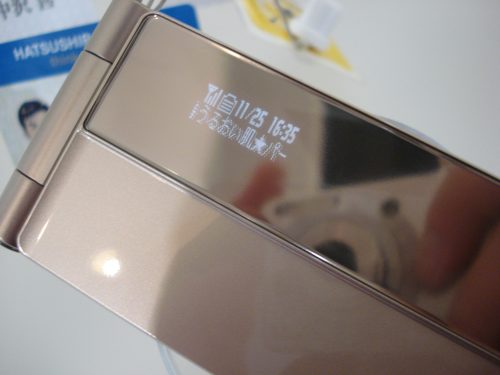
Over 90% of the phones in Japan are flip phones so the outside cover display is important for things like date/time, signal & battery meters, and scrolling message previews. Many of the models I saw featured a display that was behind a mirror type cover (you can see my camera in this photo) that makes these displays more subtle when they are sitting out on the table during a meeting. Some of the models offered for women double as mirrors so you can check your make-up.
Animated Cover Display on Japanese Cellphone
The graphics on the phones were truly stunning. Not only was the resolution magnificent, the graphics complimented the fit and finish of the phones beautifully. The example to the left is the settings page for the phone’s bluetooth feature. The idle page (as people in Nokia call the homescreen of the phone) was also a place where a lot of time was spent to create an experience with beautiful visualizations of simple things such as the time.
Cellphone Bluetooth Settings Screen
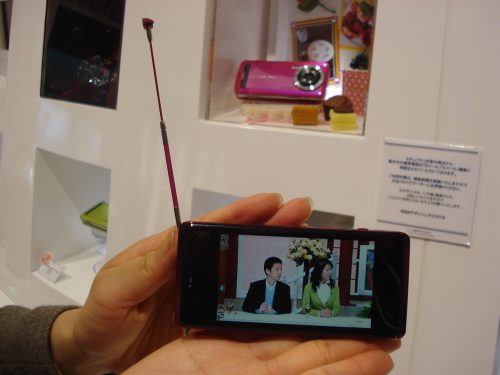
The average person spends two hours a day on the train commuting to and from work or school so many phones have built in television antennas to pick up broadcast TV using a technology called 1seg. These phones are equipped to make the transition to digital television next year and, with enough on-board storage, could even begin to act as pocket Tivos.
Broadcast TV via Cellphone
I’m still learning the ins-and-outs of the cell phone operator business but it’s curious why we don’t see more of these phones outside of Japan. The Japanese domestic market is cut-throat and margins on these devices are razor thin so there’s not a lot of money to be made on these devices for the manufacturers that make them (indeed, Nokia’s pulled out of marketing devices for the Japanese market for all but their high-end Vertu brand).
When I asked around, people told me the PR and marketing of having a leading device was more important than the revenues. I can see what they are driving at when you see a specialized sports phone branded by G-Shock and the 8.1 megapixel camera phone from Casio as well as the TV phone by Sharp. Each of these devices help position their company for their other products and become extensions of their other products.
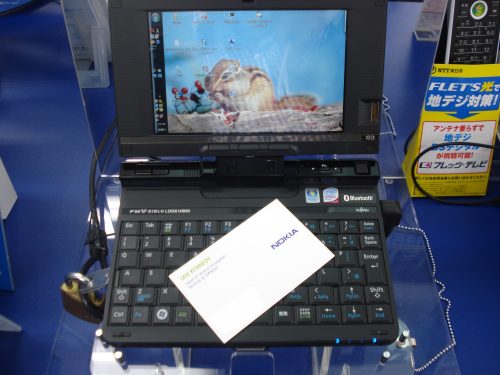
The last image is obviously not a phone but I include it because it’s an example of the full featured laptops that are on sale from the cell phone vendors. They are subsidized so you can pick one up for under $100 with a two year wireless data plan (about $40/month). Most run Windows XP so if you throw Skype onto one of these things along with your bluetooth headset, it could work as a phone.
Fujitsu Netbook
Yes, that’s a standard sized business card on the keyboard. Don’t think anyone’s going to write the next great novel on this machine but it certainly is an impressive feat of miniaturization!
Following up on yesterday’s post about more unique uses for GPS, here’s some stuff I’m running on my Nokia E71 which I’m finding really useful.
Traffic Pilot – download the client to your phone and turn it into a traffic sensor. When running, your location is tracked and used to determine average speed. Crowdsourcing everyone who is running Traffic Pilot is then used to figure out if a road is congested or not. I’ve been using Traffic Pilot for the past few weeks and comparing it to traffic reports on NPR and KCBS and it’s often determined congestion before the incidents are reported on the radio.
Included is a link to “Traffic Report” which will read off conditions for the roads in your area with a helpful scroll bar so you can rewind back if you miss something. Coming soon, Traffic Pilot will use your daily commute patterns to learn which routes you take and send you an SMS if there’s any trouble reported on any of the routes.
Screenshot – useful tool I found to take screenshots of your cellphone screens. It’s not “signed” for the E71 so you need to use the Symbian Signed site to upload the .sis file and get a link to a signed versionThere’s no “camera” key on the E71 so you need to change the default. I use the Backspace key with the 2 second timer.
Google Maps with Streetview – it’s now out for Nokia’s Symbian OS. Figure out what that dive bar your friend told you about looks like from the street.
Skype Lite – for low-cost international dialing. I use it when connected via wi-fi.
Sports Tracker tracks your workouts and plots them on a map which you can share with your buddies. You need a MicroSD memory card (SanDisk 8GB microSD) to run it for some reason. Nokia Research is hosting a version of Sports Tracker that runs on an E71.
Be sure to check out the Solace theme which brings in all the N86 icons and adds a nice gloss to the menus.
I’m still in the Gee Whiz phase of my learning about the mobile phone industry. The ease at which someone uses SMS to text a cab reservation in Helsinki taught me to look at SMS as a command line for the real world and today I’m learning about mobile SMS banking.
My colleague Jan Chipchase (his blog, Future Perfect, which covers culture and technology is fascinating btw) points to a video which (complete with “natty soundtrack”) shows SMS fund transfers in action in rural India.
Just as parts of Eastern Europe skipped over laying telephone cables and went straight to cellular, the third world, where there is no established banking infrastructure, is jumping ahead to mobile electronic banking.
DoCoMo’s new branding campaign is underway and it’s a full court press on people here in Tokyo on segmenting the market into four major archetypes.
Take a guess – which box goes with the individual featured in the photo above. Stumped? Bath yourself in the full flash experience of a very slick marketing site.
What do you call a mobile phone that comes with a built-in address book, browser, camera, GPS, music & video player, projector, voice translator, razor, coffee brewer, and harmonica?
I’m a web guy. I have been working on web products and web sites for many years and have grown used to the tools and platforms available to web developers. The mobile web is different. There are so many layers of technology which are still evolving. The layers of abstraction which make web development easy don’t exist in the mobile world so it’s difficult to unify experience across devices. I’ve been trying to put my finger on an easy to way to illustrate this and today I was pointed to a post by Mike Rowehl (who runs the Silicon Valley Mobile Monday events) that hit it home for me.
If I was looking to develop for PCs and had to join Dell’s developer program to get into about developing for Dells, and then Gateway’s developer program to make my app work on Gateway, and then Toshiba to make my app work on Toshibas – and then have to worry about differences between Comcast and Savis and Internap at the network level. Nothing would ever get done.
This is the current state of the mobile web if you’re a developer. It’s too damn difficult and if you’re trying to reach a global audience, you really need to pick and choose your platforms carefully to avoid death by one thousand exceptions. Thanks to the iPhone we can see the benefits of a tightly defined ecosystem. While I don’t believe in the restrictions the iPhone places around its device and data you put onto it, I hope that Apple’s example gives everyone a taste of what’s possible so that consumer demand will drive the industry towards common APIs that will make greater cooperation and thus innovation possible.
Via Todd Sampson’s Delicious stream comes Walt Mossberg’s review of the Autonet WiFi router which lets you get an internet connection via it’s domestic US EV-DO cell network and bath your car and everyone within 100 feet of your car in up to 800k download speeds.
Hmm, what could you do with a mobile fast internet connection – the mind wanders.
Wire up the steering wheel to servo motors and crowdsource your cross-country drive?
A traveling campervan packed with a bunch of laptops that you hand out to bored people looking for something to do while waiting at the doctor’s office and have them complete tasks on your Amazon Mechanical Turk account. Make it a game and give out prizes to the best worker.
Park your car outside major media events, rent out a bunch of Eye-fi enabled cameras and earn top dollar from major networks for your real-time coverage from your army of amateur photographers.
Cell phones are getting larger to accommodate a larger display and laptops are getting smaller and more portable. As the cellphone gets more expensive and the laptop gets cheaper there will come a time in the not too distant future where they will cross. Which device will it be? The netbook or the smartphone? Who’s going to make the first bookphone?
Add VOIP software and all you need is a Bluetooth headset to make your calls. What’s a carrier to do? Will they offer netbooks on subsidy to get you to commit to their dataplan? It’s already happening.
Used to distinguish new sessions and visits. This cookie is set when the GA.js javascript library is loaded and there is no existing __utmb cookie. The cookie is updated every time data is sent to the Google Analytics server.
30 minutes after last activity
__utmc
Used only with old Urchin versions of Google Analytics and not with GA.js. Was used to distinguish between new sessions and visits at the end of a session.
End of session (browser)
__utmz
Contains information about the traffic source or campaign that directed user to the website. The cookie is set when the GA.js javascript is loaded and updated when data is sent to the Google Anaytics server
6 months after last activity
__utmv
Contains custom information set by the web developer via the _setCustomVar method in Google Analytics. This cookie is updated every time new data is sent to the Google Analytics server.
2 years after last activity
__utmx
Used to determine whether a user is included in an A / B or Multivariate test.
18 months
_ga
ID used to identify users
2 years
_gali
Used by Google Analytics to determine which links on a page are being clicked
30 seconds
_ga_
ID used to identify users
2 years
_gid
ID used to identify users for 24 hours after last activity
24 hours
_gat
Used to monitor number of Google Analytics server requests when using Google Tag Manager
1 minute
_gac_
Contains information related to marketing campaigns of the user. These are shared with Google AdWords / Google Ads when the Google Ads and Google Analytics accounts are linked together.
90 days
__utma
ID used to identify users and sessions
2 years after last activity
__utmt
Used to monitor number of Google Analytics server requests
10 minutes
You can find more information in our About Me and .





![Reblog this post [with Zemanta]](http://img.zemanta.com/reblog_c.png?x-id=6bae4f4c-1bc5-446d-ace7-345f23d54631)


 Via
Via