Jan Chipchase is a research anthropologist at Nokia who travels the world and studies how people interact with technology. His blog (future perfect) is a fascinating stream of one off thoughts and observations which twist your mine to look at the everyday world around us with a new sense of wonder.
In the photo above he writes about how patrons at a bar in Tokyo use a cellphone’s timer to update an age-old drinking game:
A game of spin the bottle updated for the digital age – gather a crowd, take one digital camera, turn on the flash, wind the strap taut, set the timer and let unwind – as the camera spins, whomever is snapped when the timer runs out takes a shot
Sharing location has become much easier but it brings up a lot of new questions. Who owns the data, what can you do with this data? Brady Forrest of O’Reilly Media has been exploring these issues with the Where 2.0 conference and brought together four people at this year’s Web 2.0 Summit to discuss the state of the technology.
April Allderdice from MicroEnergy Credits – they connect micro-finance loan officers in the third word with first world companies that want to buy carbon offset credits. Using GPS with their mobile devices, these loan officers can monitor when someone switches from a coal stove to a solar panel and make available those credits in aggregate for bulk offset purchases.
Rich Minor from Google Android – G1 phone can report location via GPS, Cell Tower ID, and Wifi. The Wifi location services is provided via Skyhook. Unlike the iPhone, the G1 phone can run GPS tracking as a background process.
Ted Morgan from Skyhook Wireless – they have a map of wifi access points (70 million) around the world. This allows you to get maps of physical locations, even inside a building (i.e. 4th floor). Skyhook is the wifi locator on the iPhone – there are over 500 apps on the iphone that use location. They also offer an API for web apps (see Loki API documentation). Not covered in the presentation but I just noticed that BrightKite has a Guess My Location feature which uses Loki and Mozilla’s Geode service to determine location based on your IP address.
Greg Skibiski from Sense Networks – the same way Google analyzes links across the web, Sense Network looks at the way people move about in the geo-world to track past behavior to predict future behavior. (i.e. people that sleep in the Noe Valley neighborhood tend to go out to eat in the Union Street area).
Both Twitter and Facebook are missing integrated location information. People are just starting to realize the power of location. For example, on the Android app Cab4me, you can push one button to request a taxi – location is automatically forwarded to the taxi companies. Yahoo’s Fire Eagle platform broke a lot of ground when it launched but it hasn’t really baked itself into the developer ecosystem (yet).
Skyhook has My Loki but the gave over the storing of location to Fire Eagle. They don’t want to create the impression that they are tracking individual users because of the freak-out factor. Verizon delayed enabling location chips for two years while they were writing their privacy policy on location data. Governments can subpoena this information which gives most companies pause on storing this kind of information. Fire Eagle’s privacy policy is quite good with explicit controls over how your data is shared with third parties. Fire Eagle also, by default, send an email reminder indicating your privacy settings to remind you of your settings.
CitySense from Sense Networks – Featured at the top of this post, this app aggregates personal location information with anonymous location data from other members to show activity on a city map. Currently available on Blackberry (iPhone coming soon) and only for San Francisco. Similar in approach to Nokia’s Friend View application.
MacroSense from Sense Networks – they buy taxi cab location data and match it up with zip code (block level) info to get wealth indicators and try and draw correlations with other indicators to try and predict financial indicators. They sell this data to financial firms and do custom analysis for hedge funds.
Output from a MacroSense report such as the Nightlife Activity Index which shows that many people tended to stay out late right before the recent market crash. Other graphs include the SF Morning Arrival Index (concluding that people in the Financial District get to work early when the market is booming, and later when it’s down) and the SF Taxicab Demand Elasticity Index (indicating middle income people tend to order cabs just prior to market downturns).
For more on Location Based Services such as these, see LBS Zone newsletter and O’Reilly’s Where 2.0 conference in May.
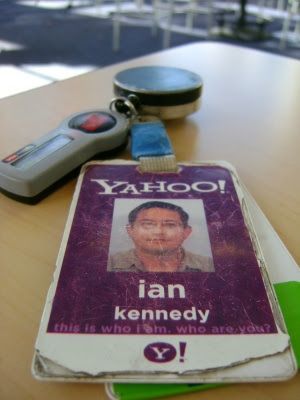
On Friday I’ll hand over my badge, laptop, and Blackberry, finishing up three years at Yahoo. I’m leaving MyBlogLog in the good hands of Todd Sampson to drive the product vision and manage the engineering team and Tilly McLain who will look over the day-to-day care and feeding of the site and community.
My self-proclaimed tag line on the internal company directory is turning Yahoo inside out. This has been my personal mission since I joined Yahoo a little over three years ago. There is great stuff to be shared at Yahoo, as long as you let people get to it in a way that’s useful to them.
I enjoyed working with people who shared my passion to transform Yahoo into to a modern platform. It hasn’t been easy – opening up programmatic access to Yahoo is fraught with many built-in conflicts. Third party content licenses, traffic guarantees, and international legal constraints all make it difficult to let services flow completely free. It’s an industry-wide problem. Much of the way the advertising industry measures the impact of their online campaigns is rooted in the pageview metric which runs counter to providing the best of what you’ve got via an API call. For folks such as ComScore (who help advertisers evaluate rates) an API call doesn’t count as a pageview or roll up into a CPM so it’s a hard to argue letting people get at data without forcing them to come to a pageview to get it.
But consumer demand on the internet is like a natural force. If you don’t go with the flow, the market will route around until it finds what it needs. As with ripped music files, if you don’t provide your data via an API and figure out how to build a business off of that, folks will scrape your pages or go to your competitor. Yahoo gets this and there are many people working to provide a structured way to get at their data in a sustainable way that can guarantee that they will be able to continue to provide it. Pay a visit to the Yahoo Developer Network site to see what’s there and watch this space as there’s more in the queue.
With this as a backdrop, I was invited to take my thinking to a new company and a new industry. In a few weeks I’ll be joining Nokia and working to make their devices more socially aware. The Nokia s60, iPhone, Blackberry and Android (rumored) application stores give us developer ecosystems around each device. What will the world be like when devices can communicate with each other via social networks, across device platforms, across mobile carrier networks? Much the same way the web browser has unified communication across Mac & PC, the mobile web will do the same for “broadband-enabled” cell phones. Add GPS (location), Bluetooth (proximity), integrated camera/video and a voice interface and you’ve got a whole new set of opportunities that are just too good to pass up.
Imagine this use case. Your phone knows your alarm goes off at 6am every morning, that you drive the San Mateo bridge every weekday on your way to work at around 7:30am. It’s entirely possible for your phone to automatically check traffic conditions before you leave sometime after you awake and let you know that there is heavier than normal traffic and suggest an alternate route and read it out to you in a phone call, while you drive. If you’ve got your calendar in there, there is no reason that your phone can’t offer to call ahead and let the people in your first meeting know that you’re running late. All the pieces are in place to make this happen, automatically, right on your device. That’s the kind of service that will enhance your life, that’s the kind of service suite I’m excited to build.
Thank you to everyone who lent an ear to my crazy talk in the early days and pointed me to others who would listen and helped me build a band of believers. A nowhere near complete list of shout outs include:
Toby Coppel, Gerry Horkin, Dave Vockell, Gil Ben-Artzy, and David Katz, who took me under their wing in Corporate Development and helped me refine my message into bite-sized Powerpoint presentations and introduced me to the Harvey Ball.
Sumit Chachra, Aaron Stein, Josh Rangsikitpho, John Lindal, Josh Blatt, Cody Simms and others who fought the good fight down in Burbank.
Finally, thank you to my kids who taught me to look at social networks in a new light and and my wife who kept the family ticking and the home fires burning through it all.
For those interested in peering into a subset of what inspires me, here’s a sample of my OPML file. Keep up the good work Marshall,Louis, and Mark.
I’m going to take a week off to re-charge before the new gig kicks off at the Nokia offices in Mountain View. I’m looking forward to working with one of the original Yahoo bloggers, Russell Beattie. It’s been awhile since I’ve been a regular in the South Bay so if you’re interested in getting together, drop me a line.
In the shadow of today’s G-Phone and Android news, there’s some great stuff being posted over at Nokia’s Conversations blog about their annual The Way we Live Next conference in Finland. I’ve been thinking a lot about the potential of mobile lately. With the addition of location contexts and mobility, the benefits of a true mobile internet look to me to be as quantum a leap for society as when we all first plugged a modem into our PC and jacked in to the web.
Here’s some cool stuff in the labs:
Traffic Works – 100 GPS-enabled phones used to monitor real-time traffic conditions. After a successful field trial in Northern California, next step would be to integrate smartphone schedule to, “tell you about a traffic problem before you leave the house.” It’s similar to Dash but this is software that works on a standard, GPS-enabled phone. How about applying the same distributed network to monitor and predict the weather?
What about using built-in stress sensors which look at things like pulse to determine the stress levels in different areas of the city? You could use it to track crime hotspots (or surly Starbucks baristas). Happy City Map anyone?
Nokia adds 10 million new subscribers a month (works out to something like 14 phones/second!), much of it in places such as Africa and India where they don’t call them cellphones, they call them Nokias. As the networks grow to support them, these devices become the gateway to the internet for low income communities. Did you know that there are generator trucks that roll into town in rural India to provide phones with their weekly charge? To these folks, the cellphone is the internet. What kind of bridges can we build when your child, who has a class report on Kenya, can actually message with someone there?
Nokia’s Point and Find service is something my father, a city guide living in Tokyo, could use. Point your camera phone at an object and a combination of image recognition and GPS goes to work to give you more details about that object. It’s like using QR Codes in terms of ease-of-use but with real world objects and a rich content database on the backend.
How about taking advantage of wi-fi positioning to map out the inside of a building? Looking for a particular meeting room or where to find your seat in a football stadium? Indoor Positioning is something that could help.
Let’s not forget the obvious stuff either. John Battelle asks in the wake of the Chatsworth train wreck why there isn’t a simple speech > text, text > speech translation layer for phones.
Why I can’t simply say to my phone: “Text Michelle” and the phone gets ready to send a note to Michelle. Then I say “Mich I’d rather hit Left Bank than Ambrosia for din love you bye” and the damn text goes to Michelle?
Say Michelle is driving. Her phone buzzes with a text. She’s driving, so she says to no one in particular “Listen text”. There’s my voice! Is this too complicated to make happen? Please. It’s not.
All powerful stuff. With the bluetooth headsets everywhere, we are not too far off from the world of Arthur Dent’s babel fish.
Facebook said last week that they aim to be the next Mobile Address Book. Just like the address book on my Blackberry connects with Yahoo’s corporate LDAP servers to look up the latest phone number or email of any Yahoo employee, Facebook and other social networks are building mobile clients to become the consumer version of the Blackberry Enterprise Server.
Connecting on Facebook is easy – invitations come in, you approve them, and then you each get access to more information about that person. The first time I installed the mobile Facebook app on my portable broadband device (Blackberry, not iPhone) was when I needed to look up a phone number on the way to a meeting with Mary Hodder. We had set the whole thing up on Facebook and it never occured to me as I walked out the door that I didn’t have her phone number. I downloaded the client and installed it while walking over to meet her so I could confirm that address which wasn’t in my phone’s address book.
The concept of a connected address book really takes hold in the mobile space when it’s a pain to navigate the web to look someone up. Yahoo has their oneConnect client for the iPhone. LinkedIn and Plaxo also have mobile interfaces.
So who is going to build the most compelling mobile address book? What are the most important elements?
When someone updates their profile, push updates out to each address book.
Lookup service to find contacts not in your address book
Import and Export of contacts.
Avatar or Photo support as a visual memory.
Fields for profiles on other social networking sites (MyBlogLog, Twitter, Brightkite, Last.FM, etc).
Lifestreaming to browse your contact’s latest updates. Nice to know before you call them, gives you context.
Yahoo, Facebook, LinkedIn, Plaxo, or something else? Which service will pull together all the features you need and gain the critical mass needed to become the default address book in the cloud and on your phone?
When a contact calls, your phone displays a photo, social networking “status” info, as well as past meetings and any notes you’ve entered on that contact.
Choose your own written form of communication: e-mail, social network message, IM, Twitter, SkypeChat — whatever. So, for example, you can choose e-mail, and I can choose Facebook messaging. You send an e-mail to me, and I get a Facebook message. I reply with a Facebook message, and you get an e-mail.
Connect with calendar data so meetings with contacts are logged with the contact data. That way you’ll be reminded in the future about your history with each contact.
Kill any contact information. You should have the ability to decide you don’t want to share your Skype contact anymore, so you should be able to blast it from everybody’s address books.
Ringtonesoup is making the rounds because a sample of Marissa Mayer’s laugh is one of the most popular ringtones on the site. Intrigued, I was pleased to find a site which makes it dead easy to upload and share your favorite samples. They have a contest going on for the best “Booty Call” ringtone so that became my project for the night.
1. Grabbed a sound file as a source. I chose a one of my favorite sets from Christina Moritz’s mixes.
2. Converted the mp3 file to a wav file that I could edit. I used WavePad which has a free download.
3. Selected a 5-second sample and uploaded it to ringtonesoup and submitted it to the contest.
4. Sent a link to the sample to Christina because I know she loves this song (as do I) by Madrid de los Austrias which shows up fairly regularly in her shows.
The average price for a four- to eight-week-long banner ad campaign on a content provider’s wireless Web site is now $75,000 to $150,000, up from $25,000 to $50,000 last year. About 3% to 5% of phone users click on banner ads on their screens — higher than the 1% click rate of computer users, says Jeff Janer, chief operating officer of Third Screen Media.
Belkin has announced a wi-fi phone for Skype. No need to attach anything to your computer, this device will talk directly to a broadband wi-fi connection, any connection. Skype software comes pre-loaded.
Now you can make calls from a handset from any open hotspot.
If you already have a Skype account, it’ll pull in your contact list from your account the first time it connects.
It supports WEP, WPA, and WPA2 with PSK encryption but doesn’t support browser-based authentication so public hotspots that require you to login to a web page such as hotels are out.
I see that Nokia’s shipping a piece of software that in hindsight is so obvious, it’s amazing no one thought of it earlier. As onboard storage gets larger and larger (the new Nokia’s have 4GB!), the viability for the phone to double as an iPod substitute makes more and more sense. Sony played around with their memory stick but it’s a pain to have to copy files from your PC over to the stick in what’s basically a glorified floppy disk.
While I have a pretty steady collection of favorites in my Nano, I primarily listen to podcasts. Basically, updating my podcast subscriptions & recharging are the only reasons I synch up my iPod on a daily basis. What if we were able to break the cord?
MobileCrunch reports that Nokia announced development of new software that will pull down podcast subscriptions into the phone. We all have cell phones charging up on our bedside table. What if you could set it up to make a call in the middle of the night (when bandwidth is cheap and fast) to download your multi-megabyte podcast subscriptions? The phone companies are going to be psyched because they can put their excess bandwidth to use while using up your minutes and you’re going to be happy because maybe you can leave your iPod behind every now and then.
Contains information related to marketing campaigns of the user. These are shared with Google AdWords / Google Ads when the Google Ads and Google Analytics accounts are linked together.
90 days
__utma
ID used to identify users and sessions
2 years after last activity
__utmt
Used to monitor number of Google Analytics server requests
10 minutes
__utmb
Used to distinguish new sessions and visits. This cookie is set when the GA.js javascript library is loaded and there is no existing __utmb cookie. The cookie is updated every time data is sent to the Google Analytics server.
30 minutes after last activity
__utmc
Used only with old Urchin versions of Google Analytics and not with GA.js. Was used to distinguish between new sessions and visits at the end of a session.
End of session (browser)
__utmz
Contains information about the traffic source or campaign that directed user to the website. The cookie is set when the GA.js javascript is loaded and updated when data is sent to the Google Anaytics server
6 months after last activity
__utmv
Contains custom information set by the web developer via the _setCustomVar method in Google Analytics. This cookie is updated every time new data is sent to the Google Analytics server.
2 years after last activity
__utmx
Used to determine whether a user is included in an A / B or Multivariate test.
18 months
_ga
ID used to identify users
2 years
_gali
Used by Google Analytics to determine which links on a page are being clicked
30 seconds
_ga_
ID used to identify users
2 years
_gid
ID used to identify users for 24 hours after last activity
24 hours
_gat
Used to monitor number of Google Analytics server requests when using Google Tag Manager
1 minute
You can find more information in our About Me and .

![Reblog this post [with Zemanta]](http://img.zemanta.com/reblog_c.png?x-id=d863ef65-4874-4bcf-ad70-e8bbad831a4c)