Category: Work

  • Oulu Open Hack

    Oulu Open Hack

    I spent a couple days last week in Oulu (a city in Northern Finland) helping out on a hackfest. For more on the what, who and why, check out my previous post (Why we Hack). This post is to thank the sponsors and share how it went.

    What always amazes me with these type of self-organizing events is the quality of the output. There were only four people volunteering in our spare time to put this together but we managed to pull it off. All the entries were good quality and I’m pretty sure everyone had fun.

    Things kicked off with Kristian and I giving a brief overview of the ground rules and history of hack. We then stepped away to give the floor to Ivan Kuznetsov from HeiaHeia who came in on a night train from down south to join us and help get people inspired about their API. HeiaHeia is a cool concept. Kind of like a Foursquare for health where you check-in your workouts and receive praise (or jeers) from your friends.

    Next, the UBI-Oulu guys showed us their platform which connects to 40+ interactive monitors around town. Each monitor has a bluetooth and gps sensor as well as a camera and they all talk to the UBI Platform which can read data from the web. With two huge projectors also running all night (nights are long during the Winter too) throwing images up on the side of the opera house in Oulu Harbor, you can let your imagination run wild on what you can build. If you think you have a good idea, I’d encourage you to submit it to their challenge by the end of November because the folks at UBI are granting 7000 – 10,000 EUR to the winning proposal.

    Things hummed along and teams quickly settled into their groove. The one thing, in retrospect that I regret, is that we skipped over a round of introductions to get some cross team communication going. People did eventually chat with each other but, as a chatty American, I sometimes forget that it’s helpful to break the ice a bit to get things going.

    The one highlight of the night (for me at least) was when I stepped outside to get some fresh air to wake me up a bit. I had an electronic key for the front door that I had been using all day but, unbeknown to me, this key no longer worked past midnight. All the people for whom I had a phone number had left so when I discovered that my key no longer worked, I tried to figure out what I could do. I tweeted using the #ouluopenhack hashtag to see if I could get the attention of anyone upstairs but, of course, they were all busy hacking.

    So let me paint the picture. Oulu is North of Iceland, North of Fairbanks, Alaska, basically way the hell up there. In November it’s getting dark at around 3pm. By midnight, the time I’m standing there figuring out what I’m going to do, it’s pitch dark and very, very cold. It wasn’t quite life or death, I was dressed for the weather and I could have called a cab back to the hotel but I’m sure everyone upstairs would have been like, “What the hell happened to Kennedy?” so I resolved to figure out how to get back in but time was ticking.

    Snow was on the ground but I luckily found one pebble and took at look up at the windows up on the second floor, the only ones lit, and and tried to imagine the room layout. I picked the one 2 feet x 2 feet window that I remember was next to a table with some guys working and threw the pebble, my single chance to get some attention. I lucked out and hit the window and two scruffy guys peered into the darkness to see me waving frantically and shortly afterwards padded down in their socks to pop open the door.

    All the world’s technology at my disposal and I had to resort to communication technology made famous by Shakespere’s Romeo. Those that know what I’ve been working on at Nokia now know that my prototype now has a real-life use case!

    I went back to playing with some Nokia APIs before moving on and fiddling around with the Twilio API to make a hack that, would allow someone to leave a message that would get transcribed by Google Voice and emailed to the Oulu Open Hack mailing list (just in case I got locked out again). I think I finally finished up and headed back to my hotel around 2am.

    Prizes, we had three

    One for the best app using Qt or QML, one for the best UBI hack, and the overall favorite by popular vote.

    Alexander Savin won the Nokia C7 with a cool QML app which connected to HeiaHeia to visualize your workouts and automatically upload them to the service.

    Ville Alatalo and Jyrki Laurila won the UBI hack prize with their 4squbi app that used the Foursquare API to show you tips from around each UBI screen and who was checked in nearby.

    Jason Brower won the overall with his very ambitious hack which sensed the rhythm you shook your phone to a playing song and played it back to you via the phones vibration engine. The final application is so that people could share vibration-enhanced ringtones.

    All the hacks along with videos are listed on the Oulu Open Hack wiki.

    Shout Outs

    Kristian Luoma (CasCard) managed to score a high-quality venue with free bandwidth and good lighting (and a zen rock garden to boot!) from the University of Oulu’s Center for Internet Excellence. I can’t think of a better place to host a hackfest and we all thank them for bearing with our 24-hours of streaming random tunes from our Spotify channel and the use of their staff kitchen refrigerator where we chilled our cans of energy drink.

    Thanks go to Jyrki’s company Codemate who paid for the t-shirts and very professional badges and lanyards for everyone.

    Also, thank you Forum Nokia for paying for the pizza and drinks (I’ll be sending you my receipts!) and tossing in a C7 phone as the prize for the best QML hack.

    Ville did an amazing job on the designs for the shirts, website, and posters. I think in all Kristian, Jyrki, Ville, and I put no more than 10-15 hours total work towards organizing the hackfest but it was due to Ville’s artwork that we managed to look more professional than we actually were! Ville also captured the video on a hacked up N8 and spliced up all the demo videos and created a highlight reel below. (update: lost to the sands of time)
  • Why We Hack

    Why We Hack

    Reposted (with modifications) from ouluopenhack where I’ll be tomorrow.

    It all starts with an itch. Something that bugs you. It’s some kind of “pattern” that you identify. A manual task that you find yourself doing over and over again that you want to automate. Why is the color  printer always default to printing in black & white? How can I patch the OS on my phone so that it pauses the music player when the headphones slip out of the audio jack? Software engineers are inherently lazy and are always looking for ways to optimize the world around them, automate menial tasks. This itch is motivation to hack.

    To back up, “hack” is not, what Hollywood tells you. It’s not about breaking into a mainframe to steal data or wreak havoc. No, the modern term for “hack” is the software equivalent of duct taping some things together to try out an idea. You know that site There, I Fixed It – it’s kind of like that but with software. Definitely not ready for prime time but it gets you thinking of what’s possible.

    Why Oulu. Why November. Who’s behind this anyway?

    This all started when I  joined Nokia and found myself in Helsinki posting to an internal mailing list about this thing called Hack Day that was a fun thing they did at Yahoo to let off steam and try out new ideas. Kristian Luoma bit and he and I worked together to put on the first, internal Nokia hack event in Oulu which we called a “Hackfest” in November of 2009.

    A follow-up event was held in Helsinki the following year and then Kristian left Nokia to work at his start-up and I got busy with other projects. With the gentle nudge of Ville Alatalo, Jyrki Laurila and others from the original Hackfest in Oulu, the project was brought back and because 11-11-10 is a nice pattern falling conveniently on a Thursday, Ville, Jyrki, Kristian, and I set the date for the 2nd Annual Oulu Hackfest and got to work.

    Slideshare presentation of previous Nokia Hackfests

    In order to involve the greater Oulu community (why keep all the fun to ourselves?), we decided to open up the event to non-Nokia people for a greater exchange of ideas. While no one knows really what to expect at these events, like any good dinner party, we all look forward to making it come together as we go along and making sure everyone has fun. Who knows what ideas will be dreamed up and tried out? What problems will the group tackle? What is broken in our world? How can we make things better?

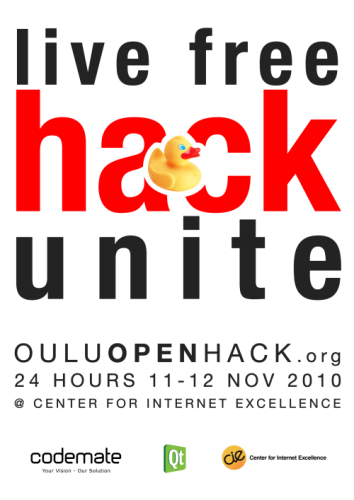
    live free, hack, unite

    The fun starts on November 11th at 11am on the Center for Internet Excellence campus in Oulu and find out. If you just want to drop by at Noon for the final demo presentations, join us at Noon on November 12th. For all the details, follow the links at ouluopenhack.org. or tune into twitter at #ouluopenhack.

  • Soylent, the macro made of people

    More on this question of crowdsourced writing, (plugging wet-ware into software) comes Soylent, (yes, it’s made of people) a research project which has written a add-in to Microsoft Word.

    Hooked into Amazon Mechanical Turk, this project offers three services:

    • Shortn – trim document length without changing meaning
    • Crowdproof – distributed human proof-reading
    • The Human Macro – open-ended tasks such as changing the tense of document, “natural language crowd-scripting”

    Think of how something like Soylent and other outsourcing services change the game. I used to work with someone that would farm out the preparation of his expense reports to Man Friday. How soon before someone, in a moment of bureaucratic weakness, whips up a script to to outsource preparation of the weekly TPS report to management from inside Corporation X. Chances are, it’s already happening.

  • User-Driven Development

    It’s one thing to put yourself in the shoes of your potential customers and think about how to solve their pain points but it’s entirely something else to pretend that this product already exists and think about how you would market it.

    This is the approach at Amazon and I think it’s quite effective. It’s something they refer to as, Working Backwards. This is the process of definition which helps clarify needed features (and their priority) before coding has even begun. I’m a big believer in hacking together working prototypes and tend to jump right in. This approach is more nuanced and helps shake off any geek-halo in the code-first approach. From Werner Vogal’s (Amazon’s CTO) post:

    1. Start by writing the Press Release [1] Nail it. The press release describes in a simple way what the product does and why it exists – what are the features and benefits. It needs to be very clear and to the point. Writing a press release up front clarifies how the world will see the product – not just how we think about it internally.
    2. Write a Frequently Asked Questions document. Here’s where we add meat to the skeleton provided by the press release. It includes questions that came up when we wrote the press release. You would include questions that other folks asked when you shared the press release and you include questions that define what the product is good for. You put yourself in the shoes of someone using the product and consider all the questions you would have.
    3. Define the customer experience. Describe in precise detail the customer experience for the different things a customer might do with the product. For products with a user interface, we would build mock ups of each screen that the customer uses. For web services, we write use cases, including code snippets, which describe ways you can imagine people using the product. The goal here is to tell stories of how a customer is solving their problems using the product.
    4. Write the User Manual. The user manual is what a customer will use to really find out about what the product is and how they will use it. The user manual typically has three sections, concepts, how-to, and reference, which between them tell the customer everything they need to know to use the product. For products with more than one kind of user, we write more than one user manual.

    [1] Ian McAllister, who also works at Amazon, posts on Quora about “working backwards” (it’s via this Quora post that I found Werner’s post, thank you!). He writes in more detail about how to structure the mock-press release.

    • Heading – Name the product in a way the reader (i.e. your target customers) will understand.
    • Sub-Heading – Describe who the market for the product is and what benefit they get. One sentence only underneath the title.
    • Summary – Give a summary of the product and the benefit. Assume the reader will not read anything else so make this paragraph good.
    • Problem – Describe the problem your product solves.
    • Solution – Describe how your product elegantly solves the problem.
    • Quote from You – A quote from a spokesperson in your company.
    • How to Get Started – Describe how easy it is to get started.
    • Customer Quote – Provide a quote from a hypothetical customer that describes how they experienced the benefit.
    • Closing and Call to Action – Wrap it up and give pointers where the reader should go next.

    and most importantly:

    Oh, and I also like to write press-releases in what I call “Oprah-speak” for mainstream consumer products. Imagine you’re sitting on Oprah’s couch and have just explained the product to her, then you listen as she explains it to her audience. That’s “Oprah-speak”, not “Geek-speak”.

  • Nokia N8, Big and Small

    The promotional drumbeat grows ever louder as we get closer to the release of Nokia’s new handset, the Nokia N8. Nokia’s marketing machine is a wonder to see in action. Two promotions I thought particularly clever are both world record breakers and nicely bookend the catchphrase for the device, It’s not technology, it’s what you do with it.

    Dot, the world’s smallest stop motion video. Commissioning the folks behind the Wallace and Gromit movies (Aardman Animations), the Dot short is made up thousands of frames shot on a mounted N8 using its 12-megapixel camera. Painstakingly, the team managed about 4-seconds of footage a day. When they were done, these were stitched together into a minute and a half stop motion movie.

    Rosengård, the world’s largest projection screen. Going from micro to macro, a nine-story screen hoisted between two cranes served as the screen for an HD video signal projected from four massive projectors. Over 2,500 people (1,000 from the comfort of their balcony) were able to enjoy Prince of Persia, the Sands of Time fed by the HDMI port on an N8.

  • Are you a Hacker or a Hustler?

    Micah Baldwin has a great post on what it takes to make a successful startup. One of the first questions you need to ask is if you have both a Hacker and a Hustler.

    A Hacker is more than a code monkey, who can quickly build software and find interesting ways to hack together code. Thats a developer. Thats someone who is definitely an important part of a startup, but not critical to its success. A Hacker is someone who looks the problem, and solves it in a unique and special way. A Hacker finds the process of problem solving exciting and interesting, and spends the majority of their time looking at the problem in multiple ways, finding many potential solutions.

    <snip>

    A Hustler on the other other hand is a relationship builder. Someone who can build direct relationships with their customers. They arent really promoters, although they do a lot of promotion. They arent salespeople, although they do a lot of selling. They are passion people. They have the ability to articulate their passion clearly and in a way that gets other people equally passionate.

    Micah also writes about the current Posterous campaign, releasing a blog import service every few days, building buzz over the weeks. Bold and audacious the campaign has certainly generated its fair share of buzz, shaking a mostly complacent blog platform industry into reaction. The snarky headlines of each announcement are targeted perfectly towards the users of each platform and leave you wondering where they will aim next.

    Riffing ideas like two jazz musicians

    Todd Sampson and Eric Marcoullier of MyBlogLog fame are a classic Hacker & Hustler pair. It was great working with them and to see how these two childhood friends bounced ideas off of each other. Eric (the Hustler) was brilliant at latching MBL on to the latest meme trending on Techmeme as a way to garner attention and Todd (the Hacker)  never ceased to amaze me with his unique insight on the problems of the day. If you haven’t had the chance to try out their latest idea, definitely check out OneTrueFan, the browser plug-in that talks back.

    So which one are you? The Hacker or the Hustler?


  • Viral Video – Two Approaches

    My aunt Karen is in the advertising industry and she forwards me snippets where our two industries cross paths. It’s always interesting to see something you know really well from another perspective. In this case, she sent over an article from Advertising Age, Why Microsoft Killed Kin After Just Six Weeks

    While the article’s conclusion is probably correct, the pricing was too high for the limited features (no GPS?), I think they went too easy on the viral video marketing campaign which rang false from me right from the beginning. Granted, I am way out of the target segment but if I can see through a staged scene, I am sure the teenagers who ran across the YouTube clips did too.

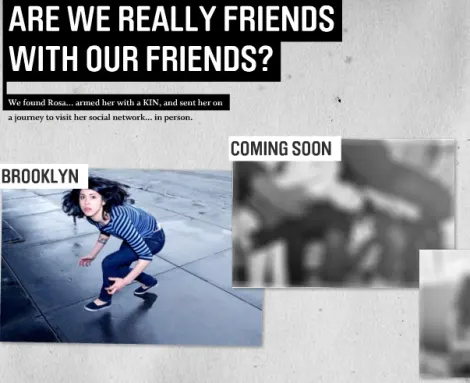
    the campaign followed 24-year-old Brooklynite Rosa Salazar as she used her Kin to connect with her friends via text messages, Facebook, MySpace, Windows Live and Twitter, with her friends’ updates rising to the top of her feed. The campaign used insights from more than 50,000 20-something consumers to appeal to the hipster, metropolitan crowd.

    Why Microsoft Killed Kin After Just Six Weeks
    Brooklyn

    When you view this video on YouTube, you’ll quickly find out, from the related videos column on the right of the page that Matty, the subject in this video, is actually a professional stand-up comedian. From that point on, the bubble is burst. You notice that the shaky camera is a professionally shaken camera. You realize the ambush scene where Rosa meets Matty has two cameras that had to have been set up in advance. You realize that what’s supposed to be intimate and a cool little insight shared with just me is actually a slick ad produced by Redmond. You feel dumb for even thinking this was genuine.

    The alternate approach is to just get weird. This video by Nokia (where I work) is super slick and it’s hard to tell if it’s even about a phone. I am not a marketer and I have no idea how effective they were in driving sales but they sure are fun to watch!

    N900 – The Journey Starts Here
  • Use your bike to charge your phone

    Sometimes it’s the simple things. Why not a dual purpose phone charger, phone mount for your bicycle? Stay above 7.5 mph and you’ll charge your phone at the same rate as if you plugged it into the wall and you’ll be able to enjoy free turn-by-turn navigation.

    Launching first in Kenya where it’s really needed but also coming to the first world sometime hopefully soon.

  • docomo’s designer collection

    My wife just got back from Japan and picked up the latest brochure from NTT Docomo. As a member of the very desirable young female demographic, she’s always been pestering me that Nokia should focus less on whiz-bang geek features and more on the phone as a fashion statement.

    I would agree and, in that vein I present to you this year’s Summer collection from docomo, part of their “style” series.

    Up first is the Emilio Pucci phones featuring the trademark geometric shapes of that famous Italian designer. These phones are made by Sharp. Check out the video where the announcer is impressed with the front-facing camera that can be used as a mirror!

    FrancFranc is a Japan-based interior designer. Their phones are made by NEC. The main features of this phone are a keypad with a unique LED lightshow when you flip it open and custom designer wallpapers that come pre-installed which you can see on the video.

    NY handbag designer kate spade makes an appearance with the signature two-tone finish on the outside. This phone is made by Panasonic and features an “eco-mode” that turns down the display lighting and increase battery life. A squeeze on the sides of the hinge opens the phone and a unique pink LED “illumination” on the front cover activates when you fold the phone shut. The bubbly Tokai Walker reporter is once more on the case.

    OK. It kills me that this isn’t a Nokia but I guess Sharp is going to see what they can do to interpret the marimekko brand  as a keitai. The phone features the signature Unikko pattern with matching wallpaper inside and colorful treatment on the buttons inside. Sharp has also taken the time to outfit the animated sheep that walk across the screen into marimekko patterns. Our video announcer pronounces this phone, kawaii.

    British interior designer Conran burst onto the Tokyo designer scene a couple of decades ago with a splashy book launch and showcase store in Shinjuku’s hip Park Tower complex. The brand holds sway and LG has worked with Studio Conran to produce this phone. This phone goes out on a limb by not going with the flip-phone form factor deciding instead to look at the ergonomics of the phone. It’s gentle curve is so that it can easily fit in your back pocket and hug your face. Coming in Brown, Black, and Dark Red, I’m thinking this phone is targeted for the older, thick rimmed glasses type that tends to prop the phone on their shoulder while sketching notes.  The Tokai Walker crew spends most of the video analyzing the design before they even turn it on.

    For the full marketing experience, check out NTT’s mini-site including the wonderfully weird Darth Vadar Who is My Boss clip.