I just got an email from the folks behind the Mobile Web Server which runs on Nokia S60 phones. They figured out how to run a web server on your phone so you can configure your mobile device to basically be a node on the internet, addressable via an IP address, hosting web pages, streaming GPS and sending camera information. I haven’t played with it in a while but one cool feature they had was a widget that you could put on your Facebook page which featured a button which allowed anyone viewing your Facebook page access to your camera on your phone.
Today, perhaps in response to the broad coverage about the Find my iPhone story I blogged about, they reminded me about the Remote Start feature where you can start the web server via an SMS message which you can send to your phone.
We would like to remind you about the remote start feature. In the unfortunate situation that your phone got lost somehow, it would be possible for you to start the server if you are not having it always on. . . When the server is online you can see who has been calling, read the messages or if you are uncertain where it is, use the positioning or web camera to locate it.
While Kevin’s friend walked the streets of Chicago with a broadband modem-enabled laptop, they homed in on the actual person who had taken their phone and confronted them.
“Have you got it?” I asked as I marched up to the guy, acting far more intimidating than I felt. Our iPhone-pilfering friend apparently works at the sketchy bar, and as he fished around in his bag, he gave a questionable alibi about having found the phone, intending to return it, but being intimidated by “all these scary-looking messages” that kept popping up on the display. “Um, yeah, those were from me,” I replied curtly. He pulled my phone out, totally unharmed, and handed it over. I resisted the urge to giggle.
Kevin acknowledges that this wouldn’t have been possible if the phone’s battery died
I’d been amazed that the phone had enough battery life to make it through the night and still beam its location; the moment its battery was dead, then it would be game over for our little scavenger hunt. I unlocked my phone and saw almost 20 missed calls. And then, at that very moment, the iPhone shut down and displayed the “Connect to power” icon. My phone’s battery literally hung on until the second it was in my hand. I wuv you, iPhone.
Beautiful.
UPDATE: There’s a Nokia version of this product too – a bit more geeky but if you know what you’re doing, quite powerful.
A common problem with the mobile web is that pages are not optimized for the mobile browser. Browsers are getting better but sidebar widgets and other social networking cruft often get in the way of viewing sites efficiently on a small screen over a wireless connection.
Combining both a URL shortening service and a service that optimizes pages for the mobile browser, Delivr makes it dead easy to bring pages over to the mobile web.
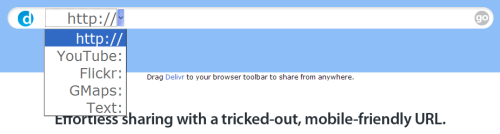
On the home page, a drop down gives you access to a number of options depending on the type of page you wish to share with your mobile friends. Choosing an option drives what data Delivr captures to create a mobile-optimized page.
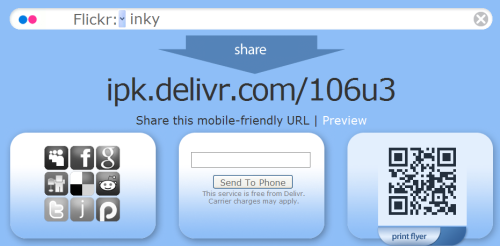
Sharing a flickr photo? The dropdown asks for a flickr username and Delivr will give you a gallery of the latest photos. Select the photo you want, add a title and message and off it goes the link as a text message (currently supports US numbers only) along with the shortened url.
Other content-specific options include a YouTube video, a map of an address on Google Maps (a great way for a business to shorten those long GMap urls), and the “text” option which gives you a whole slew of formatting options to create a mobile-optimized page. I hear from Deliver that more are options are on the way.
Besides texting a link, you also have options to send the link to a variety of social networking sites and (this I really like) they’ve even added a “print flyer” option to create a full page PDF with four postcard-sized cards complete with a QR Code that links directly to the page you’re sharing. Send this PDF off to the printer and you’ve now got a nice postcard to hand out to customers or prospects at the next conference.
Delivr strives to makes things as easy as possible. If you think logging into a site is too much of a pain, they have a bookmarklet that you can add to your browser bar. If even that is too much of a hassle, you don’t even need to have an account to check out their latest trick. Just add “delivr.com” in front of any url to transform it into a mobile ready page.
That’s all it takes to throw a URL over the transom an create a mobile-friendly version of that page that can be shared with all your cellie-toting friends. As with other URL shortening services such at bit.ly, delivr also provides analytics around each link you share, tracking where traffic is coming from (web, the unique print URL, or QR Code). Marketers are already playing around with the service to analyize where they can be most effective in getting the word out with Green Day currently running a promotion for their upcoming release on May 15th.
Every aspect of this service has been thought out carefully, the simplicity of the site is deceiving. Delivr has created a simple platform that can be extended any number of ways; into the virtual space through their series of mobile-optimized landing pages and into the physical space via the QR Coded PDF postcards. If you think that URLs are the currency of the web – Delivr is in a great position to be the central bank for URLs on the mobile web.
Promoting new features of the Nokia E71 with Taiwanese magician Liu Qian performing a little street art. I can’t wait for the SMS-a-pigeon feature when it comes out.
There’s been good debate around how the source of traffic to sites is changing, shifting from the search engines to social sites such as Facebook and Twitter. I confirmed that I too am seeing a greater percentage of traffic come in via links shared on social sites and shared a colleague’s theory about what this would mean for Google’s advertising revenues. Fred Wilson also posted about this topic here and here.
What about attention? How does the average visitor from a social site compare to someone from a search engine? Niall Kennedy tweeted the following stats from his referral logs:
Twitter: 7 seconds
Digg: 20 seconds
StumbleUpon: 40 seconds
Facebook: 52 seconds
Delicious: 82 seconds
Here are my stats for the past year:
StumbleUpon: 40 seconds
Digg: 42 seconds
FriendFeed: 53 seconds
Facebook: 60 seconds
Twitter: 86 seconds*
Delicious: 110 seconds
Techmeme: 114
MyBlogLog: 176 seconds
Compared to the attention span of those coming from the major search engines we get:
Live.com (MSFT): 21 seconds
Yahoo: 35 seconds
Google : 40 seconds
Ask: 46 seconds
It would be interesting to see figures from other sites, especially online shopping sites which are the ones most interested in getting (and therefore likely to pay for) traffic. While it’s clear that visitors from social sites are more engaged with my blog because they tend to hang around a bit longer, that may not be the case with a shopping site where there is less intent to purchase than if they come from a search engine but Mark Essel thinks otherwise.
Increasingly, the flow of web links is being made between individuals via social media sites. Your good fishing buddy who knows the Bay area, shares a link to his favorite supply store. As focused communities become populated across geographic barriers, local quality referrals become more likely. But what if you want to know what store fishermen prefer in San Francisco? You could simply use twitter search for fishing san francisco. In real time you could send a message to several individuals who are interested in fishing in that region.
Shared links are compelling but they need to be matched with impulse buying or discoverable when you’re looking for it. I’m thinking of O’Reilly’s flash discount shared via twitter (44% off to celebrate the 44th president) which was effective in bumping registration at the recent Web 2.0 Expo. The other way to generate business via shared links is to make them searchable so you can find what you need when you want it – but then we’re right back at sending traffic via search again. Yes, you can search twitter but you can find this stuff on Google too.
The jury’s still out as I think this will be a slow shift of behavior that will take a long time to impact existing business models. The real prize is back to social search which would combine the best of the recommendation trusts of social networks with the ability to find what you need when you’re looking for it.
Facebook recommendations married to Google ‘s structure and ranking? That’s the subject of another post.
—o—
* I dug into the Twitter figures because they’re so out of whack with what Niall is seeing and it looks like there are a few visitors that hung out for a long time that are pushing that average higher than it should be.
Dan Theurer, one of the original evangelists of the Yahoo Developer Network, gave a talk (which I unfortunately did not attend) about lessons learned from building YDN. His slides are well worth a glance for anyone interested in building a developer community around their APIs.
Liz Gannes posted that Perez Hilton is now seeing more traffic coming in via Facebook than Google.
My colleague Udo Szabo at Nokia HQ in Finland has a theory that I call the Unified Theory of Interweb Economics. The theory goes something like this:
Advertising is a function of your traffic volume, the more traffic that comes to your site, the higher rates you can charge.
Social sites such as Facebook and Twitter have a lot of link sharing going on as friends post links to share them with each other.
When Facebook and Twitter send more traffic than Google search referrals, advertising dollars will follow the source of that traffic.
Google’s dominance in online advertising will be threatened.
One would think we’re seeing the first hints of that with perezhilton.com and it will take a long time before we see this trend across the board. But in hindsight this is obvious and looking at my stats for the past month I find that 44% of my visitors are coming from search engines and 45% from referring sites with a vast majority coming from StumbleUpon, a social site for sharing links.
The more you think about it, the shift in balance of power has already taken place. SEO is still a big industry but now there are companies that will help you with SMO (“social media optimization”). On twitter we’re starting to see scam artists try and insert themselves into the conversation just as they used to do with Splogs.
And so the wheel turns round once again and there appears to be a new king of the hill – AOL Keyword > Yahoo Category Link > Google Keyword Ranking > Social Site referral.
The jury’s still out as to which social site will send you more links but it’s looking more and more like Facebook. We used to have the Digg effect but no one talks about that anymore. Twitter certainly has the ability to send you a bunch of traffic in short order but the audience is still mostly the early-adopter set and any traffic will most likely be short-lived as the re-tweets scroll into the past.
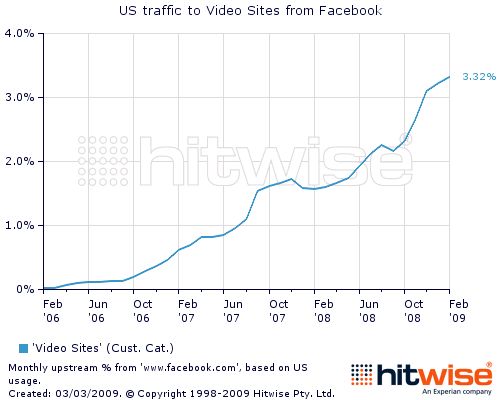
Facebook, with 175 million users, certainly has the right broad-based distribution to broadcast a link and send back traffic. They have added new features such as FriendFeed’s “like” feature to make quick sharing easy. The Facebook Connect and Comments widgets also will help insert new links into Facebook for redistribution.
But while it’s great to get an influx of new visitors via a social site, it’s no good if it’s not a lasting reference. Has the pendulum swung to far the other way? There are some searches that work great on the real-time web, the latest viral video comes to mind, but others such as the listing for your local plumber just don’t work on something like twitter. Not that it’s worth anything but I still get a regular influx of traffic because I’m the #2 listing for insulting british slang even though the post is over three years old.
I think it’s fair to say that the social sites such as Facebook and Twitter will erode Google’s monopoly on online advertising. Google’s never been really good at building social sites and have shared in the growth of social networking in the past by providing the advertising engine for the most popular social sites. What happens with these sites start to go direct to the advertisers? Will Facebook advertising revenues come from traditional cost-per-click/auction model or is some other type of model required to succeed in a social networking site?
I was lucky my trip to Helsinki overlapped with a meeting of Arctic Startup, an occasional meeting of high-tech entreprenuers. The event was held in the Dubrovnik Lounge, a cozy event space in downtown Helsinki which had room for about 100.
It reminded me of other Web 2.0 events that I’ve been to outside of silicon valley in Tokyo and on the East Coast of the US. A gathering of the faithful who spend their days virtually tapped in to what is going on in the valley come together face-to-face to compare notes and talk about the latest news and gossip. Everyone wants to know how things are in the Valley and if it’s really like what they’ve read. The organizers do a great job of bringing everyone together and encouraging people to help each other out and share stories of what works connecting people.
The evening’s event centered around a panel discussion about the state of VC funding in Finland and I was suprised to learn how active the Finnish government is in helping get startups off the ground. It’s difficult for a nordic startup (there were visitors from Sweden and Estonia) to secure VC funding from overseas so their best bet is to use the University system to build a prototype and secure an grant from the “tekka” (I know I’m spelling this wrong) that has become more open to funding alternatives to the pure R&D projects they have traditionally funded.
I met with Indrek Vainu from Estonia who implored me to let people I know that there’s government grants available for businesses that establish themselves in Estonia. As long as you can bring $2M to the table, the Estonian government will match that amount as a grant, doubling your runway. The application process takes some time but it’s worth it. Indrek consults on helping with the application process so if you’re interested in getting in touch, let me know and I’ll put you in touch.
I also learned about the rather infamous case of Riot On, a mobile entertainment startup in early 2000 which famously swindled its investors and ended up giving startups a bad reputation that they’re still trying to overcome. There’s a great documentary about that crazy time and how it all went down. You can see the whole thing on Joost.
ID used to identify users for 24 hours after last activity
24 hours
_gat
Used to monitor number of Google Analytics server requests when using Google Tag Manager
1 minute
_gac_
Contains information related to marketing campaigns of the user. These are shared with Google AdWords / Google Ads when the Google Ads and Google Analytics accounts are linked together.
90 days
__utma
ID used to identify users and sessions
2 years after last activity
__utmt
Used to monitor number of Google Analytics server requests
10 minutes
__utmb
Used to distinguish new sessions and visits. This cookie is set when the GA.js javascript library is loaded and there is no existing __utmb cookie. The cookie is updated every time data is sent to the Google Analytics server.
30 minutes after last activity
__utmc
Used only with old Urchin versions of Google Analytics and not with GA.js. Was used to distinguish between new sessions and visits at the end of a session.
End of session (browser)
__utmz
Contains information about the traffic source or campaign that directed user to the website. The cookie is set when the GA.js javascript is loaded and updated when data is sent to the Google Anaytics server
6 months after last activity
__utmv
Contains custom information set by the web developer via the _setCustomVar method in Google Analytics. This cookie is updated every time new data is sent to the Google Analytics server.
2 years after last activity
__utmx
Used to determine whether a user is included in an A / B or Multivariate test.
18 months
_ga
ID used to identify users
2 years
_gali
Used by Google Analytics to determine which links on a page are being clicked
30 seconds
_ga_
ID used to identify users
2 years
You can find more information in our About Me and .

![Reblog this post [with Zemanta]](http://img.zemanta.com/reblog_c.png?x-id=d23d522a-2a01-4e8a-87ee-eaa5b187c4dd)

![Reblog this post [with Zemanta]](http://img.zemanta.com/reblog_c.png?x-id=6e08aa3a-5a81-4bc7-821f-2f4748a8815d)
![Reblog this post [with Zemanta]](http://img.zemanta.com/reblog_c.png?x-id=d07a0852-e643-4642-9441-ddd84b21d12b)