Tag: advertising

  • Do Social Gestures a Business Model Make?

    Is twitter a directory or a utility? This is the question that Charles Hudson raises in his post The Database of Intentions is More Valuable than the Database of Musings. While investigating prospective business models, he raises good questions about the ability of a collection of “accumulated musings” to determine intent which is what is most valuable to advertisers.

    But maybe advertising  is not the great revenue driver of the next generation of startups after all, at least not advertising as we know it. Maybe it’s just me but I feel a need to make sense of all the stuff we share with each other. There seems to be value in tapping into the pulse of the “now web” but the methods of pulling meaning out of the noise seem crude. Keyword searches? Is that the best we can do?

    Something went wrong with the Intense Debate comments on last night’s post on Keywords and Meaning. It’s unfortunate because there were some really thoughtful responses to the post which I’ll repeat in this post because they are worth reading.

    Todd writes:

    Keyword extraction from Twitter could be cool, but may kill of serendipitous discovery, my favorite aspect of Twitter. If keywords or meta-categories are predetermined truly unique hawtness, unprecedented new things ( a Twitter specialty ) will just get deleted? That would be FAIL.

    I wonder if more of a “people with attributes” are really what’s needed. Example, I do want to know what’s going on with the latest developments for Symbian operating system, particularly activity streams and address book stuff. Rather than rely on keyword extraction, I could just assign an attribute to your tweets…

    twitteruser:iankennedy=novi

    …I can be fairly assured news filtered by real humans, THEN assigned an attribute of my choosing will bring me some good results. A tag cloud of all tweets containing “symbian, activity stream, address book” would be noisy ( pollute with people asking each other for tech support? ), difficult to pull meaning from while drinking beer at my favorite bar.

    Jonathan Strauss writes:

    The TechCrunch post you cite was inspired by John Borthwick’s very interesting essay on how Google’s approach to content filtering breaks in the realm of what he calls the ‘Now Web.’ Like you say above: “Google’s PageRank, while valueable in sorting out the reputation and tossing the hucksters, is no good when applied to real-time news which is too fresh to build up a linkmap.”

    In the (relatively) static web, the network nodes are pages and the endorsement actions are the links between them which are effectively permanent as well as public, and thus crawlable. In the Now Web, the network nodes are people and the endorsements are ephemeral share actions, the majority of which are not public or crawlable (i.e. email, IM, Facebook — what I call the ‘Deep Now Web’). And so, authority also takes on a different form from the aggregate view that PageRank provides to the personal measure of how much influence an individual has with her social network on a particular topic at a given moment.

    I agree that we need to have a means of systematically capturing the newly important metadata of share actions and that it needs to be done at the point of sharing (see Jeff Jonas). But, I believe the more easily adopted (and thus ultimately more useful) taxonomy will be one of contextual metadata (i.e. who/what/when/where/why/how) rather than the more personal folksonomy/tagging approach you suggest.

    There was also reactions via twitter from Kevin Marks:

    https://twitter.com/kevinmarks/status/1213846940

    The act of sharing links, photos, or other metadata on social networks is an action, to a certain extent, that gesture is more interesting than the actual data itself. The fact that my usually dormant cycle racing friends are now extremely active on twitter these past few days as the Tour of California is on is as much an indicator of interest as the actual substance of their conversation.

    Keywords are part of the picture – the complete context around who/when/where/why/how are just as important as the tidbit of data itself. The meta-data contains more clues than the data.

    The cellphone is a rich source of meta-data which can be captured at the source, the moment of sharing. Feeding contexts captured from the cell phone would be a great way to add context to any act of sharing.  There are privacy concerns and ownership questions. There needs to be a real value demonstrated to the potential user before they give up some of this privacy. But that’s a topic for another post.

  • Branding Personal Technology

    When devices get more personal, it is increasingly more important for people to brand their device to signal their personality. Watches have always been a popular vehicle to carry corporate brands. In Silicon Valley it’s become popular to slap stickers on your laptop to show your allegiances. As devices move mainstream, embedded branding is a premium for which people pay extra.

    The example above is of a Hello Kitty netbook that comes from Japan (available in the US from the grey marketer, Dynamism). Most have seen the Prada phone (photo) but in Japan I also saw a new phone branded by Coach.

    Other examples above include the Yahoo shortcut embedded into every phone you buy from Softbank which I hear also requires each buyer of the iPhone to set up a Yahoo account and set Yahoo to the phone browser’s home page before you can leave the store. The Disney phone didn’t do so well in the United States but due to the ravenous popularity of the little mouse items in Japan, I think it will fare much better.

    What other examples of successful branding have you seen?

    Reblog this post [with Zemanta]
  • DoCoMo Branding

    DoCoMo’s new branding campaign is underway and it’s a full court press on people here in Tokyo on segmenting the market into four major archetypes.

    Take a guess – which box goes with the individual featured in the photo above. Stumped? Bath yourself in the full flash experience of a very slick marketing site.

    Reblog this post [with Zemanta]
  • P & G on Monetizing Social Media

    Procter & Gamble Co.
    Image via Wikipedia

    Ted McConnell, General Manager of Interactive Marketing at Proctor and Gamble at a recent forum on digital media held in Cincinnati (where P&G is based) when speaking about advertising on social networks.

    “I think when we call it ‘consumer-generated media,’ we’re being predatory,” he said. “Who said this is media? Media is something you can buy and sell. Media contains inventory. Media contains blank spaces. Consumers weren’t trying to generate media. They were trying to talk to somebody. So it just seems a bit arrogant. … We hijack their own conversations, their own thoughts and feelings, and try to monetize it.”

    Ted really gets it. People are communicating on social networks and if you dance around the edges trying to get their attention, you’re just getting in the way.

    The rest of the article in Ad Age where I found this quote is pretty good.

    Reblog this post [with Zemanta]
  • The Ultimate Smartphone

    What do you call a mobile phone that comes with a built-in address book, browser, camera, GPS, music & video player, projector, voice translator, razor, coffee brewer, and harmonica?

    A hoax!

  • When Targeted Ads Hurt

    Rachel Beckman of the Washington Post writes about her experiences with Facebook demographic targeting.

    After my quaint status update about the muffin top ad, Facebook got even more vicious, like a schoolyard bully provoked by my initial reaction. With the knowledge that I was engaged to be married, the site splashed an ad across the left side of the screen playing into a presumed vulnerability. Do you want to be a fat bride? You’d better go to such-and-such Web site to learn how to lose weight before the big day.

    . . .

    I assumed that the diet ads would subside after I changed my relationship status from “engaged” to “married” in May. They did. I now receive these:

    “Trying to get pregnant? Visit our site now. We’re a national network of fertility specialists treating male and female infertility.”

    Ouch. I am reminded of the time Facebook tried to hook me up with an alternate wife.

    Reblog this post [with Zemanta]
  • Pay-per-Click Marketing comes to Television

    Tivo and Amazon have teamed up in a partnership that anyone following the two could have seen coming. It will soon be possible to click your Tivo remote and order items like the latest album from the musical guest on the David Letterman show.

    The concept of using your remote to purchase stuff you see on TV is an old one but it’s never taken off.  This time, based on the success of Amazon’s one-click fulfillment platform (including the ingenious mobile version), it might just succeed. They just need to get more than 4 million Tivos into US homes.

  • Fridays mean Guiness


    The latest in a series of from the “Good things come to those who wait” commercials was filmed in a small village in northern Argentina. Hat tip to Scott with the deets.

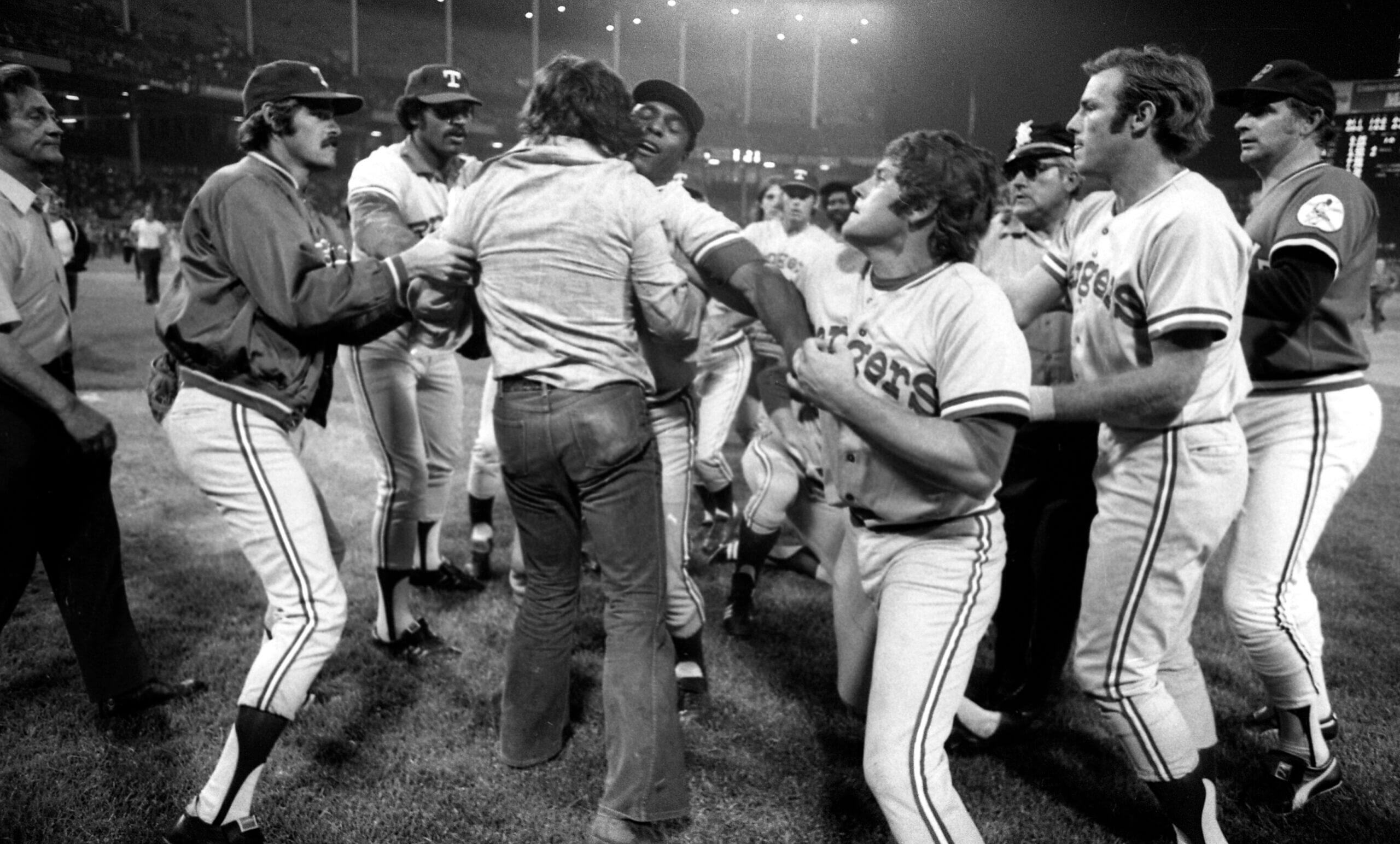
  • Ballpark promotions gone horribly wrong

    Ballpark promotions gone horribly wrong

    As we slide into the World Series we remember the Cleveland Indians 10-cent beer night.

    Management forgot one small detail: drunk people get restless. More than 25,000 fans showed up for the event, most of them already tipsy at the gate. Among the more tame incidents was a woman who flashed the crowd from the on-deck circle, a father-son team mooning the players (good bonding experience, I guess) and fans jumping on the field to meet shake hands with the outfielders. Then, in the bottom of the ninth, the Indians tied the game, but never got a chance to win. Fans started throwing batteries, golf balls, cups and rocks onto the field and one even took the glove of the Rangers right fielder. As the player rushed into the stands to get his glove back, fans starting swarming the field to stop him and threw chairs to block his way.

    Quoted from at Mental Floss.