With word out about Yahoo’s acquisition of Right Media I want to publish a post that’s been sitting in my drafts folder for a good couple of weeks. Think about where online advertising is going and how the internet is expanding and what that means and why an open ad exchange makes the best sense for getting the right message to the right person at the right time.
First the internet. In the past we had IPSs (AOL, Earthlink, Comcast) and portals (Yahoo, MSN) serving as the on-ramp to the internet. The concept was that you would “log-on” to the internet and have the portal act as your guide. Microsoft had a marketing slogan that asked, “Where do you want to go today?” as if the internet was another world which required a guide.
In the past few years search engines, notably Google, have taken over the role of guide and have become the most popular starting point, serving as an index for the internet. People became more savvy and a few well-placed keywords are all you need to drill deep into a site, by-passing front doors, jumping directly to the page with the information you seek. With always-on broadband and multiple computers in each home, search engines have became touchpoints that people would turn to many times each day to vector out and ferret out a specific piece of information.
Cell phones are the next frontier and there’s already pressure on the cellphone carriers to breakdown their walled garden directories and search engines are re-engineering their sites to adopt themselves to the mobile context.
On the bleeding edge we’re seeing the internet experience fade away as a separate experience as more and more objects around us are connected to “the cloud” and are “internet-enabled.” Much has been written about Second Life and other alternate reality environments that are infiltrating our everyday experience of the world around us. But the cloud is seeping into our First World life and data and experience on the internet is more and more inter-mingled into the real world.
- The SanDisk music player is wifi-enabled and will pull the latest music down based on your listening profile for your drive to work.
- The Nokia N800 wifi-tablet has media player software so you can stream your music collection anywhere. It’ll run Skype so you can save on your cellphone minutes and with GPS software, it’ll keep track of where you go or give you directions.
- Smart Signs Media has technology which enables a billboard to pick up the FM radio signal of passing cars and flash messages customized to the demographic of the radio station to which
- you’re listening.
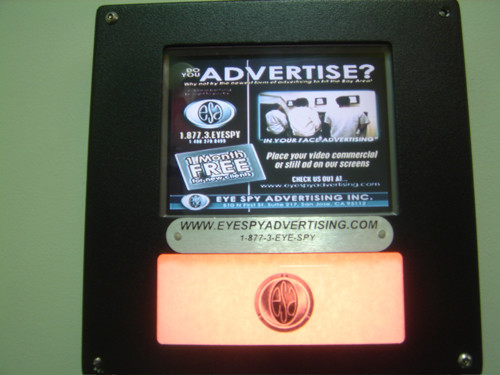
I even joked to colleagues about a scenario where internet-enabled signs on the bathroom wall would replace the sports pages tacked up in front of the men’s room urinals at your local sports bar. The content on the page would be swapped out based on behavioral cookies left on your cellphone browser which it would pick up via Bluetooth. At a recent Stirr Mixer, a version of this was starring me in the face!
To me this says that there is no longer an separate experience called the internet. It is becoming an integral part of the world around us. On the one hand we struggle to apply relevance to Web 2.0 and what that means for the average Joe but on the other hand, we see bits and pieces of this new web popping up all around us everyday infecting everyday objects with connected intelligence.
How will advertising work in this new world of IP-enabled objects? The current landscape of online advertising consists of a myriad of networks and business models that are experimenting with different ways of getting your attention. We have text ads, banner ads, flash animations, affiliate networks, CPM, CPC, CPA, Branded MySpace profiles, microsites, in-game advertising, the list goes on. Each method talks to its own collection of partner sites where content is blended with messages to varied degrees of context and integration. If you were to compare this landscape to financial markets, it would look like disparate stock exchanges without a currency market to normalize and determine value.
Right Media is unique because it normalizes monetization across multiple ad networks. A single line of javascript on your site can now optimize across multiple ad networks in realtime so that the best offer is served up, dynamically, to your audience.
To me, an open and transparent ad exchange is to the online advertising market as the global currency markets are to the global economy. By allowing markets to compete with each other on an open exchange, advertisers and publishers can optimize their sites against the maximum opportunity and let their audiences determine which messages resonate the best and adjust accordingly. An exchange is best able to integrate new publishing platforms (including toilet billboards!), new advertising units, and optimization mechanisms.
An open market trumps a closed exchange everytime so I give a big ol’ high-five welcome to the folks at Right Media. If you run ads on your site, check out Direct Media Exchange for a glimpse of the future. They’ve integrated delicious, youtube, and flickr as learning tools and have a vibrant community around their product. They even held a recent hack day which shows that their heart is in the right place for innovation. Congratulations and welcome to Yahoo!
UPDATE : Charline Li at Forrester has a great post on the Right Media ad exchange model and the benefits for Advertisers and Publishers.