Category: Work

  • Radar, cool hyper-local service from outside.in

    Image representing Outside.in as depicted in C...Image via CrunchBase

    outside.in, the local news site co-founded by geographer-historian Steven Johnson, launched a service called Radar which claims to feed you news from within 1,000 feet of your stated location. Similar to the other hyper-local services like EveryBlock and Topix, their service parses blogs and other social media for stories tied to a specific location.

    outside.in also added GeoToolkit for publishers that want to geo-tag their feeds and take advantage of outside.in distribution. For users, they’ve synched with Yahoo’s FireEagle platform to automate updating of your location. The “news within 1,000 feet” is a compelling promise and hopefully it will generate enough interest in the service so they can reach critical mass.

    Local news is a hard nut to crack. I still get the best results from a variety of bloggers that cover my home town which I can share via My Yahoo. The winning solution is going to be a hybrid of automated parsing (which has it’s own limitations) and crowd-sourced editorial that brings in the right people with the right set of incentives. Local Newspapers have the institutional clout to invite local participation but I’m still looking for a site that expands on the seemless integration of community blogs at the Lawrence-Journal (work incidentally started by EveryBlock’s founder, Adrian Holovaty).

    Who’s going to write the CMS platform for the local newspaper that wants to go online?

    Reblog this post [with Zemanta]
  • NBC holding Olympic videos hostage

    NBC is milking their investment in broadcasting rights for the Beijing Olympics by making anyone that wants to view their videos jump through a few hoops.

    Hoop Number One: Install Silverlight 2.0.

    This limits installation to only Windows machines or Intel-based Macs. Oh, and you have to restart your browser so you if you don’t save the URL of the video you wanted to watch – your left to the mercy of NBC’s navigation.

    Hoop Number Two: Reveal your local NBC affiliate & zip code info.

    This gives NBC data to see just how much traffic they are taking away from their local affilates with online video. When it comes time for re-negotiation, they can hold this data in their hand to show how they don’t really need the affiliates to reach their audience which is why they need to pay more for the rights to re-broadcast NBC programming.

    Despite these two hoops, the desire to see a quick reply of something like the incredible 4×100 meter Men’s relay is so strong that people will jump through these hoops. Not enough to jump out of the current habit of hitting up Yahoo’s Olympic coverage (which is doing a stellar job), but still respectable.

    Badi hated installing Silverlight and may never use it again but he did install it and I doubt he took the time to remove it after he saw the video. As far as Microsoft is concerned, mission accomplished.

    Despite the hassles, I actually like some of the features of Silverlight as it’s featured on the NBC site. It’s really smart is that you’re able to fast forward (or reverse) in low resolution but once the video starts playing, it gradually sharpens the image to higher resolution. The video clips on the NBC site are of exceptional quality to those used to YouTube clips. As with NBC’s other site, Hulu, NBC is leading the way, showing us how a television company can reinvent itself for the internet.

  • FriendFeed Needs Trackback

    The success of distributed commenting systems such as Disqus, Intense Debate, and most famously, FriendFeed have generated a heated debate over if we should let discussions break out all over the place in small pockets or try to gather them all together in context with the source material so that everyone can benefit from a collective debate.

    On the one hand, you have those that encourage everyone to “go with the flow” and let discussions take place inline, wherever convenient. Duncan Riley falls in this camp with his post last week about Blogging 2.0.

    On the other, you have those that want to pull the discussion back into context. If it’s a blog post, they would like to see these distributed pools of discussion pulled back together under the original blog post. Fred Wilson falls into this camp with his post today, Leaving the Instigator Out.

    fredwilson comment

    Call me old school but I’m with Fred on this one. I think it’s possible to have both cookies – keep discussions distributed but at least tie them together so you’re not logging to sites across the web trying to chase down the latest discussion. The solution is to revive the long forgotten Trackback.

    Trackback was developed by the blogging pioneer Six Apart back when blogs expanded beyond a close circle of friends and there was a need for blogs to notify each other when they were expanding on a conversation and moving it to a new venue. The standard practice was that if you wanted to take someone’s idea and expand on it a bit more than would fit comfortably into a comment box, you would post about it on your own blog and trackback to the original post. This would do two things:

    1. send a ping to the original blogger so that he or she would know that you’re expanding on their idea,
    2. add a link in the comments section so that people reading the original post could follow the discussion over to the new blog post

    Trackback was a very simple technology but it provided a thread that linked the two posts and brought the readership of both posts together. If you were moving the conversation from one blog to another, sending a trackback ping was the right thing to do, it was common courtesy, an attribution. That link, that attribution, is what has gotten people up in arms. Without this link, both the original blogger and the reader of the original post are cut off from distributed discussions and that just doesn’t seem right or efficient.

  • MyBlogLog and Web 2.0 Expo

    Todd and I have been busy hanging out over at this week’s Web 2.0 Expo (save one short visit to the nearby Blue Bottle Coffee, thanks Sam!) but the team has been back at MyBlogLog HQ cranking out some cool stuff regardless.

    HCard & VCard support – very cool to see these come to light. Todd has the scoop.

    MBL Mobile – we brushed off this hack and updated it a bit. Steve wrote a java client (and Chris made a cool Mac installer) that you can download and run on your desktop. It runs in the background and a little bubble pops up when a fellow opted in MyBlogLogger is within Bluetooth range.

    Wi-Fi enabled invitations – O’Reilly was kind enough to give us the IP Addresses of the wi-fi routers at the Expo. We now look for any traffice coming from this range and if we see a MyBlogLog member accessing it from this range, we leave them a message on their MyBlogLog profile inviting them to check out MBL Mobile and to stop by the Yahoo booth and say, “Hi”

    Collective Intelligence – as we have done before, we use the wi-fi address range to collect a gallery of all the MyBlogLog members that have used the internet via the Web 2.0 Expo routers. We sometimes get around to showing a rank ordered list of the most popular links but didn’t get around to it this time.

  • The Lifestream Filter Will be the Next Great Algorithm War

    I’m paraphrasing the title of this post from David Recordon who threw this line out following a chat I had with him a couple of weeks back. It’s a very insightful observation that predicts opportunities in the real-time world which lifestream services operate.

    It’s now easier than ever to pull together an aggregated feed of content from across the web. Facebook and FriendFeed organize this content around your friends and contacts. MyBlogLog also presents a New in My Neighborhood view which shows a mixed feed of all your contact’s lifestream content. Yet, once you get more than a handful a friends on these systems, the number of updates (especially if any of them are using twitter) quickly spins out beyond what you can handle.

    Twitter is often used to announce new blog posts and the new broadcast service from Six Apart, Blog It, only exasperates the problem by spawning multiple posts from a single Facebook entry. We live in a world where finding out what your friends are doing is not a problem. The difficulty is in filtering through the hundreds of updates that stream by each day to those events that are most relevant without losing the sense of serendipitous discovery that we experience today.

    So here we are today. It’s like we’re all discovering search engines all over again. In a matter of weeks we’ve gone from “Wow! I can find everything here!” to, “Crap! Over 600,000 results for the phrase Serendipitous Discovery? How can I find the one reference I’m looking for?”

    The huge opportunity ahead is a filter to bubble up the things you need to know without missing anything you want to know.

    A couple of posts point to this being a trend

    We’re trying a few things out at MyBlogLog that vector results based on how you have tagged yourself on your profile. Right now, in a user’s New in My World feed, it’s a straight, chronological feed based on items that match your tags. Also, because it’s based on meta-data, this only means we can present you with items that are tagged so that leaves out plain text updates such as twitter posts but we’re just getting started.

    As David’s quote indicates, this is a huge opportunity and something I look forward to working on. I look forward to a robust debate on different approaches in the coming weeks!

  • Community 2.0 with Twitter

    MyBlogLog just launched an experiment and a shared account at twitter.com/mybloglog. All of us on the team have twitter accounts and have been tripping over each other using our accounts to respond to people and get the word out to our various, over-lapping pools of followers.

    The twittersphere is so noisy anyway that when we sat back and thought about it, having a central voice for MyBlogLog the product just made more sense. There are thousands of MyBlogLog users that have added their twitter accounts to their profile and rather than reaching out to them piecemeal, it just seemed to make more sense to have a single account to handle the outgoing communications.

    So a single account to broadcast the occasional shout out or service update is a no-brainer. The harder, experimental part is the listening part. We set up a script that automatically follows anyone that has added their twitter account to their MyBlogLog profile. It’s impossible to keep up with the thousands of conversations going on amongst our members so we’re taking the advice of our very own twitter ninja, Todd and are limiting our listening to just the @mybloglog replies and direct messages.

    Who knows what will happen, we’ll have to just go with it a bit and see how it goes. It’s just a few hours since we’ve announced this and the replies are already rolling in at a pretty rapid clip. I’m a little worried because we all have a product to run as well and the interruptive nature of twitter brings out my worst ADD tendencies.

    One thing is for certain, this channel is an excellent source of real-time feedback. MyBlogLog releases early and often and we thrive on input to tap us in the right direction or smack us upside the head if we’re dead wrong. The early responses to the follow script range from positive to “what took you so long?” so I think we did the right thing.

    Some of the followers have let us know about other companies that are playing around with branded twitter accounts. Here’s a running list so far:

    Ironically, it doesn’t seem like @twitter is really used in the same way. Curious.

    Update: looks like we’re headed in the right direction. Overnight reactions are almost all positive and the Stop Twitter Spam makes me realize we dodged a bullet by posting about why we were auto-following all 14,000+ that have added their twitter ID to their MyBlogLog profile.

  • Netsquared Mashup Challenge

    The Netsquared Mashup Challenge applications are in and now it’s time to vote on your favorite of the 122 that have been submitted. It’s all for a good cause and the projects listed here are good inspiration for those attending Mashup University where I’ll be doing a brief presentation tomorrow morning on the MyBlogLog API.

    For more on the Netsquared Mashup Challenge, see the video below:

  • Panel on Activity Streams

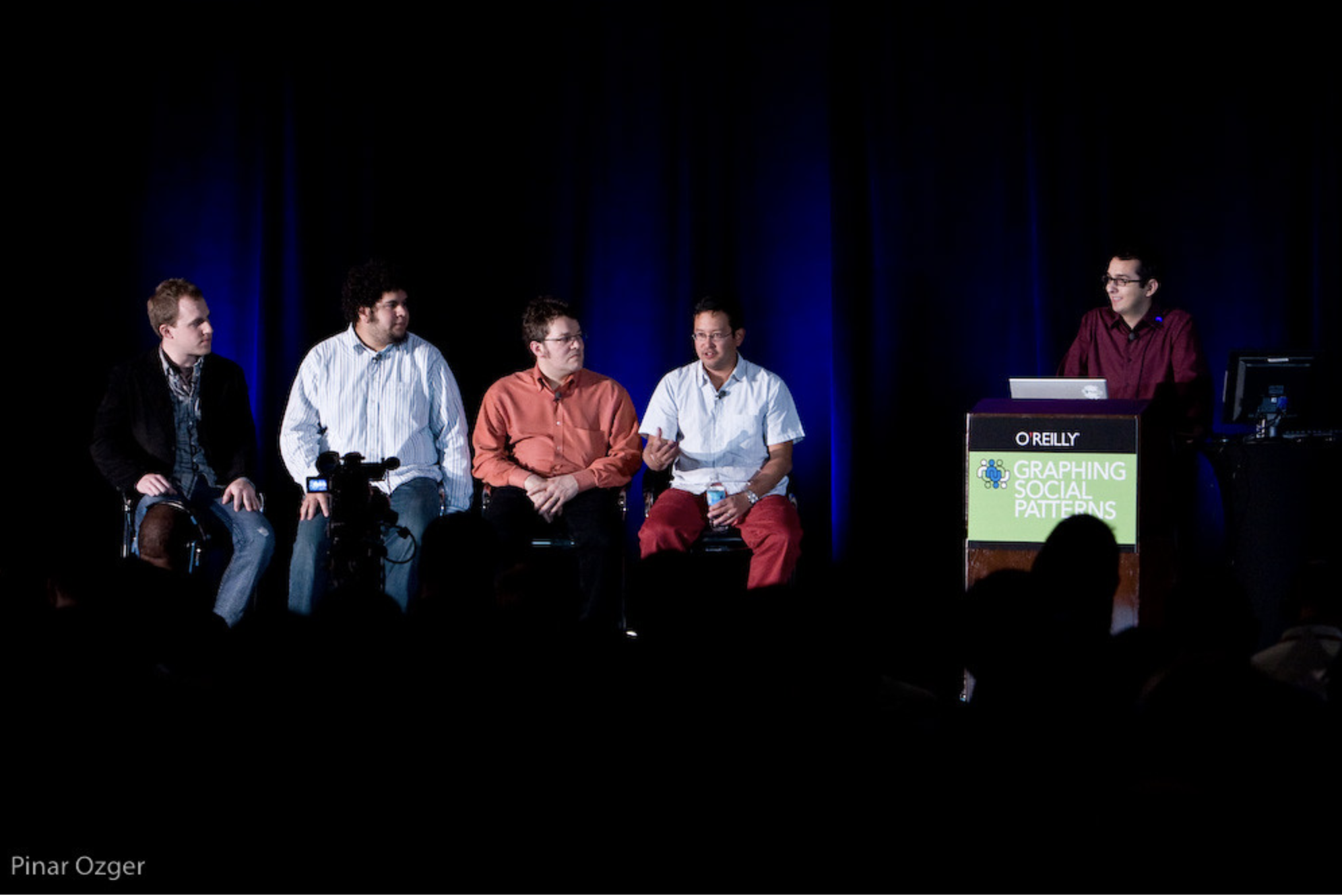
    Panel on Activity Streams

    A panel discussion at O’Reilly’s Graphing Social Patterns conference with myself, Bret Taylor (FriendFeed), Kevin Marks (Google) and David Recordon (Six Apart) on the rollout of shared activity streams as part of the latest revolution in social network. Moderating was Sean Ammirati of ReadWriteWeb.

    Photo by Pinar Ozger

  • Video of my Graphing Social Patterns talk on MyBlogLog API

    I gave a talk today announcing the public launch of the MyBlogLog API. The is the only API that I know of that allows you to look-up a person’s identifier across social networks. Read the docs here.

    Other URLs from the talk:
    Blog Juice – a bookmarklet to look-up social activity of recent reader.
    Raven SEO –  a working example of a portable, social network
    Meetspace – using Bluetooth to discover which MyBlogLog members are in your proximity

    Update: Slides from the talk posted on Slideshare.