Tag: Google

  • Google Reader Power Readers – unlocked

    Browsing my feeds this morning I saw an ad for Google’s Power Readers feature appended on the bottom of a TechCrunch post. The ad pointed to the Google Power Reader page, an editorially crafted bundle of feeds made up of linkblog posts, generated by celebrities hand-picked and using Google Reader. This is the first time I’ve seen Google step up and take such an extensive editorial role in a product to the point where they are actively promoting an editorial voice.

    It’s a smart way to promote not only the sharing feature of Google Reader but also Google Reader as place to consume feeds. My only criticism is that the subscribe option for this bundle of feeds is limited to . . . Google Reader.

    Fail.

    There is a way to eventually make it to the source url for this bundle but you need to go down the path as if you were going to add it to your Google Reader account (meaning you need to login to Google) before they tell you the URL for the Journalists Shared Items page (via a re-direct URL which contains “source=prhomejournalistsall” which gives us a hint that the PR department is behind this. From there you can get to the RSS feed and subscribe to it as you will.

    For kicks I’ve added the feed into a My Yahoo page with a few extra bits from Yahoo editorial added in as a bonus. A bundle of bundles if you will. You can grab it here.

  • Google’s Flash-Eating Spider

    This announcement is definitely cool and will open up whole new areas of the web to search. But truthfully I just wanted to post this because it lends itself to a great headline.

    From the FAQ posted on the Google Webmaster Blog:

    Q: What content can Google better index from these Flash files?
    All of the text that users can see as they interact with your Flash file. If your website contains Flash, the textual content in your Flash files can be used when Google generates a snippet for your website. Also, the words that appear in your Flash files can be used to match query terms in Google searches.

    In addition to finding and indexing the textual content in Flash files, we’re also discovering URLs that appear in Flash files, and feeding them into our crawling pipeline—just like we do with URLs that appear in non-Flash webpages. For example, if your Flash application contains links to pages inside your website, Google may now be better able to discover and crawl more of your website.

  • Feedburner Stats Way Down

    I noticed a big drop in the number of Feedburner subscribers to my blog over the past few days with the number of subscribers dropping nearly 50% starting sometime Thursday last week (May 8th). I noticed one other person reporting a drop and they pointed to Google Reader numbers being the culprit and, sure enough, if you look at the two graphs below, my Google Reader numbers are down significantly (230 vs. 60) but other readers (Netvibes for example) are down as well.

    Anyone else notice this?

  • Tim O’Reilly is Skeptical about OpenSocial

    Tim O’Reilly sums up quite nicely the key problem we’re all waiting to see solved with OpenSocial

    If all OpenSocial does is allow developers to port their applications more easily from one social network to another, that’s a big win for the developer, as they get to shop their application to users of every participating social network. But it provides little incremental value to the user, the real target. We don’t want to have the same application on multiple social networks. We want applications that can use data from multiple social networks.

    Tim’s a great writer and is able to sum up what took me over 600 words to try and describe. But both these posts are worth a read for the comments.

    In my post, Paul Linder from Hi-5, one of the launch partners for OpenSocial says that OAuth will be the preferred authentication method that will potentially bind identeties together across social networks. This is great because it’ll be neutral.

    In Tim’s post, Kevin Marks from Google reminds everyone of the technical challenges of preserving privacy of data across social networks that honor the complex rules and “social norms” of each social network. In his comment, Kevin hints that “publicly articulated performative” social networks (i.e. twitter, MySpace) would be easier to integrate because the data such as friend connections are public and connections are made with that in mind.

    This is why I think the momentum and growth will favor social networks that are built on openness. Just as my parents are frustrated with the permissioning layers of flickr that I have put in place for personal photos, the vast majority of users are going to opt for simple to understand integrations, those that are open.

  • How does OpenSocial map identities?

    I’ve been pouring over all the commentary on yesterday’s announcements of Google’s OpenSocial initiative. I’ll reserve judgment until the MyBlogLog team has had a chance to check out the documentation to see what’s possible. One open question I have is the one raised in this post by Dan Faber about the GetFriend call,

    MySpace CTO Aber Whitcomb’s MySpace profile incorporates a widget from Flixster that shows what his MySpace friends think about certain movies. In order for that to happen, MySpace must look that information up in Flixster and the question I basically had was “How does the process know how to map a MySpace identity to a Flixster identity.”

    This mapping is key. From what I can see in the API docs, you need to look up each person on a service and get back a service specific list of that person’s friends on that service. For example,

    http://orkut.com/feeds/people/14358878523263729569/friends

    This gets you a list of all the friends of this person on Orkut. This gets back a list of member IDs specific to Orkut. These member IDs can be used with the fields populated by the service to retrieve things like,

    • Display Name
    • profile url
    • email address
    • IM handle
    • phone number

    This is what I glean from the API Reference doc. There is also another field called gd:extendedProperty where each service can put their own, service-specific information but it is not clear if this will extend to include a unique identifier that can be used to map a “John Smith” on one system to a “John Smith” on another.

    So in order to make something like a flixter module work in a MySpace page to show what your MySpace friends are doing on Flixter this is what happens,

    1. Login into MySpace
    2. Have Flixter module lookup your MySpace friends via OpenSocial
    3. Have OpenSocial return a list of your MySpace friends with their OpenSocial numerical identifiers
    4. Parse the response for unique identifiers that you can use to lookup a list of Flixter users via OpenSocial
    5. Figure out which of the responses that are returned are, in fact, the same people on your MySpace friends list

    Again, how do I make sure that “John Smith” that is on my MySpace friends list is the same “John Smith” I get back from Flixter? What if 20 “John Smith” records are returned? Which one do I present? I can double check email addresses but that can no only be easily spoofed but also the email address I use on MySpace might be different from the email address I use for Flixter.

    MyBlogLog Services TabThis mapping is key. MyBlogLog has a Services tab on each members’ profile (click on graphic for a larger view) where members can enter all their identities on different social networks. This was built as a simple locater service because MyBlogLog members like to find each other where ever they hang out. MyBlogLog could be this mapping table but, as it’s built right now, there is no authentication to prove you own the profile you put into the table (other than Facebook) so we’d have to build that authentication layer in.

    Maybe this is where OpenID comes in? Can OpenID serve as the unique key that ties this all together? Why weren’t they part of the announcement? This seems like a key bridge that needs to be put in place before all the pieces work as advertised. Am I missing something?

    Update: Bob Warfield posts that Google ID is the recommended key to tie everything together via something called AuthSub. I sure hope this isn’t the only mechanism going forward. This brings us right back to a centralized, shareholder-owned, authentication service which isn’t very open.

  • Google Maps in your Pants?

    Oh my God – this is so bad it’s funny. Dave Cassel of 10 Zen Monkeys deconstructs a radio spot on the GPS-enabled Helio that features a jingle refrain that’s going to stick with me a long time. I don’t think this was what Google was thinking when they set out to “organize the world’s information.”

  • When Ad Sense Misbehaves

    Jay Allen of Six Apart points to Ad Sense showing up in his Vox comment box. It’s a bug of course (limited to Safari) but with all the talk about marketers "inserting themselves into the conversation" this made me laugh.

    Ad Sense in Comments

    UPDATE : Whiz kids over at 6A kicked the tires and now all is well – there’s nothing to see here – move along. 

  • Legalese down your throat

    As someone who played around with Google Video shortly after launch I got an email last night letting me know that Google will start running advertisements on selected content. At the end of the email it asks you to login to agree to a new Terms of Service. Is it just me or does this line sound strange?

    If you don’t agree to the new TOS, we will assume you acknowledge and accept these changes, and will include your content in Google Video, as it is today.

    I would have thought that legally, they need to assume that not reviewing a revised TOS means defaults to not agreeing and opting you out. What if I was hiking Kilimanjaro and just didn’t have a chance to check my email?

  • Google Analytics has overlays

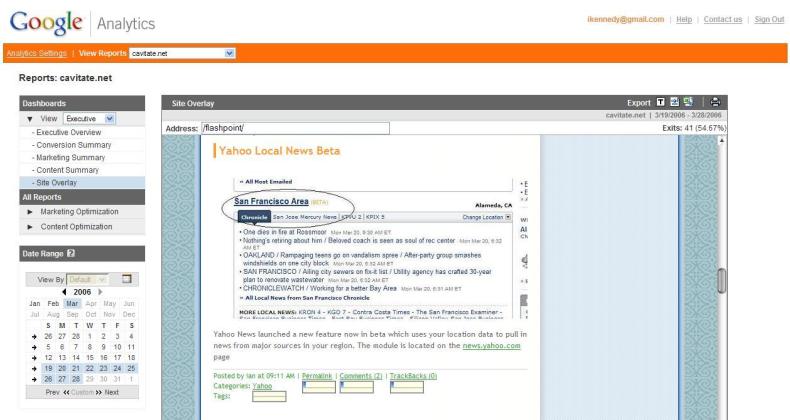
    Google Analytics has overlays

    I was playing around with Google Analytics today and noticed that they slipped in a new feature which is pretty cool. Each link on your page has an overlay on it which, with a little relative progress bar, shows the frequency of clicks. Nice way to visualize how effective your links are if URLs don’t mean anything to you.