Tag: web 2.0

  • Ergo Sum in the Digital Age

    Steve Rubel calls it Picture-in-a-Picture marketing, Fergus calls it widget marketing. As the traditional walled garden web blows apart, more and more small, loosely joined pieces are made available to re-configure themselves into new combinations.

    Call it mashups for the rest of us – your blog or MySpace profile is a platform where you mix & match services like an events badge and content such as your linkroll. Mix it all together and add a spice of CSS for your new digital persona.

    In the future, will we be defined by the services running on our pages? Will these pages continue to update even after we’re gone taking on a life of their own?

    UPDATE: Sue Mernit and I were laughing. We both came up with almost the exactly same meme but she added a biblical spin also adding the exciting and important development of Yahoo Local’s support of Microformats.

  • Masher Defined

    Hi Matt. I was going to post a comment on your post but your blog provider seems to be down for maintenance so I can’t seem to open up an account on their system so I’ll post on my blog and trackback to you.

    You might want to step away from using the term “masher” to identify someone that puts together mashups of web APIs.

    mash•er

    Pronunciation: (mash’ur)

    n. Slang.

    a man who makes advances, esp. to women he does not know, with a view to physical intimacy.

    Random House Unabridged Dictionary, Copyright © 1997, by Random House, Inc., on Infoplease

    On second thought, maybe if you swap out “man” for “developer” and “women” for API, then it does work.


  • RSS is the TCP/IP Packet of Web 2.0

    Reading through Richard MacManus’ excellent recap of coverage of Microsoft’s live.com launch event I followed the link to Nivi’s comment on CrunchNotes that "live" spelled backwards is "evil" therefore if Google is not “evil” that means that Google = Microsoft. (clever!)

    This lead me to Nivi’s post about how new services out there which generate or transform dynamic RSS feeds are really acting as relays for information packets.  We can view these new services as command line interfaces for an internet operating system. So, (take a deep breath as we gloss over some technical details to make a leap of generalization) extending the analogy,

    • Search Engine APIs = command line interface to file systems
    • Tags & other categorization engines = transforming DLLs that filter and transform relevance
    • RSS = protocol level information packet
    • Internet = information bus

    Where do blogs & wikis fit in this picture? Are they the user interface by which we browse this internet-scale OS or are they the scripting platform where we can pull together several API calls into a unique output which we publish as "plug-ins" to the standard utility that comes with the "plain old browser service" (POBS). Ok, time to get some coffee.

  • Belated Review of Web 2.0

    I’m a bit slow out the gate with this post and I expect you all to take whatever I say with a big ol’ grain of salt because of my new position with Yahoo. Truth is, there’s lots going on both here at Yahoo and the industry at large. Let’s take a quick rundown over the events of the past week:

    No wonder we’re all out of breath! I only attended the workshops and opening day sessions but feel like I was there because I picked up on the buzz at the afterparties and have read through lots of the posts about the conference.

    Two points of discussion that I wanted to highlight because I didn’t see them mentioned anywhere else.

    Esther Dyson contributed and interesting riff on the variable of time and how that might impact the relevance of what an advertiser might be targeting or a search engine presenting. If someone subscribes to a feed or buys a book today, they may not continue to have that interest in the  future. We all must keep in mind that behavior profiling via a clickstream may actually deceive. If someone is a starving student that likes to browse expensive car sites, does that really make them a qualified buyer to the BMW advertiser? If they did a lot of research for a new computer last month, post purchase, that may not be their interest and in fact, it may be more appropriate to target marketing messages for accessories instead of new systems.

    The challenge is to build an ad network which can take feedback from it’s participants. The example I’ve been turning over in my mind is the banner ad that has a button which allows you to block future instances of ads in it’s category from every appearing again. If I’m presented with an ad for a Buick Lacrosse, I should have the option to "opt out" of those ads. This feedback should make it’s way back to the advertising engine and modify my profile appropriately. Not only is the beneficial to me, as a consumer who never wants to see and ad for a Buick again, it also is beneficial to Buick who will not have to waste their inventory on me.

    The second point was best summed up in a one-liner attributed to Ross Mayfield, "Let’s stop measuring impressions and start measuring the impressed." Online advertising in the Web 1.0 world looked at banner impressions and then, with self-serve networks such as AdSense, cost-per-click. In the world of blogs, trackbacks, and rss subscriptions, it’s now possible to measure something like a cost-per-influence. It’s time for the publishers and advertisers to come together and experiment on this new unit of measure and try out new business models that are made possible by this innovation.

    In my mind, advertising is useful and complimentary if it adds to the experience of what I’m reading. It can do this by being either educational, entertaining, or highly contextual (or best case, all three). The tools we have at our desposal are improving and modern day metrics allow us to also to measure not only the nameless "daily uniques" but also the quality of an audience demographic and impact of a writer like never before. I am hopeful that this will ultimately reward quality writing which will benefit us all.
     

  • Web 2.0 Acid Test

    On the eve of the second annual Web 2.0 conference, Tim O’Reilly posts a longish analysis that tries to get to the bottom of this slippery label, “Web 2.0.” Ever more important because more and more marketing departments are slapping this label onto their products because it’s hip and bleeding edge, O’Reilly’s piece is seminal because of his position of authority.

    In recognition of this enhanced definition, I’ve gone in and renamed my 2 year old “Web as a Platform” category “Web 2.0”

    You really should read through to the end but the list of qualities (you don’t need all) that make up a real Web 2.0 company are worth pulling up below:

    • Services, not packaged software, with cost-effective scalability
    • Control over unique, hard-to-recreate data sources that get richer as more people use them
    • Trusting users as co-developers
    • Harnessing collective intelligence
    • Leveraging the long tail through customer self-service
    • Software above the level of a single device
    • Lightweight user interfaces, development models, AND business models

    Words to live by in this new age.

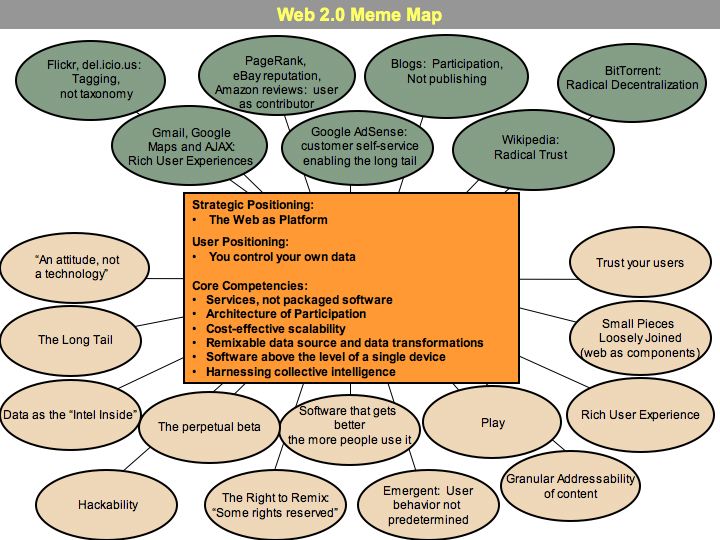
  • Tim O’Reilly Web 2.0 Meme Map

    Tim O’Reilly Web 2.0 Meme Map

    For those who want it in pictures, Tim O’Reilly’s posted a map of all the memes that make up Web 2.0. Alex Barnett goes one step further and annotates it with links.

  • RSS feeds for Salesforce

    You gotta love it. Ex-Newsgator developer, Charlie Wood has attached RSS feeds to salesforce.com. If you have a salesforce.com subscription, you can now subscribe to a feed of your Open Opportunities or Open Escalations. This has been out since July and is now in 2.0 – I’m only now caught wind of it.

    On their TypePad-powered blog they are taking feedback from their customers and announcing new features so if you’re a user, this is a feed you’ll want to subscribe.

    Charlie’s venture, Spanning Partners, has the tagline, “RSS-enabling the enterprise, one application at a time.” Cool, I can’t wait to see what’s next!

  • Round Up of Round Ups

    It’s that time again. Both Kottke and MacManus post lengthy on the inevitable coming together of web services into a unified Web OS. The state of web 2.0.

    GoogleOS? YahooOS? MozillaOS? WebOS? – Jason Kottke
    Web as Platform Mash-Ups – Richard MacManus

  • Plain English Description of Web 2.0

    I’ve been writing about this new world of mix-and-match web services for some time now so it’s great to see the concept begin to be written up by the popular press.

    The next step is to boil down these API transactions to the lowest common denominator of the web, the hyperlink. The average person can then bring together their favorite services into weblog posts to add context to the results generated by each of these links. You heard it here first, the weblog is more than just a place to publish your views and point to interesting websites, it’s a lightweight development platform for us non-programmers to pull together the results of database views and add context around them.

    Click to see:
    San Francisco Gas Prices
    – read about Gas Prices in the San Francisco Chronicle

    Each of these links are dynamic which means that the results today will be different from a month from now. The example above is basic but as you add more variables to your search these links carry with them an intelligence that can be shared and improved upon in a way that is quite powerful. No longer are you just pointing to static webpages, with these dynamic links you are pointing to dynamic views of data that are your unique view of something.

    I’ve been collecting scenarios that help illustrate the power of this new world.

    1. Create a simple form that accepts input of your flight number >
    2. Submit and look up arrival city and time >
    3. Submit results and look up Chinese restaurants rated 3 star and above within 10 miles of airport >
    4. Display results

    Do you have any similar scenarios?