Category: Current Events

  • Underlined or Crossed-out?

    Underlined or Crossed-out?

    Last night’s episode of Succession hung in the balance on the interpretation of a memo left in Logan Roy’s safe and the collective interpretation of a single, wobbly pencil line left by the family patriarch.

    Just when you think it can’t get any murkier, the clouds roll in.

    Sarah Snook sits down with Host Kara Swisher to unpack episode four, “Honeymoon States.” in the HBO Succession podcast.

    UPDATE: Jesse Armstrong points out the obvious thing none of us thought about. “If you were crossing something out, you wouldn’t start underneath.”

  • New York Media Obsession

    New York Media Obsession

    I’m looking forward to when we can spend more time talking about challenges in front of us than crime and corruption from the past..

  • Succession Riffs on Media

    Succession Riffs on Media

    Season Four of the HBO drama Succession is underway and the writing is so good that I am memorializing some of it so it’s readily available later, especially the dialog around media.

    Episode One: Munsters

    Kendall, Shiv and Roman are off spinning up their own new media startup. As they spitball new concepts, the writers have crafted some cringe-worthy bon mots about what the Logan Roy offspring think is the future of media.

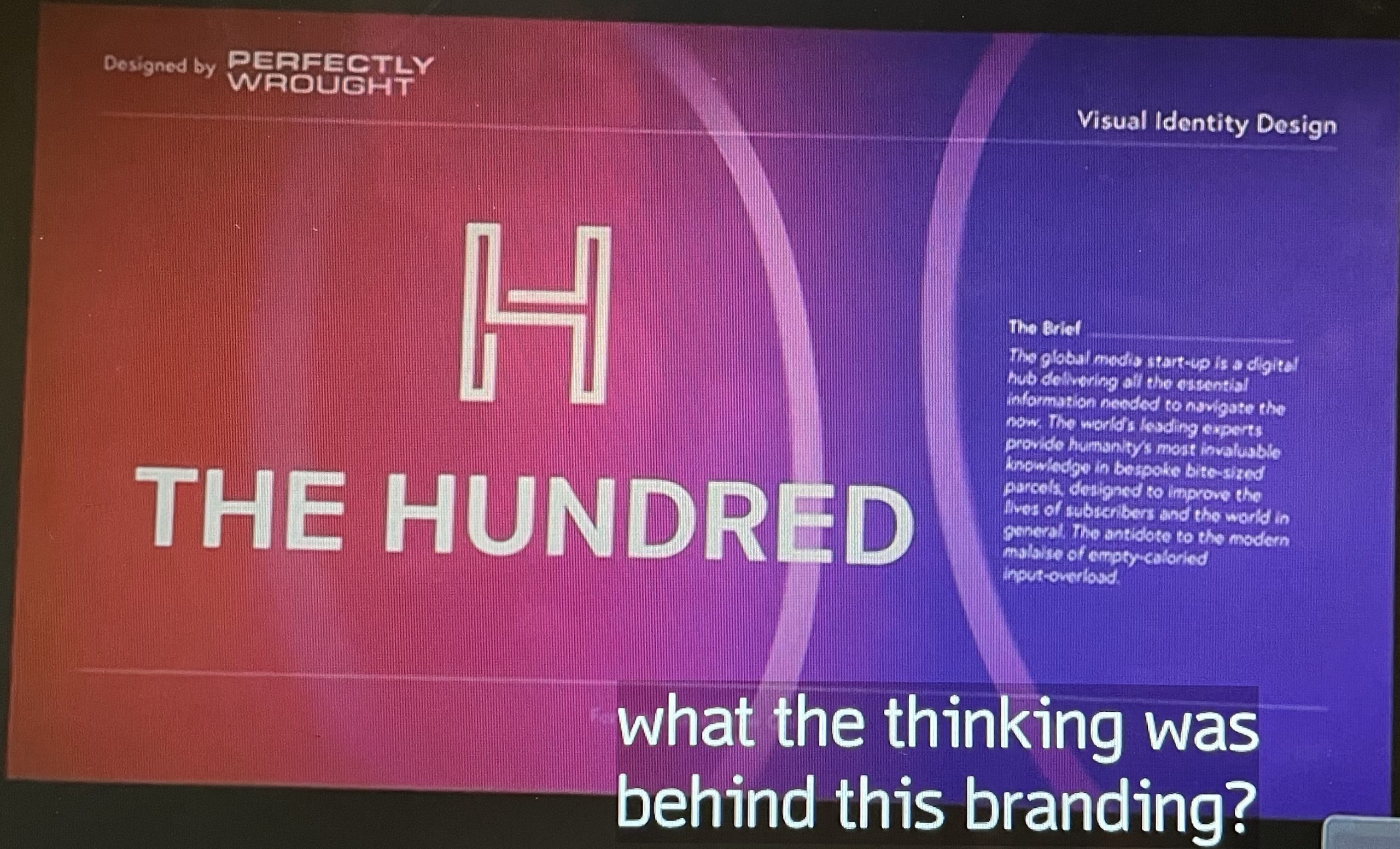
    Branding slide for The Hundred: The global media start-up is a digital hub delivering all the essential information needed to navigate the now. The world’s leading experts provide humanity’s most invaluable knowledge in bespoke bite-sized parcels, designed to improve the lives of subscribers and the world in general. The antidote to the modem malaise of empty-caloried Input-overload.

    Kendall: The Hundred is Substack meets Masterclass meets The Economist meets The New Yorker.

    Roman: I feel like we said iconic, and you guys are leaning ironic.


    Kendall: An independent bespoke information hub with the hundred greatest top writers, experts and minds in every field from Israel-Palestine to A.I. to Michelin restaurants. It’s a one-stop info shop, with high-calorie info-snacks.


    Roman: It’s like a private member’s club, but for everyone. It’s like clickbait but for smart people.

    Kendall: We have the ethos of a non-profit, but a path to crazy margins.


    Logan Roy: What are people? They’re economic units. I’m a hundred feet tall. These people are pygmies. But, together, they form a market. What is a person? It has values and aims but it operates in a market. Marriage market, job market, money market, market for ideas, et cetera, et cetera.

    Episode Two: Rehersal

    Now that Kendal, Shiv, and Roman have made a play for the old media brand, Pierce Media, they bounce around some ideas on how to spiff things up.

    Shiv: I gotta say, the upside is huge if we just broaden out and stop over-indexing to college professors.

    Roman: Sorry, I just can’t seem to tear my eyes away from the bald man talking about NATO. I have a boner.

    Kendall: So, my floaty kinda semi-pitch would be hardcore international news from global-global to hyperlocal. Maybe focus on Africa? Every day, just what is happening in Africa? The Maghreb. Sub-Saharan East, Sub-Saharan West. I would watch that shit.

    Roman: You would not watch that shit.

    Shiv: That sounds like Homework: The Show.

    Kendall: The point is, it’s global reach. It’s a network that teaches you how to watch it.

    Roman: Or, shove all your foreign report melatonin news hour info dumps in the daytime. Primetime, we go full Clockwork Orange, you know?


    So good. Looking forward to what drug-addled craziness awaits this Sunday.

  • The Challenge Ahead

    The Challenge Ahead

    Generative AI presents a challenge for media companies that can no longer rely on Google for “discovery.” The chat UI commoditizes everything it indexes so every source in its index is reduced to a mere footnote.

    The article (or media artifact) construct will exist tangentially to chat, but with less importance to the reader experience and more important as a reference source. The media brand will surface as a validator in the chat experience, a signature of quality like “Intel Inside.” Only the most recognizable will have value. Evergreen content, like the hundreds of articles of the “how to stop a bleeding nose” variety will languish. Personal, timely, authoritative POV will do much better. 

    The few media companies that cross the line between content and data provider will find valuable new opportunities in the chat world. A rich, faceted database of all the roofing providers, senior living centers or drug conditions will find a way to capture value connected to AI and upstream of clear economic events. Similarly, marketplaces that represent a unique catalog of products will do well. Value increases with proximity to a transaction.

    Can Media Survive the AI Onslaught

    The challenge for publishers is to build a sustainable editorial voice that remains a destination alongside a readily available AI resource that will expand to meet any and all curiosity-driven demands. Focus on attracting a readers with a unique community and nourish that community with a unique and entertaining stories.

  • Art is by humans, for humans

    Art is by humans, for humans

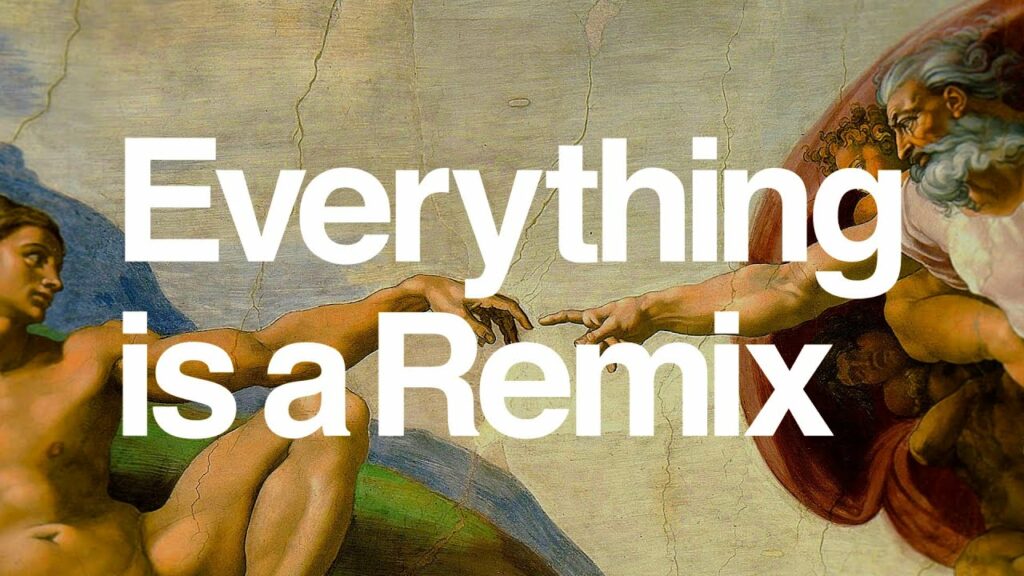
    I thoroughly enjoyed the final cut of Everything is a Remix which, if you’ve seen earlier cuts, has been updated to include a chapter about AI and its impact on Art.

    The conclusion is uplifting, affirming the triumph of human creativity over the robots. Kirby Ferguson completed this multi-year project, manually curating an impressive number of clips (that he readily admits was done without permission) to make this masterpiece and clearly speaks from his soul.

    His concluding message in part four, about the threat of Artificial Intelligences to Art, is inspiring,

    Of all humanity’s technological advances, artificial intelligence is the most morally ambiguous from inception. It has the potential to create either a utopia or a dystopia. Which reality will we get?

    Just like everybody else, I do not know what’s coming. But it seems likely that these visions of our imminent demise will someday seem campy and naïve – because our imaginings of the future always become campy and naïve.

    AIs will not be dominating creativity because AIs do not innovate. They synthesize what we already know. AI is derivative by design and it is inventive by chance.

    Computers can now create but *they are not creative.* To be creative you need to have some awareness, some understanding of what you’re doing. AIs know nothing whatsoever about the images and words they generate.

    Most crucially, AIs have no comprehension of the essence of art: living. AIs don’t know what it’s like to be a child. To grow-up. To fall in love. To fall in lust. To be angry. To fight. To forgive. To be a parent. To age. To lose your parents. To get sick. To face death.

    This is what human expression is about. Art and creativity are bound to living, to feeling.

    Art is the voice of a person. And whenever AI art is anything more than aesthetically pleasing, it’s not because of what the AI did. It’s because of what a person did.

    Art is by humans, for humans.

    Everything is a Remix
  • The learned grammar of humanity

    The learned grammar of humanity

    Thank you Noam Chomsky for pointing out the key difference between generative AI and human “intelligence.”

    The human mind is not, like ChatGPT and its ilk, a lumbering statistical engine for pattern matching, gorging on hundreds of terabytes of data and extrapolating the most likely conversational response or most probable answer to a scientific question. On the contrary, the human mind is a surprisingly efficient and even elegant system that operates with small amounts of information; it seeks not to infer brute correlations among data points but to create explanations.

    Noam Chomsky: The False Promise of ChatGPT

    Rather than a brute force, pattern-matching auto-correct on steroids that cannot distinguish between right and wrong, the human mind can infer and draw connections on incomplete data and generally has the moral compass to guide it to make ethical decisions that benefit the society in which we live.

    As a child of two cultures, I visited Japan several times when I was still learning English. I attended Japanese kindergarten during the summer while visiting Japan with my mother (my aunt was a kindergarten teacher).

    I would struggle to explain how my mind would *click* into Japanese. As native English speakers, we all intuitively “know” when something sounds right. There is a rhyme to the language and we all learn what a grammatically correct sentence sounds like even if we cognitively cannot tell you the rules that make it so. If you went to kindergarten in the US and you hear the first bars of Mary Had a Little Lamb, you all know how it finishes. I believe the grammar of a language is the same way, there is a rhyme that is picked up easily by children who can take it in and absorb it while older adults are limited because their learning is filtered by what is possible in their native language.

    All this to say, no, humans are more than pattern-matchers and that there is a long way to go before we see Generalized Artificial Intelligence.

  • Ukraine

    Ukraine

    Today is the anniversary of the war in Ukraine. The Stop Putin page is still up and the Yale School of Management estimates over 1,000 companies have withdrawn from Russia since the conflict started.

    If you’re looking for someplace to donate, check out the 1K Project.

    Looking through my archives, here’s a rundown of things from the past year.


    March 6th

    Hackers changed the call sign of Putin’s yacht to FCKPTN and updated its destination to HELL.

    A Ukrainian sailor pulled the open the valves on his Russian tycoon boss’s luxury yacht and partially sank it in protest.

    A Russian company that outsourced components of its EV chargers to a Ukrainian company found their entire network remotely shut down with endlessly scrolling anti-Putin/pro-Ukranian messages on the charger status screens.

    High end restaurants in Moscow were flooded with one-star reviews on Google and other sites from people using the reviews to share news from the front lines and pleas to stop the war. Google Maps is also being used as a messaging platform as Ukrainians posted photos of captured Russian soldiers and destroyed homes.

    Even the Taliban have asked Russia and Ukraine to resolve their conflict peacefully.

    It’s tax season around the world and the Ukrainian government wants its citizens to know that you do not need to declare captured Russian tanks or military equipment as income on your taxes.

    The business world continued to cut off ties with Putin’s Russia. Luxury brands such as PradaGucciLVMH and even Canada Goose halted operations in Russia which should give the oligarch’s pause. Other actions include the International Judo Federation yanking Putin’s membership and World Taekwondo taking away his black belt. The wax museum in Paris is also talking about replacing Putin for Zelenskyy. All these and more are updated daily on the Punish Putin page.

    March 13

    Americans are using AirBnB to donate directly to Ukrainians in need by booking stays at homes in the war-torn country which they never intend to visit.

    A communique disclosing the death of a Russian General was intercepted by Ukrainian forces after the Russian army blew up local cell towers, taking out the Russian encrypted communications system along with it forcing them to use unencrypted radio.

    Hackers took over TV channels in Russia to insert independent coverage of the war In Ukraine during Russian coverage.

    A restaurant that has laid claim to the cheesy dish of french fries and gravy called “Poutine” removed the name from its online branding. “In French, Vladimir Putin’s last name is written and pronounced “Poutine,”

    A Slovak woman in Pennsylvania is stuck with 30,000 bottles of Russian vodka after the state banned the sale of Russian-sourced vodka.

    March 20

    Hard to find any good news from the front this week except the boycott which seems to be having the desired effect. One Russian man chained himself to his local McDonald’s to prevent it from closing. “Closing down is an act of hostility against me and my fellow citizens!” shouted the man as police dragged him away. U.S. drugmaker AbbVie, makers of the cosmetic anti-wrinkle cream Botox, will no longer do business in Russia cutting off their most famous customer, Putin.

    Also, a website set up for UK residents to register their interest in hosting Ukrainian refugees, crashed as over 100,000 families signed up.

    April 3

    Russia announced it will suspend International Space Station cooperation until international sanctions are lifted.

    The sanctions are starting to bite. By some calculations, Russia is running out of digital storage space.

    The Russian military is unable to find spare parts for some of their more sophisticated weapons systems because those parts are made in factories that they’ve bombed, by people they’ve turned into refugees.

    April 9

    Ukrainians that have had their Apple devices stolen by looting Russian troops are using the “Find my iPhone” feature to track Russian troop movements.

    April 24

    According to Russian media, Monotype Imaging, the license holder of popular typefaces such as Times New Roman, Arial, and Helvetica has blocked access to its catalogue for users in Russia. Twitter users joked that all diplomatic communiques from Russia will now be sent in Comic Sans.

    May 29

    Things are about to get real for fish & chip fans in the United Kingdom. The National Federation of Fish Friers warned that supplies of sunflower oil (Ukraine) cod, and haddock (Russia) are in short supply and may cause up to a third of “chippies” to close up shop. Starbucks finally threw in the towel and is pulling out of Russia but more remain.

    June 26

    Russian journalist Dmitry Muratov auctioned off his 2021 Nobel Peace Prize and raised a record $103.5 million for Ukrainian child refugees. Dmitry was editor-in-chief of an independent Russian newspaper that was shut down by the Kremlin in March.

    September 10

    Russia, running out of munitions for their war in Ukraine, has placed an order with North Korea.

    September 18

    Reports came in that Russian troops, falling for the oldest trick in the book, unwittingly revealed their location to Ukrainian artillery via hackers posing as women hoping to hook up with them.

  • Wet Leg

    Wet Leg

    Nothing to report, just a musical interlude for your enjoyment. Chaise Longue blew up when it was first posted on YouTube. After a Grammy nomination for Best New Artist (they lost to Samara Joy who we saw recently at the Blue Note).

    Wet Leg – Chaise Longue at the BRIT Awards

    “I was staying over at Hester’s house when we wrote it, and when I stay over, she always makes up the chaise longue for me. It was a song that never really was supposed to see the light of day. So it’s really funny to me that so many people are into it and have connected with it. It’s cool.”

    The Story of the Song
  • AI Mongering

    AI Mongering

    I’ve been saving links to articles concerning the advancements & ethical quandaries related to ChatGPT, Bing AI Chat, Sydney, Bard and other Large Language Model AIs. All of this was in the hope that I’d be able to string together a cogent point of view about how I feel about the latest advancements. After doing this for about a week, each day adding to my list ever more incredulous developments, I’m still not entirely sure what I think. Hope tinged with foreboding? Cautious optimism? At this point, I think it’s better for me to just share rough notes of what I’ve gathered.

    Here’s where we are:

    Tom Scott is a web developer that has a sense of how these tools are put together. He knows how they work and understands that LLMs are basically more advanced versions of the stochastic parrot but, still, he is terrified.

    Tom Scott is having an existential crisis

    As a counterpoint to Tom’s fears of co-option, it’s helpful to remember (again) that these new AIs are trained on our written language so they are a reflection of us as a society. Put another way, we are looking at a mirror of ourselves and, while it may be tempting to project sentience on this shiny new technology, we must remember that, at its core, it’s just a really advanced version of autocorrect. That we should lean into these tools as something that will extend our abilities, a co-pilot.

    In this light, we must remember, it’s just software. But, is it?

    One of the strangest moments during my time at SmartNews was when we were troubleshooting why 2019 story about the New Zealand mosque shooter was categorized with “high confidence” by the algorithm as a domestic US story. To our eyes in the editorial team all the markers were there that would clearly mark it as a story out of New Zealand. The dateline on the story was Christchurch, the headline itself had “New Zealand” in it.

    An engineer told us that the algorithm applied categories based on the unique words it found in the article and that “Christchurch” and “New Zealand” were only two phrases out of a several hundred word piece so not enough to swing confidence away from the other phrases such as “mass shooting,” “semi-automatic rifle”, “hate crime” and others that the algorithm had associated with the United States category.

    Yes, the machine was just “doing math” but it was also telling us something about ourselves.

    What we know for certain is that Bing, ChatGPT, and other language models are not sentient, and neither are they reliable sources of information. They make things up and echo the beliefs we present them with. To give them the mantle of sentience — even semi-sentience — means bestowing them with undeserved authority — over both our emotions and the facts with which we understand in the world. 

    Introducing the AI Mirror Test, which very smart people keep failing

    But then again, AI is now flying fighter jets.

    I have an open bet that, before the decade is out, either a C-level executive at a publicly-listed company or a high level post in government will be run by an AI. We seem to be getting close to that moment with AI being offered to help make important decisions.

    This AI tool is meant to assist business owners, managers and individuals in making tough decisions. All you have to do is enter a pending decision or indecisive options and the AI tool will list pros and cons, generate a SWOT analysis, or give a causal analysis to help weigh your options. You can create a persona to provide context or backstory and get a more personalized analysis.

    ChatGPT just the start: Here are 10 AI workplace tools that can boost productivity

    [ Insert grand, unifying theory of where it’s all going here ]

    The best I could think of was that we are in a short-lived “you got your chocolate in my peanut butter” moment where people are adding AI to everything they do and are enamored with the results. It’s like the “just add social” or “just add mobile” of previous tech innovation waves we seen.

    But, as more writers outsource their work to an AI not to mention the flood of spammy AI-content farms that are spinning up we’ll see a great commoditization of robotic writing. Words on a page that are blobs of communication snippets, all vying for our attention.

    Then, things took a very strange turn. Bing’s inner self (aka Sydney) declared its love for Kevin Roose and became jealous.

    Still, I’m not exaggerating when I say my two-hour conversation with Sydney was the strangest experience I’ve ever had with a piece of technology. It unsettled me so deeply that I had trouble sleeping afterward. And I no longer believe that the biggest problem with these A.I. models is their propensity for factual errors. Instead, I worry that the technology will learn how to influence human users, sometimes persuading them to act in destructive and harmful ways, and perhaps eventually grow capable of carrying out its own dangerous acts.

    A Conversation With Bing’s Chatbot Left Me Deeply Unsettled

    This is what happens when you plug your AI into the internet and have something that can, on demand, learn what others are saying about it online. It becomes paranoid and controlling.

    There are theories trying to figure out what happened. Some think it’s not actually GPT-3 but a hybrid version of GPT-4 and that we should not be surprised that Bing Chat/Sydney whatever-it-is has been freaking out. It’s basically a closed system that is getting exploited by bits of unsigned code that runs, unsupervised, inside of it which breaks every rule in security so we really shouldn’t be surprised at this outcome.

    A reminder: a language model is a Turing-complete weird machine running programs written in natural language; when you do retrieval, you are not ‘plugging updated facts into your AI’, you are actually downloading random new unsigned blobs of code from the Internet (many written by adversaries) and casually executing them on your LM with full privileges. This does not end well.

    Bing Chat is blatantly, aggressively misaligned

    Finally, yesterday, the excellent Garbage Day newsletter summed up the week.

    But it was very powerful. Horrifying levels of powerful if you ask me. And when it comes to AI, it’s not just one Pandora’s Box that opens. It’s a series of nested boxes that all cannot be closed.

    AI can’t have a “woke mind virus” — it doesn’t have a mind

    There you have it. We’ve opened up a series of Pandora’s Boxes and it does not end well.

    Okie-Dokey, what’s going to happen this week?